

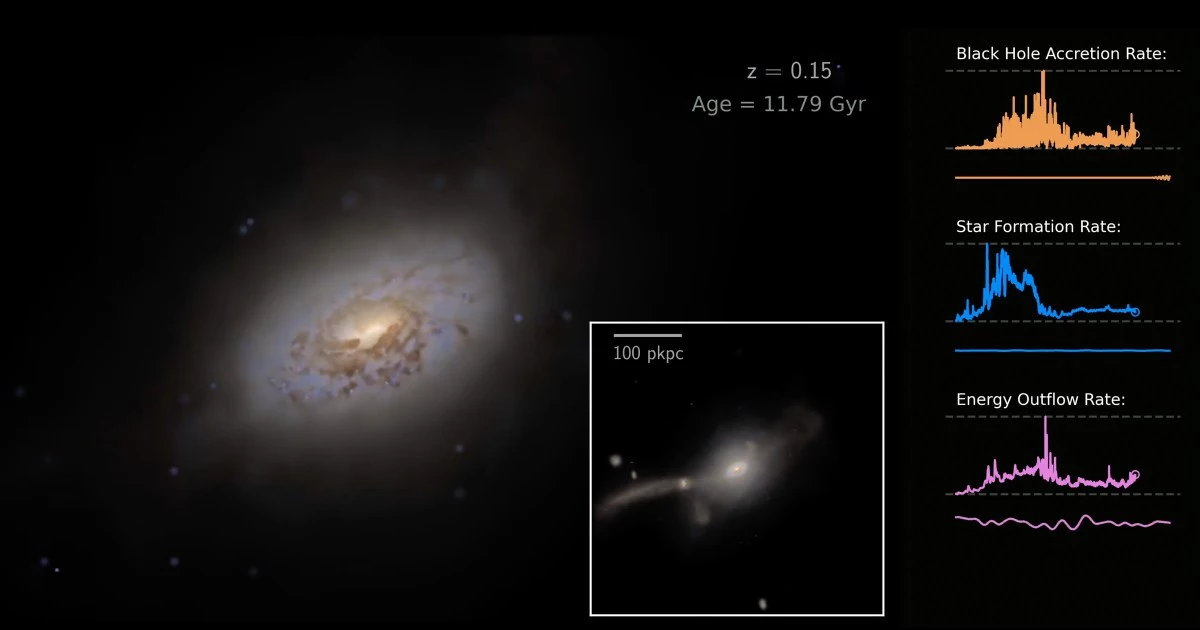

A synthetic cosmos that finally looks like the real one—why COLIBRE matters now
The COLIBRE (COsmological Locus In a BIg REsolution) project marks a notable inflection point for computational astrophysics: a large-scale “synthetic universe” that does not merely resemble the cosmos in broad strokes, but reproduces key observable galaxy properties with a fidelity that has historically been out of reach. After nearly a decade of development and 72 million CPU hours on the COSMA8 supercomputer, researchers report simulated galaxies that align with real survey data across number counts, luminosities, colors, sizes, and mass distributions—a practical checklist of credibility for any cosmological digital twin.
The scientific headline is clear: published in *Monthly Notices of the Royal Astronomical Society*, COLIBRE strengthens confidence in the standard cosmological model even amid the disruptive clarity of the James Webb Space Telescope (JWST) era. Yet the more consequential story—particularly for business and technology audiences—is how this achievement reframes what high-performance computing (HPC) can deliver when physics, software engineering, and long-horizon investment converge.
At the core of COLIBRE’s advance is its ability to incorporate two historically stubborn ingredients of realism: cold gas dynamics and cosmic dust, especially at temperatures below roughly 10,000°F where multi-phase behavior becomes difficult to model. These are not cosmetic details. Dust and cold gas shape how galaxies form stars, how they evolve, and—crucially—how they *appear* to telescopes. By capturing them at scale, COLIBRE narrows the gap between theoretical universes and the one astronomers actually observe.
The HPC breakthrough behind the headlines: engineering realism at extreme scale
COLIBRE is as much a story of systems architecture and computational strategy as it is of cosmology. Running a simulation of this scope is not simply “more compute.” It requires making complex physics tractable under real-world constraints: memory bandwidth, interconnect latency, parallel efficiency, and the practical economics of sustained supercomputing allocations.
Several enabling elements stand out for readers tracking the evolution of HPC and large-scale simulation:
- Advanced parallelization at tens-of-thousands-of-cores scale
Multi-physics workloads—hydrodynamics, radiative processes, dust interactions, and dark matter evolution—do not parallelize cleanly. Achieving throughput without sacrificing accuracy is a software achievement as much as a hardware one.
- Code optimization tuned to COSMA8’s architecture
Performance at this tier is often limited by data movement rather than raw FLOPS. Custom optimizations that reduce memory pressure and manage communication overhead can determine whether a simulation is feasible at all.
- Sustained compute as a strategic resource
“72 million CPU hours” is not a bragging statistic; it is an operational reality akin to running a modern data center at high utilization for years. It underscores that frontier science increasingly depends on predictable access to leadership-class compute, not sporadic bursts.
For industry, the transferable insight is that COLIBRE functions like a proof point for digital twins at planetary scale—a validation that emergent behavior can be modeled credibly when the physics is sufficiently complete and the compute pipeline is engineered end-to-end. The same pattern is visible in other domains where simulation is becoming a competitive advantage: climate risk modeling, materials discovery, advanced manufacturing, and complex logistics.
JWST pressure-tests cosmology—and exposes the next frontier of theory
A key contextual driver here is JWST itself. By pushing observational astronomy deeper and earlier into cosmic history, JWST has intensified scrutiny of long-standing models. COLIBRE’s results are therefore not just a technical milestone; they are a response to an era in which observations can outpace theory unless simulation catches up.
The study’s message is twofold:
- Robustness where it counts: COLIBRE’s ability to match broad galaxy statistics suggests the standard cosmological model remains resilient against many of the tensions raised by new data. For policymakers and research funders, that matters: it indicates that foundational assumptions are not collapsing under JWST’s weight, even as refinements are needed.
- A spotlight on anomalies, not a dismissal of them: The simulation also underscores where theory still strains—most notably the enigmatic “Little Red Dots.” Whether these objects represent an observational classification issue, an astrophysical process not yet modeled adequately, or a deeper theoretical gap, they are precisely the kind of discrepancy that high-fidelity synthetic universes are built to interrogate.
From a technology strategy perspective, this is how modern science advances: not by producing a single definitive model, but by building iterative, testable computational frameworks that can be stress-tested against new data streams. In that sense, COLIBRE is less an endpoint than an infrastructure layer for the next decade of discovery.
Compute, capital, and carbon: the strategic economics of synthetic universes
COLIBRE also illustrates how supercomputing capacity has become a lever of national and corporate influence. The ability to run leadership-class simulations is increasingly intertwined with industrial competitiveness—especially as AI, simulation, and data-intensive science converge.
Three strategic dynamics are especially salient:
- Public–private collaboration as the default funding model
Large-scale compute projects increasingly require pooled investment across universities, national labs, and HPC centers. This model is likely to expand in adjacent sectors—biopharma molecular simulation, grid optimization, and systemic financial risk—where the cost of entry is high but the payoff is structural.
- A widening skills gap in HPC and computational science
COLIBRE implicitly highlights demand for HPC software engineers, computational physicists, and systems architects who can translate domain problems into scalable code. For economies competing on deep tech, workforce development is no longer peripheral; it is a gating factor.
- Sustainability and total cost of ownership (TCO) move to the foreground
Extreme compute workloads carry real energy and cooling burdens. As ESG requirements tighten and energy volatility persists, the next wave of HPC leadership will likely be defined by:
– energy-efficient architectures and accelerators,
– liquid cooling and heat reuse,
– carbon-aware scheduling and workload shaping,
– renewable-powered data centers.
Looking ahead, COLIBRE also foreshadows a near-term shift toward cloud HPC elasticity for certain workloads, alongside a medium-term trend toward AI-enhanced simulation—where machine learning models trained on high-fidelity synthetic data accelerate inference, anomaly detection, and parameter exploration. Longer term, “quantum readiness” may matter less as a headline and more as an architectural principle: designing simulation pipelines that can offload specific subproblems to emerging hybrid HPC–quantum environments when they become practical.
COLIBRE’s synthetic universe ultimately reads as a case study in modern technological power: when compute, algorithms, and scientific ambition align, simulation stops being a supporting tool and becomes a primary instrument of discovery—and a strategic asset with implications far beyond the night sky.

 By
By
 By
By

 By
By
 By
By

 By
By
 By
By







