

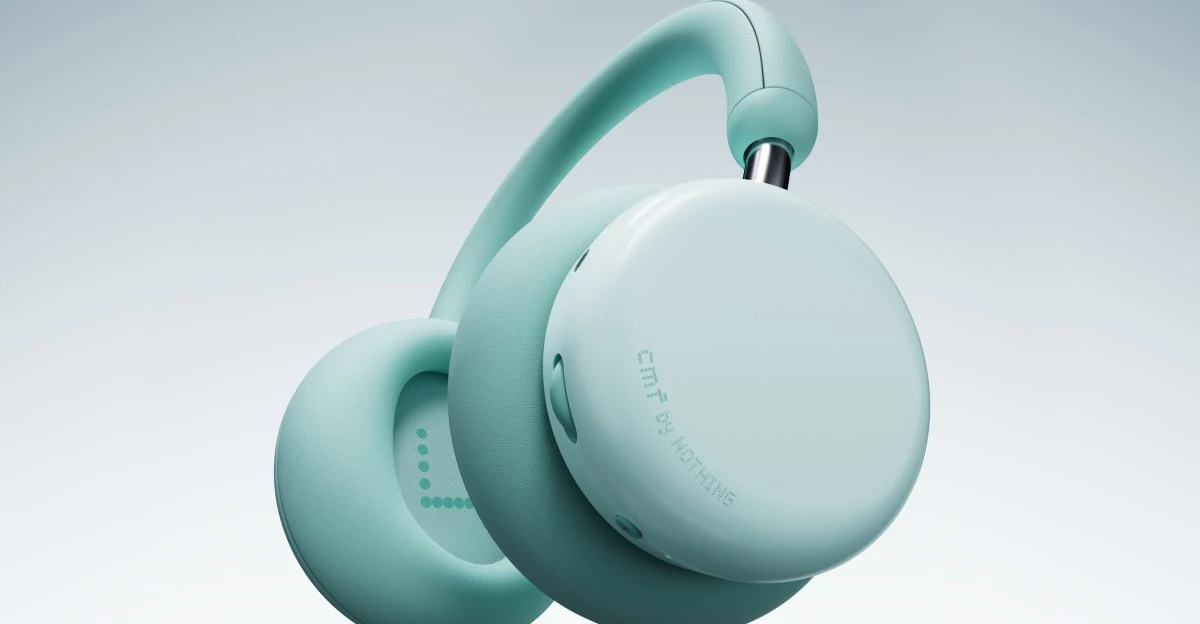

Disrupting the “Affordable Premium” Audio Frontier
The unveiling of the CMF Headphone Pro marks a pivotal moment in the evolution of personal audio. Priced at a strikingly accessible $99, this over-ear wireless headset from CMF—Nothing’s value-driven sub-brand—signals a deliberate recalibration of the industry’s value equation. In a market where “affordable premium” is no longer an oxymoron but a growth engine, the CMF Headphone Pro surfaces as both a product and a statement: democratized access to features once reserved for the $250-plus elite, now within reach for a broader global audience.
This headset’s arrival is not merely a matter of cost engineering. It is a study in how design, technology, and modularity can be harmonized to serve both the pragmatic and the aspirational. The CMF Headphone Pro’s 100-hour battery life, adaptive active noise cancellation (ANC), and tactile hardware controls are not afterthoughts—they are the main event, engineered for a consumer base that demands durability, autonomy, and simplicity.
Hardware as Experience: Rethinking Controls, Power, and Modularity
The CMF Headphone Pro’s design philosophy is refreshingly contrarian. In an era when touch panels have become de rigueur, CMF’s embrace of tactile buttons and a multi-function roller is a nod to user certainty and mechanical longevity. This is not nostalgia; it is a calculated response to the pitfalls of accidental input and the hidden costs of complex bill-of-materials (BOM). For price-sensitive markets, robustness trumps novelty, and the Pro’s interface is a masterclass in purposeful engineering.
Perhaps more quietly revolutionary is the “energy slider”—a physical EQ adjustment that bypasses the latency and friction of app-based controls. This not only anticipates regulatory currents in the European Union, where interoperable and accessible audio settings are becoming a mandate, but also re-centers control in the hands of the user. The result: a lower cognitive load and a more immediate, tactile relationship with technology.
Battery life is where the CMF Headphone Pro truly redraws the map. With a 720 mAh cell delivering up to 100 hours of playback (50 with ANC enabled), it sets a new standard for efficiency—outpacing incumbents like Sony’s XM6 and Bose’s QuietComfort Ultra by a wide margin. For consumers in emerging markets, where charging access can be sporadic, this “multi-week autonomy” is more than a spec; it is a lifeline.
Modularity, too, is more than a design flourish. Interchangeable cushions extend the product’s aesthetic and functional lifespan, gesturing toward the right-to-repair movement and anticipating forthcoming EU ecodesign regulations. The architecture hints at a future where batteries and speaker drivers might be equally replaceable, aligning with a broader industry shift toward sustainability and circularity.
Navigating Economic Headwinds and Competitive Tensions
The CMF Headphone Pro’s $99 price point is not an accident of cost-cutting, but a strategic incision into a market segment where volume growth outpaces the high end by more than three to one. As global headphone volumes rise but average selling prices (ASPs) slip, the “goldilocks” zone—where value elasticity is at its peak—becomes the new battleground. CMF’s estimated gross margin, north of 50% even after channel mark-ups, demonstrates that premium features and profitability are not mutually exclusive.
The staggered U.S. launch, deferred until October 2025, is a chess move with multiple layers:
- Component Cost Optimization: Delaying entry allows CMF to ride the downward curve of ANC chipset prices, potentially shaving several dollars off per-unit costs.
- Regulatory Foresight: With U.S. tariffs on Chinese audio imports in flux, waiting offers hedging against sudden cost spikes.
- Strategic Synchronization: Aligning with the anticipated Nothing Phone (3) launch opens the door to synergistic bundling and higher average revenue per user (ARPU).
Competitively, CMF threads the needle between budget stalwarts like Anker’s Soundcore Life Q series and the audiophile cachet of Sony’s XM6. The risk of cannibalization within Nothing’s own portfolio is mitigated by clear internal segmentation: CMF for pragmatic, robust value; flagship lines for design maximalism.
The Road Ahead: Modular Sustainability and Market Realignment
The CMF Headphone Pro is more than a product launch—it is a harbinger. As adaptive ANC and extreme battery life inevitably diffuse into sub-$80 devices, the spec ladder will compress, forcing premium brands to pivot toward ecosystem lock-in, spatial audio, and AI-driven personalization. Regulatory winds, especially from the EU, favor modular and repairable designs, and those slow to adapt may find themselves locked out of key markets.
For device makers, the message is clear: hardware-embedded differentiation and sustainable modularity are not optional—they are the new table stakes. For supply-chain partners, the rise of adaptive ANC in the mid-tier signals a surge in demand for MEMS microphones and DSP cycles. Retailers and channel partners will find the $99 price point a potent lever for promotional strategies, while investors should note the template Nothing is setting for design-first brands scaling into mass-market relevance.
In the shifting landscape of consumer electronics, the CMF Headphone Pro stands as a bellwether—heralding a future where premium-grade autonomy, modular repairability, and accessible pricing are not at odds, but inextricably linked. For those charting the next chapter in personal audio, the signal is unmistakable: the axis of competition has shifted, and the time to adapt is now.

 By
By
 By
By

 By
By
 By
By

 By
By








