
Drought as a balance-sheet variable, not a seasonal headline
This summer’s drought map in the United States—where all but five states are under drought advisories—is less a weather story than a signal that human-driven climate change is reshaping hydrological baselines. For business leaders, the immediate impacts are visible in livestock losses, stressed agricultural logistics, and reduced yields. The deeper implication is structural: drought is increasingly a persistent operating condition that propagates through supply chains, credit markets, and consumer prices.
In practical terms, prolonged aridity behaves like a slow-moving shock with fast-moving consequences:
- Agricultural throughput declines: lower yields and degraded pastureland tighten supply, especially for grains and feed inputs.
- Supply-chain fragility increases: processors and distributors face uneven regional availability, higher transport costs, and quality variability.
- Food-security risks widen globally: when major producing regions underperform, import-dependent markets face heightened exposure to price spikes and shortages.
For corporates with exposure to food, apparel, bio-based materials, or any water-intensive upstream inputs, drought is no longer an “externality.” It is a forecastable risk factor that can be modeled, hedged, and mitigated—if organizations treat water availability with the same rigor applied to energy costs, FX volatility, and carbon compliance.
Konya’s sinkholes: a case study in groundwater depletion and governance failure
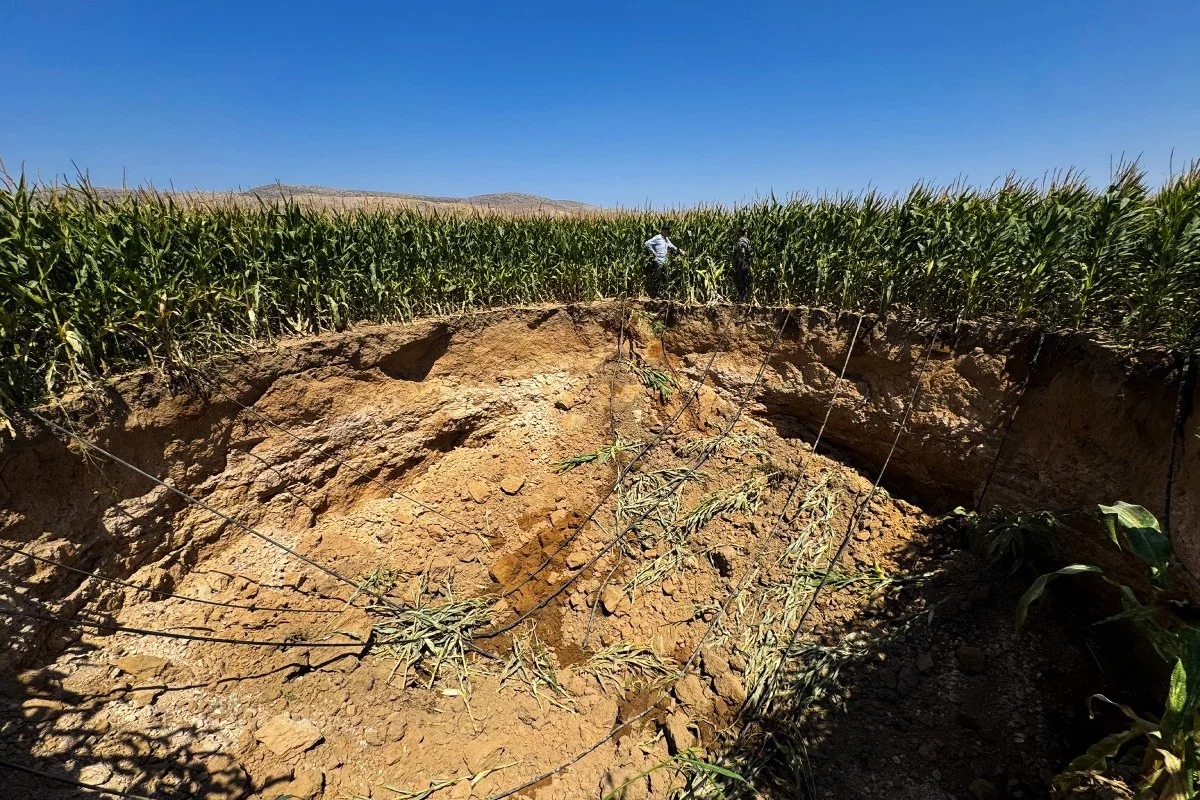
Turkey’s central Anatolian basin, particularly the Konya region often described as a national “breadbasket,” offers a stark illustration of what happens when finite groundwater systems are treated as limitless. The basin’s geology is naturally karstic—prone to cavities and subsurface dissolution—yet the scale of recent sinkhole formation points to a compounding driver: sustained overextraction, including pumping from illegal wells, amid worsening aridity.
The result is not merely environmental degradation; it is a direct threat to economic continuity:
- Physical asset risk: sinkholes can destroy farmland, roads, irrigation infrastructure, and nearby buildings with little warning.
- Operational uncertainty: farmers face abrupt land loss and unpredictable water access, undermining planning cycles and investment decisions.
- Ecosystem and community strain: a closed groundwater system that cannot self-replenish destabilizes local livelihoods and biodiversity.
Konya also highlights a recurring policy tension seen in drought-impacted regions worldwide: environmental advocates call for stricter oversight and enforcement, while policymakers may hesitate due to near-term agricultural dependence and political sensitivity. For investors and insurers, that gap between hydrological reality and regulatory response becomes a measurable risk premium—one that can surface suddenly when sinkholes, crop failures, or social pressure force delayed reforms.
Water technology moves from “efficiency” to “infrastructure”
As drought intensifies and aquifers decline, the market opportunity shifts from incremental conservation to systems-level water intelligence and resilience infrastructure. The most consequential innovations are those that convert water from a poorly measured input into a digitally monitored, auditable, and optimizable resource.
Key technology vectors emerging from the drought-and-subsidence landscape include:
- Precision water-management platforms
IoT sensors, satellite imagery, remote-sensing drones, and AI analytics can enable near-real-time monitoring of groundwater levels, soil moisture, and irrigation efficiency. For karst aquifers and subsidence-prone basins, digital twins—dynamic models that simulate aquifer behavior—could help forecast sinkhole risk and guide pumping limits before irreversible damage occurs.
- Distributed desalination and water recycling
Closed or stressed basins create demand for modular desalination (where feasible) and wastewater reclamation units that can be deployed at industrial sites, farms, or municipal edges. Strategic partnerships between membrane-technology providers, utilities, and industrial operators can turn water reuse into a scalable service model rather than a bespoke engineering project.
- Blockchain-enabled traceability for water footprints
As brands and regulators push for credible ESG reporting, immutable ledgers may be used to authenticate water credits or verified water stewardship claims—an emerging parallel to carbon markets. The value proposition is less about novelty and more about auditability: proving that reductions are real, localized, and not double-counted.
What ties these technologies together is a shift in buyer intent. Water tech is increasingly purchased not only to “save water,” but to secure production continuity, reduce liability, and defend reputations in regions where water stress is becoming politically and socially charged.
Market consequences: inflation, insurance repricing, and strategic repositioning
The economic transmission mechanism from drought to corporate performance is already familiar—commodity volatility and inflationary pressure—but the next phase is likely to be defined by risk repricing and strategic realignment.
Several dynamics stand out:
- Commodity volatility and margin compression
Prolonged drought threatens staple yields, raising global grain and feed prices. Companies with unhedged exposure to agricultural inputs may see margin erosion, while commodity traders can exploit arbitrage between water-rich and water-scarce regions. The competitive edge will increasingly belong to firms that integrate drought indices and groundwater analytics into procurement timing and supplier diversification.
- Agricultural credit and insurance recalibration
Lenders and underwriters are being pushed to incorporate hydrological depletion and sinkhole liability into models. Expect tighter lending in drought-vulnerable geographies and higher premiums for parametric products as insurers update assumptions about “rare” events becoming routine.
- Land valuation shifts and investment strategy changes
Overexploited basins may experience declining farmland valuations, while capital flows toward assets with secure water rights, efficient irrigation, or regenerative practices. This creates openings for sustainable-agriculture funds pursuing buy-and-build strategies, including drip irrigation conversions and soil-health improvements that reduce water demand.
- Geopolitics and resource nationalism
Freshwater scarcity can trigger export restrictions on water-intensive crops, new water-security legislation, and tougher cross-border negotiations. For global food conglomerates, water risk becomes part of geopolitical analysis—affecting where to source, where to invest, and how to structure long-term contracts.
Across these threads, a consistent message emerges: water is becoming a strategic asset on par with energy and carbon. Organizations that embed water intelligence into enterprise risk management, pilot closed-loop reuse systems, and engage constructively in adaptive regulation will be positioned not only to withstand drought-driven disruption, but to shape the next generation of resilient food and industrial supply chains.

 By
By

 By
By
 By
By
 By
By

 By
By