

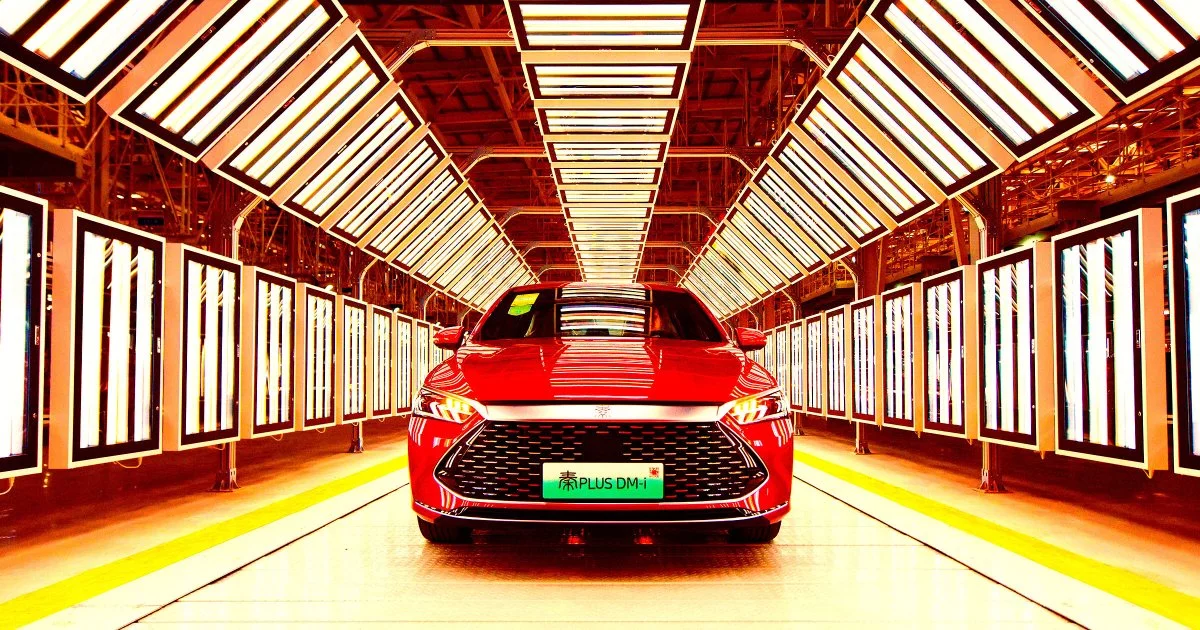

A widening affordability gulf reshapes the passenger-vehicle market
Fresh pricing data is crystallizing a stark divergence in the world’s two most consequential auto arenas: the United States is drifting toward a high-price, high-finance model, while China is normalizing mass-market electrification at prices that would be considered entry-level used-car territory in America.
In March, Kelley Blue Book placed the average U.S. new-vehicle transaction price at $51,456—a level increasingly made “reachable” through 84-month loans that stretch household balance sheets and elevate default risk if rates stay higher for longer. Across the Pacific, China’s domestic manufacturers are offering more than 200 EV and hybrid models below $25,000, including multiple best sellers under $12,000. The Geely EX2—roughly $10,060—is emblematic: a subcompact hatchback priced like a decade-old beater in the U.S., yet packaged with contemporary digital interfaces and credible everyday usability.
This is not merely a pricing curiosity; it is a portfolio and strategy mismatch. U.S. legacy automakers have largely migrated toward SUVs and trucks, retreating from sedans and other lower-margin segments. China’s OEMs, by contrast, are maintaining a full spectrum of body styles while pushing EVs into the center of the mass market. Even Tesla—the U.S. EV bellwether—faces a more complicated narrative amid leadership turbulence around Elon Musk, adding uncertainty to the competitive posture of America’s most influential EV brand.
For consumers, the contrast is visceral: $10,000 in China can buy a new, warrantied, digitally modern vehicle; in the U.S., it more often buys an aging internal-combustion car with high mileage and looming maintenance.
How China is compressing EV costs—and expanding features at the low end
China’s ability to deliver low-priced EVs is not the product of a single advantage; it is the compounding effect of industrial structure, supply-chain design, and manufacturing tempo. Three mechanisms stand out.
- Vertical integration and battery scale: Chinese OEMs and their battery partners have built tightly coordinated ecosystems spanning cell production, pack integration, and vehicle assembly, supported by domestic access to key inputs and years of policy-driven capacity buildout. The result is a structurally lower per-kWh cost, which is the single most important lever for affordable EVs.
- Feature democratization: Vehicles like the Geely EX2 and its peers increasingly ship with large infotainment screens, over-the-air update capability, and baseline ADAS features. In the U.S., these have often been used as trim-level upsell tools; in China, they are becoming table stakes even at budget price points. That shift recalibrates global consumer expectations about what “entry-level” should include.
- Modular platforms and rapid iteration: Chinese automakers have leaned into modular EV architectures that can spawn multiple body styles with limited retooling. This accelerates refresh cycles and allows OEMs to respond quickly to demand signals—an agility advantage that matters when software, user experience, and battery improvements evolve faster than traditional model-year cadence.
The strategic implication is subtle but profound: China is not only lowering sticker prices; it is lowering the perceived trade-offs associated with buying cheap. When affordability and modernity arrive together, the market expands—and incumbents that rely on premium pricing face a harder sell.
The U.S. pricing model: margin concentration, financing strain, and policy friction
America’s auto market has become increasingly defined by high transaction prices and long-term financing, a structure that can hold while employment is strong and credit remains available—but becomes fragile when rates rise or used-car values soften.
Key dynamics shaping the U.S. landscape include:
- Price elasticity meets underwriting reality: With average prices above $50,000, affordability is being “engineered” through longer loan terms. That can inflate total cost of ownership and trap consumers in negative equity, especially if depreciation accelerates or incentives return aggressively.
- Policy support with constraints: U.S. EV incentives—most notably those linked to the Inflation Reduction Act—can be meaningful, but they are also conditional on supply-chain and sourcing requirements. Those stipulations are strategically rational for domestic industrial goals, yet they can slow near-term price relief compared with China’s already-mature cost base.
- Reshoring costs vs. global cost arbitrage: U.S. OEMs are investing heavily in domestic battery and EV manufacturing, but they face higher labor, energy, and compliance costs, plus permitting and workforce bottlenecks. China’s system—benefiting from scale, coordination, and lower input costs—can sustain a pricing advantage long enough to shape consumer expectations globally.
Meanwhile, the U.S. industry’s portfolio rationalization—the retreat from sedans and smaller vehicles—has concentrated profits in trucks and SUVs. That strategy has been lucrative, but it narrows flexibility if demand shifts toward smaller, cheaper EVs as urbanization trends persist and financing costs remain elevated.
Competitive stakes: from domestic affordability to global market share battles
The most consequential risk for U.S. automakers is not simply losing a price war in China; it is confronting a world where Chinese OEMs export their cost structure and product cadence into third markets, compounding scale advantages.
Several strategic pressure points are emerging:
- Entry-level EV gap: If China can profitably sell compelling EVs below $25,000, the absence of comparable U.S.-branded offerings becomes a structural weakness—particularly for first-time buyers and cost-sensitive households.
- Brand value under redefinition: Chinese automakers are rapidly moving beyond “cheap and cheerful” perceptions through improved quality control, design, and digital ecosystems. As benchmarks converge, legacy brands that depend on premium positioning may find differentiation harder to defend.
- Export-driven disruption: Expansion into Europe, Southeast Asia, and Latin America allows Chinese OEMs to capture volume, reinforce scale, and undercut incumbents across multiple regions simultaneously—pressuring U.S. automakers that rely on global footprints for earnings stability.
For American executives, the response is less about a single “silver bullet” and more about coordinated execution: accelerating sub-$25,000 EV programs, deepening battery and power-electronics partnerships, and building durable differentiation through software-enabled services and ownership experience. The market is signaling that the next phase of automotive competition will be judged not only by horsepower and brand heritage, but by who can deliver modern mobility at a price the median buyer can actually afford.

 By
By


 By
By
 By
By

 By
By
 By
By







