

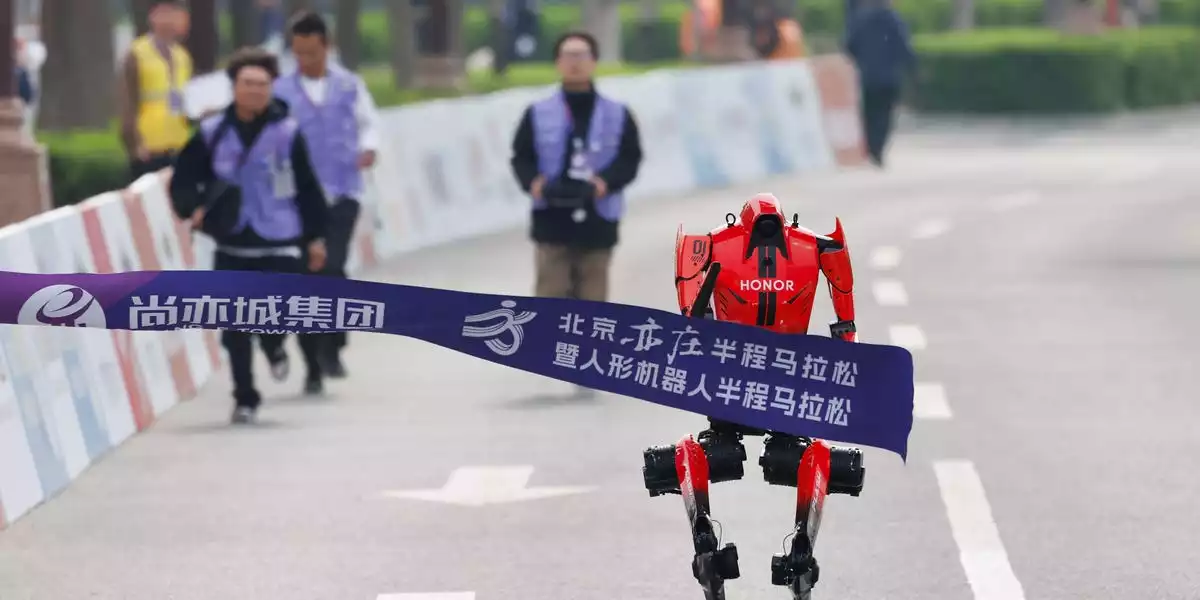

A half-marathon as a stress test for embodied AI—and a signal of China’s robotics velocity
Honor’s humanoid robot finishing Beijing’s half-marathon in 50 minutes 26 seconds—faster than the human world record of 57 minutes 20 seconds—is more than a headline-grabbing stunt. It is a public benchmark for embodied intelligence, where software, power systems, materials, and control theory meet the messy physics of the real world. The fact that the event itself has expanded from roughly 20 teams in 2022 to more than 100 this year adds an equally important layer: the performance is not an isolated lab triumph, but a visible output of a rapidly thickening domestic ecosystem.
Endurance running compresses many of robotics’ hardest problems into a single, unforgiving metric: sustained locomotion under vibration, heat, repeated impacts, and cumulative error. A sub-one-hour half-marathon implies meaningful progress in:
- Power-dense battery packs capable of high discharge without catastrophic thermal drift
- Lightweight structures and joints that reduce energy cost per step
- Real-time motion planning that can maintain cadence while adapting to micro-variations in terrain
- Closed-loop control that continuously corrects posture, foot placement, and balance
Yet the race also made the industry’s current ceiling hard to ignore. Reports of robots stumbling at launch, veering off course, and shedding parts are not side notes—they are the central engineering story. In commercial settings, reliability is not a feature; it is the product. A robot that can run fast but cannot guarantee mechanical integrity and safe recovery behaviors remains closer to a prototype than a deployable worker.
The reliability gap: why speed is easier to celebrate than robustness
The most instructive moments in these competitions are often the failures. Falls, trajectory errors, and component detachments point to persistent limitations in mechanical tolerance, fault detection, and error recovery—the unglamorous disciplines that determine whether humanoids can move from demos to duty cycles.
Several technical fault lines are exposed by long-distance legged locomotion:
- Thermal management under continuous load: actuators and gearboxes heat up; performance degrades; control becomes less stable.
- Impact fatigue and fastener integrity: repeated foot strikes amplify vibration; small design weaknesses become catastrophic over kilometers.
- Sensor fusion drift: IMUs, joint encoders, and vision systems accumulate error; the robot “believes” a slightly wrong pose until it doesn’t.
- Recovery protocols: when a gait destabilizes, the difference between a wobble and a fall is often software—reflex-like control loops and safe fallback states.
These issues echo earlier public stumbles seen across the sector, including high-profile demonstrations by other Chinese robotics brands. The pattern suggests that agile locomotion in unstructured environments remains an unsolved problem set—not because the industry lacks ambition, but because the physics are brutally exacting. The next breakthroughs are likely to come less from headline speed and more from uptime, maintainability, and graceful degradation when conditions deviate from the ideal.
Industrial policy meets supply-chain scale: how China is turning prototypes into an export category
China’s humanoid robotics surge is not occurring in a vacuum. With humanoids elevated within the country’s latest five-year plan, the sector benefits from a familiar policy playbook: targeted funding, testbeds, procurement pathways, and a narrative of strategic necessity similar to what has been seen in electric vehicles and semiconductors.
One of the most consequential data points in the material is that Chinese firms now account for more than 75% of global humanoid robot shipments. That share is not merely a reflection of demand; it signals control over key inputs and manufacturing learning curves:
- Vertically integrated component supply for actuators, sensors, and power systems
- Faster iteration cycles enabled by dense industrial clusters
- Unit-cost compression that can accelerate adoption even before full autonomy matures
At the same time, concentration raises strategic questions for global buyers and competitors: supply resilience, interoperability, and the risk that humanoid platforms become locked into proprietary ecosystems. For multinational enterprises, the procurement decision will increasingly resemble decisions in telecom and cloud: not just “does it work,” but what dependencies does it create?
From marathon optics to commercial reality: where ROI will actually be measured
A half-marathon is a proxy metric—useful, but incomplete. The commercial test will be whether legged robots can deliver measurable returns in domains where wheels fail and human labor is costly, scarce, or unsafe. The most plausible near-term pathways remain pragmatic rather than futuristic:
- Logistics and warehousing: mixed environments with stairs, narrow aisles, and variable layouts
- Hazardous inspection: industrial sites, utilities, and disaster response where exposure risk is high
- Eldercare and assisted living support: not as full caregivers, but as mobility and monitoring aides
- Precision agriculture: traversing uneven ground while carrying sensors or performing repetitive tasks
This is where AI integrations—referenced through embedded agents such as OpenClaw—become strategically important. The industry is moving toward stacks that combine:
- High-level decision frameworks (task planning, policy selection, constraint handling)
- Low-level motor control (stability, gait generation, reflex responses)
- Safety interlocks and compliance (collision avoidance, force limits, human-aware behavior)
The geopolitical undertone is unavoidable: a robot outrunning elite human performance is also a story about national capability and export confidence. But the deeper competitive frontier is quieter—standards, certification, liability, and data governance. The companies that win the next phase will not only build faster humanoids; they will build trustworthy machines that can operate for thousands of hours, be serviced predictably, and integrate cleanly into enterprise workflows.
Honor’s marathon moment shows how quickly the frontier is moving. The stumbles show how much of the frontier is still engineering, not magic—and how close the industry is to turning spectacle into infrastructure.

 By
By
 By
By

 By
By
 By
By
 By
By
 By
By
 By
By







