

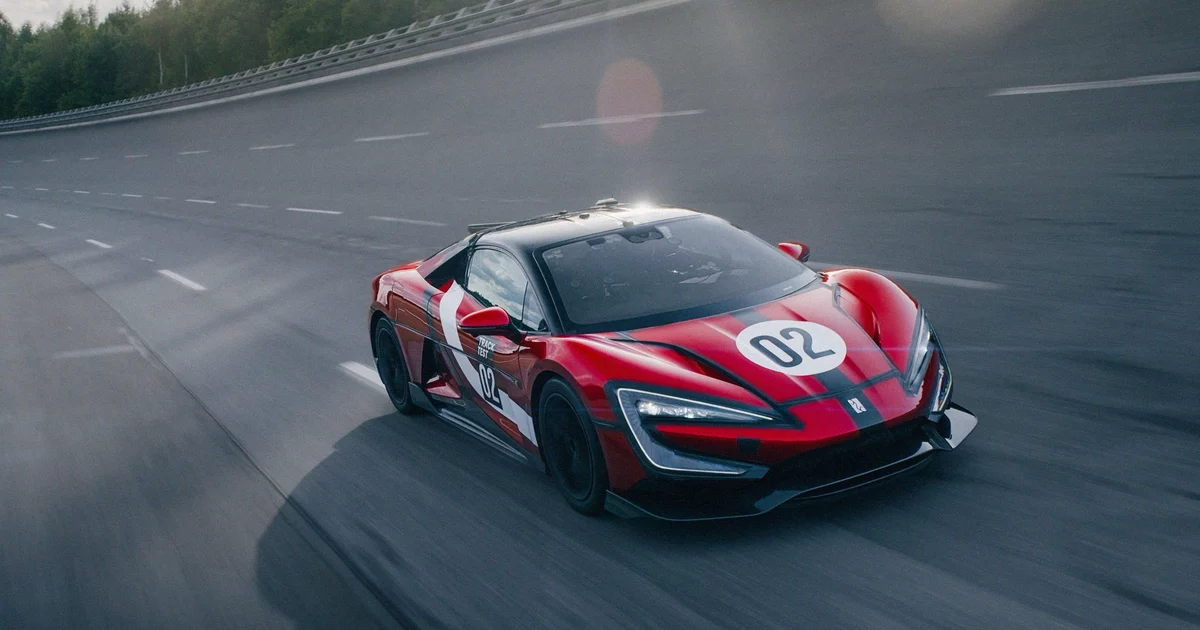

Breaking the 300-MPH Barrier: A New Epoch for Electric Hypercars
The automotive world has long measured itself against the rarefied air of the Bugatti Chiron and its ilk—machines whose price tags and performance figures seemed to exist in a parallel universe. But with the YangWang U9 Xtreme, BYD has not merely shattered the Chiron’s speed record at Germany’s ATP Papenburg oval, clocking an astonishing 308.4 mph; it has rewritten the script for what defines the apex of automotive achievement. This is not just a new chapter for electric vehicles, but a seismic reordering of the hypercar hierarchy, executed at a price point—roughly $151,000—that is nothing short of revolutionary.
Engineering Alchemy: The Technology Behind the Triumph
At the heart of the U9 Xtreme’s achievement is a confluence of innovations that, together, form a blueprint for the next generation of high-performance EVs.
- 1,200-Volt Ultra-High-Voltage Powertrain:
Where most premium EVs still operate at 400 or 800 volts, the U9’s 1,200-volt architecture slices current requirements, reducing both thermal loads and conductor mass. This not only enables blistering acceleration but also shortens charging times—provided the infrastructure can keep pace. The ripple effect will be felt across the supplier ecosystem, as power electronics and charging networks race to adapt to this new voltage frontier.
- Blade Battery Evolution:
BYD’s proprietary “blade battery” boasts 170% higher cell density and tenfold discharge rates compared to standard LFP packs. This narrows the performance gap with nickel-rich chemistries, all while retaining the safety and cost advantages that have made LFP a mainstay in mass-market EVs. The modular, structural integration of the battery hints at a future where the line between chassis and energy storage blurs—an innovation likely to cascade from hypercars to sedans and commercial vehicles.
- Quad-Motor Torque Vectoring:
Four independent motors, orchestrated by sophisticated software, allow for real-time, adaptive torque distribution. This not only delivers unprecedented traction at extreme speeds but also lays the groundwork for the next wave of autonomous dynamic-stability systems. BYD’s early mastery in this domain positions it as a first mover in the race toward software-defined vehicle dynamics.
Disruption at Scale: Economic and Strategic Reverberations
The U9 Xtreme’s record is more than an engineering coup; it is a calculated economic disruption.
- Price-Performance Paradigm Shift:
At one-tenth the cost of legacy hypercars, the U9 demonstrates how replacing mechanical intricacy with scalable electronics and commodity battery cells can compress costs without sacrificing spectacle. This is a clarion call for an industry long wedded to the notion that ultimate performance must come with ultimate expense.
- Brand Halo and Market Expansion:
Limited to just 30 units, the U9 Xtreme is less a product than a statement—a “halo” vehicle designed to burnish BYD’s credentials as it pushes deeper into Europe, Southeast Asia, and Latin America. The speed record is a global proof-point, amplifying the appeal of more accessible models in BYD’s expanding portfolio.
- Supply Chain Leverage:
As one of the world’s largest battery producers, BYD’s vertical integration—spanning cell manufacturing, power electronics, and final assembly—enables it to compress margins and insulate itself from raw material volatility. This structural advantage is likely to become even more pronounced as the industry pivots toward higher-voltage architectures.
The Road Ahead: Competitive, Regulatory, and Technological Implications
The U9 Xtreme’s breakthrough is already reverberating through boardrooms and policy circles.
- The “Voltage War” Accelerates:
Major automakers now face a strategic imperative: accelerate the shift to >1,000-volt platforms or risk obsolescence. Early adopters will vie for limited supplies of SiC and GaN semiconductors, potentially bottlenecking the supply chain for years to come.
- Charging Infrastructure in Flux:
Today’s public fast-charging networks are ill-equipped for 1,200-volt vehicles, setting the stage for joint ventures between automakers and utilities to develop megawatt-class chargers. The standards debate—CCS versus NACS—will only intensify as hardware races to catch up with vehicle capabilities.
- Policy and Geopolitical Tensions:
BYD’s ascendancy arrives at a moment of heightened scrutiny of Chinese EVs by Western regulators. The U9 Xtreme’s record may prompt new tariffs or local production partnerships, as governments grapple with the twin imperatives of competitiveness and security.
- Tesla and the Performance Narrative:
The gauntlet has been thrown. The next-generation Tesla Roadster must now leapfrog a 308-mph benchmark, or risk ceding the performance crown to BYD and emergent rivals like Rimac and Koenigsegg. Expect a renewed focus on ultra-high-voltage platforms and advanced battery architectures in Silicon Valley’s skunkworks.
A New Order for Mobility
The YangWang U9 Xtreme is not merely a marvel of speed, but a harbinger of the future—a world where the locus of automotive innovation shifts from mechanical wizardry to software, power electronics, and vertical integration. For investors, engineers, and policymakers alike, the message is clear: the age of electrical complexity has arrived, and with it, a new set of rules for competition, strategy, and value creation. The hypercar is no longer a symbol of exclusivity, but a bellwether for the democratization—and electrification—of performance itself.

 By
By
 By
By


 By
By

 By
By
 By
By







