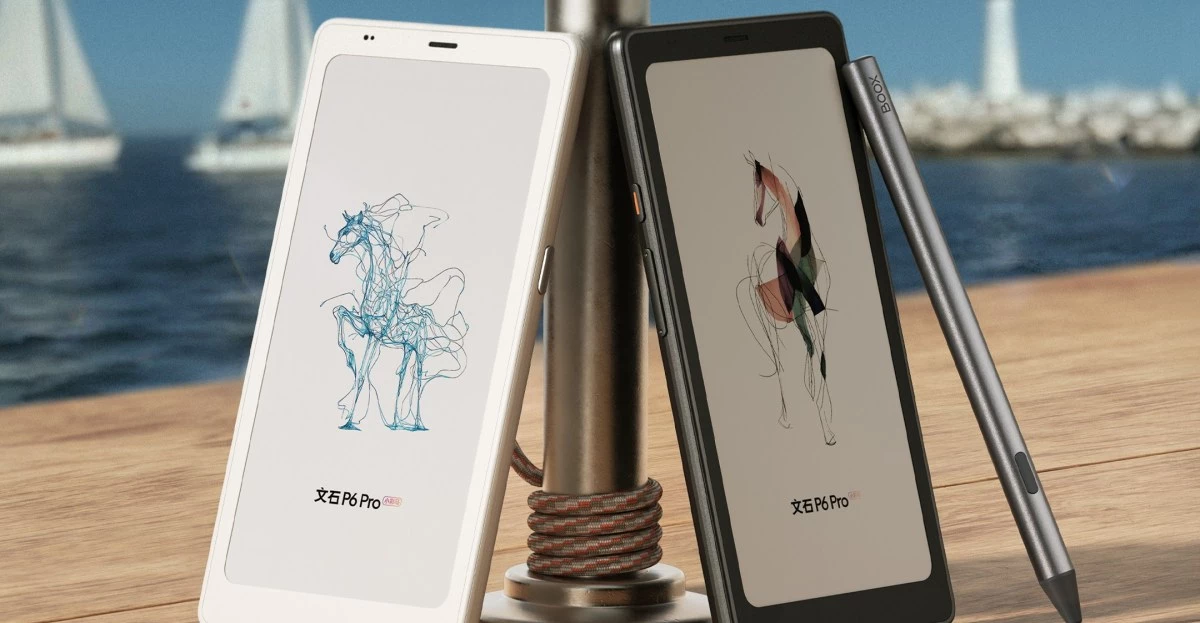

The Compact E-Reader, Reimagined: Boox’s P6 Pro Series and the New Shape of Digital Paper
When Boox unveiled its P6 Pro and P6 Pro Color in China, the move signaled more than a routine product refresh. It marked a deliberate stride into a future where the humble e-reader, once confined to grayscale novels and static PDFs, now aspires to be a connected, versatile workhorse for knowledge workers and enterprise clients. Priced at a premium—CNY 2,799 (~US $393) for the monochrome and CNY 3,299 (~US $463) for the color variant—the P6 Pro series is not gunning for the mass-market Kindle crowd. Instead, Boox is quietly staking a claim to the high ground of digital-paper innovation, where engineering ambition and strategic intent converge.
Engineering Maturity: E Ink, Android, and the 5G Inflection
The P6 Pro’s technical underpinnings read like a manifesto for the next wave of e-paper devices. Both models feature a 6.13-inch display—compact enough for a jacket pocket, yet powerful enough to host 128 GB of storage (expandable to a staggering 2 TB via microSD), and a 3,950 mAh battery. The Color model ups the ante with 8 GB of RAM, Kaleido 3 color E Ink, and active-stylus support, inviting workflows that monochrome e-readers simply cannot touch: annotating blueprints, reviewing marketing collateral, or marking up educational content in vibrant hues.
Yet, perhaps the most telling leap is the integration of a 5G SIM slot—an engineering feat in this size class, achieved without sacrificing the weeks-long battery life that defines the e-paper experience. The inclusion of 5G, with voice calling intentionally disabled, is a strategic masterstroke. It delivers always-on cloud access, sidesteps regulatory and tariff complications, and positions the P6 Pro as a complementary device: a distraction-free, eye-friendly terminal for professionals who already carry a smartphone, but crave a second screen optimized for deep work.
Boox’s commitment to a near-stock Android 13 further distinguishes the P6 Pro. Unlike the closed ecosystems of Kindle or Kobo, this open platform invites a universe of third-party apps—lightweight productivity tools, secure document workflows, and vertical-specific solutions. Stylus input and color display become more than features; they are the scaffolding for a new class of enterprise and prosumer use cases.
Pricing, Market Dynamics, and the Economics of Innovation
The P6 Pro’s price tag reflects not just margin ambition, but real-world cost pressures. NAND flash prices have surged, 5G modem components remain costly, and Kaleido 3 color filters command a hefty premium over their monochrome counterparts. The result: a bill of materials that justifies the >US $400 MSRP, even before factoring in potential U.S. tariffs that could push North American prices beyond the psychological $399 ceiling for mainstream readers.
Boox’s early launch discounts hint at price elasticity, but even these offers keep the P6 Pro above the Kindle Scribe and within striking distance of the iPad Mini. This is a deliberate segmentation move. Boox is not chasing the casual reader, but rather the prosumer and enterprise micro-segments—legal, architectural, and aviation professionals, for whom 2 TB of storage and secure, open-platform workflows are more than marketing bullet points; they are mission-critical.
The competitive landscape is shifting rapidly. Devices like Bigme’s Hibreak Pro are blurring the lines between e-readers and tablets, while Apple and TCL experiment with color e-paper and hybrid displays. Boox’s refusal to enable voice calling is not a technical limitation, but a moat—preserving the purity of the reading and writing experience, avoiding the UX and regulatory complexities of true phone-tablet hybrids.
Strategic Implications: ESG, Supply Chains, and the Future of Digital Work
The P6 Pro’s significance extends beyond its hardware. As corporations pursue carbon-neutral documentation, e-paper devices are increasingly piloted to replace printed binders in manufacturing, audit, and field service. The sub-1 W power profile of E Ink aligns seamlessly with ESG reporting, and 5G connectivity eliminates the friction of manual sideloading, enabling real-time synchronization from oil rigs to open-pit mines.
Yet, the macro context is fraught with complexity. Boox’s reliance on Chinese SoC and display suppliers introduces concentration risk for Western buyers, especially as U.S.–China tech decoupling accelerates. Dual-sourcing from Japanese display makers could mitigate this, but no such moves have been announced.
For enterprise procurement teams, the calculus is evolving. Higher upfront device costs may be offset by reductions in printing, shipping, and energy use, especially where 5G obviates the need for on-site Wi-Fi. The Android foundation mitigates lock-in risk, allowing organizations to extend existing mobile device management suites with minimal friction.
For SaaS vendors, the opportunity is equally clear: lightweight, E Ink-optimized clients can fill the whitespace left by traditional tablet-first offerings, while carriers might explore bundling low-ARPU data plans, reminiscent of Kindle’s Whispernet, to capture new subscriber segments.
As the economics of color e-paper improve and tariff regimes evolve, the P6 Pro’s strategic posture—always-connected, low-power, and open—could become the new baseline for digital-paper devices. The market’s next inflection point may come not from a single product launch, but from the convergence of hardware, software, and regulatory shifts that redefine what it means to work, read, and create in the digital age. For those attuned to these signals, the future of e-paper is not just bright—it’s in vivid color.

 By
By
 By
By

 By
By
 By
By


 By
By