

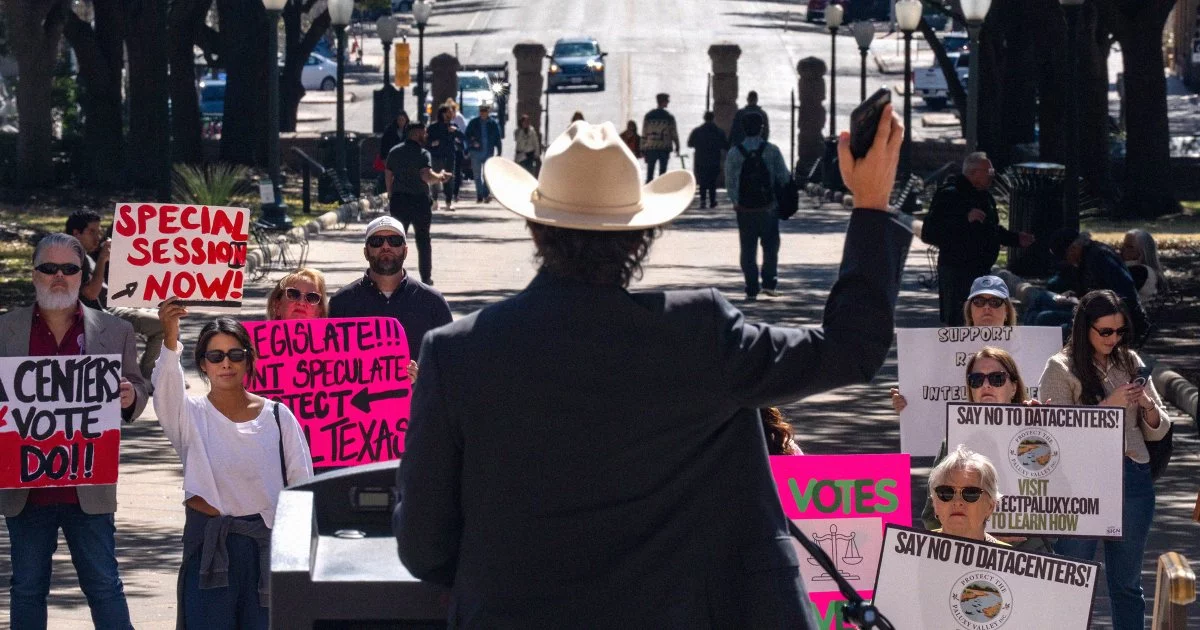

Rural America’s new flashpoint: AI data centers meet a cross-partisan wall of skepticism
A striking political realignment is taking shape far from Silicon Valley boardrooms and coastal policy circles. Small rural communities across the United States are organizing—often in explicitly bipartisan coalitions—against the rapid expansion of large-scale AI data centers. What might once have been framed as a straightforward economic development win is increasingly being treated as a high-stakes local referendum on resource use, public trust, and who bears the costs of the AI boom.
The contours of the backlash are becoming measurable as well as visible. A Marquette University Law School poll found 70% of Wisconsin voters believe data centers do more harm than good—an unusually decisive signal in a polarized era. That sentiment is now echoed in county meetings, utility hearings, and statehouse debates where the same concerns recur regardless of party affiliation:
- Grid reliability and electricity prices, especially where rural transmission and generation capacity is already constrained
- Water consumption, particularly in regions facing drought risk, aging infrastructure, or stressed aquifers
- Process legitimacy, as residents describe fast approvals and limited engagement as evidence that scale is being prioritized over consent
This is not merely “NIMBYism” in a familiar form. The opposition is being fueled by a perception that AI infrastructure is arriving as an extractive industry—drawing power and water at industrial scale while offering uncertain local upside.
The physics of AI compute: why energy and water have become political liabilities
The technical driver behind the controversy is straightforward: AI workloads are materially different from conventional enterprise computing. Training and inference at scale can require multiples of the power density of traditional data processing, and the demand profile can be volatile—spiking during intensive training cycles. For rural grids, that volatility matters as much as the total load.
Utilities facing sudden, concentrated demand often respond with new transmission upgrades, substation expansions, and peaking capacity. Communities worry—sometimes with reason—that these capital costs will be socialized across ratepayers, producing higher residential and small-business electricity bills even if the data center itself negotiates favorable rates.
Water adds a second constraint. Many hyperscale facilities rely on evaporative cooling or water-assisted systems to manage heat. Even closed-loop designs can require makeup water, and the optics are difficult in places where households are being asked to conserve. The result is a new kind of local calculus: AI data centers are being evaluated not as “digital” projects, but as heavy industrial facilities competing for finite resources.
This is already shaping technology roadmaps. To maintain momentum, operators may accelerate investment in:
- Air-cooled architectures where climate and design allow
- Liquid-immersion cooling using non-potable fluids to reduce reliance on freshwater
- On-site renewables and storage, not only for decarbonization claims but to reduce grid friction and permitting risk
- More distributed deployments (edge or modular data centers) that avoid the “single massive footprint” that triggers community alarm
In effect, the backlash is becoming a market signal: social acceptance is now an engineering requirement.
The economic bargain under scrutiny: jobs, tax incentives, and who captures the value
Data center developers frequently lead with a familiar promise—construction employment, a modern tax base, and a halo effect of tech investment. Rural officials, however, are increasingly interrogating the fine print. The critique is not that data centers create no jobs; it is that the job curve is front-loaded.
- Construction can be substantial but temporary.
- Operations are often low-headcount, with specialized roles supported remotely across regional portfolios.
- AI-driven automation, ironically, reinforces the fear that the broader economic spillover may be limited—or even negative—if local industries face labor displacement without commensurate new opportunities.
Tax policy is another pressure point. Municipalities and states often offer abatements and incentives to win projects, but residents are asking whether the net fiscal benefit holds up once you account for:
- foregone revenue that could have funded schools, roads, and water systems
- public costs associated with grid upgrades and permitting oversight
- the opportunity cost of allocating scarce land, power, and water to a single large user
This is where the debate becomes less ideological and more fiduciary. Communities are effectively demanding a clearer answer to a basic question: Is the local balance sheet improved—or merely burdened—by hosting AI infrastructure?
From local hearings to national policy: moratoria, permitting, and the new “social license” test
What makes this moment consequential for business and technology leaders is the speed at which local resistance is translating into national political momentum. Calls for a nationwide moratorium—notably from Senator Bernie Sanders and Senator Josh Hawley—signal that data centers are moving into the category of infrastructure that can trigger federal scrutiny and durable regulatory precedent.
Several dynamics are converging:
- Permitting legitimacy: Rapid approvals and limited consultation are being interpreted as a governance failure, not just a communications gap.
- Partisan cross-currents: Coalitions spanning MAGA-aligned conservatives, “Never-Trumper” organizers, faith community leaders, and environmental advocates suggest a new voting bloc organized around resource protection and local autonomy.
- Standards-setting risk: If moratoria or strict state-level rules emerge, they could establish long-lasting benchmarks for water-use thresholds, environmental review, and utility rate structures tied to AI-driven load profiles.
For operators, the strategic lesson is that “social license to operate” is no longer a soft concept. It is becoming a gating factor as real as interconnection queues and transformer lead times. The companies most likely to sustain expansion will be those that treat community partnership as core infrastructure—backed by measurable commitments such as:
- Community Benefit Agreements with transparent funding for local priorities
- Joint advisory councils that align build timelines with grid and water capacity
- Public reporting of energy and water metrics to reduce suspicion and rumor-driven politics
- Workforce pipelines with community colleges to convert a low-headcount facility into a broader skills platform
The AI economy is being built on physical inputs—electricity, water, land, and trust. Rural America is signaling that it intends to negotiate the terms, and the outcome will shape not only where data centers get built, but how the next decade of AI infrastructure is designed, priced, and governed.

 By
By
 By
By
 By
By

 By
By

 By
By
 By
By







