

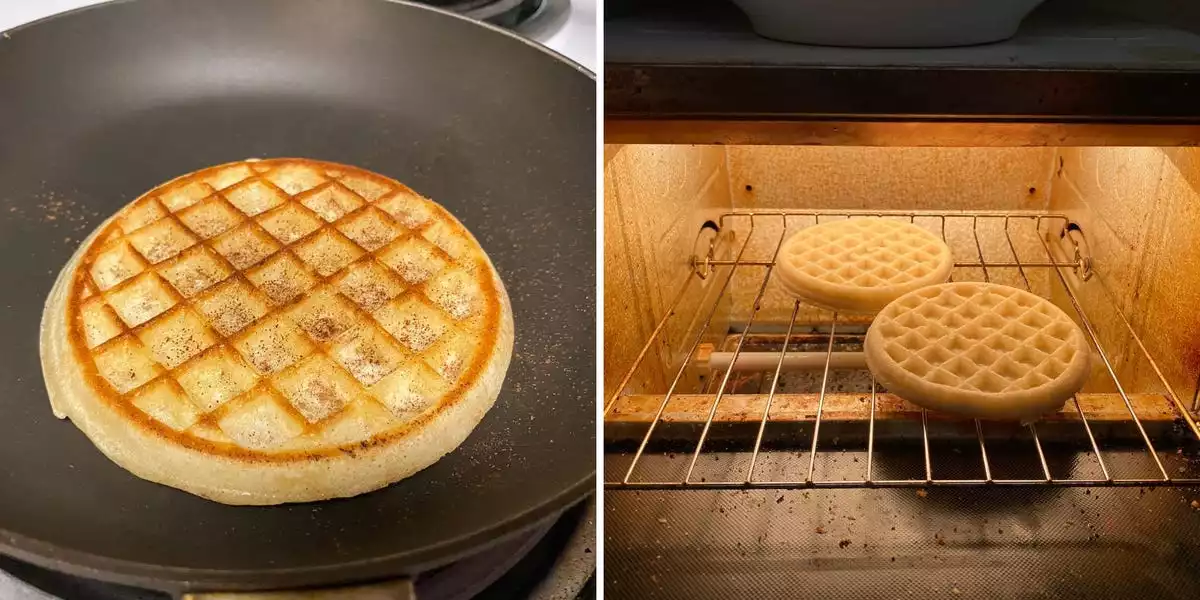

A frozen-waffle taste test that quietly exposes the limits of “set-and-forget” cooking
Chelsea Davis’s comparative trial—toaster vs. oven vs. air fryer vs. stove-top—reads like a small domestic experiment, but it lands on a larger truth about modern kitchen technology: convenience appliances often optimize for repeatability, not sensory excellence. In Davis’s results, the toaster and oven produced consistent, broadly acceptable waffles that lacked character. The air fryer, emblematic of the last decade’s countertop boom, pushed the texture too far—crisp to the point of dryness. The stove-top method, however, delivered what consumers typically describe as “restaurant-like”: a crisp exterior with a moist interior, amplified by butter and cinnamon and finished with syrup into something closer to dessert than breakfast.
From a business and technology lens, the most important detail is not simply that pan-frying “tastes better.” It’s *why* it tastes better: the stove-top approach introduces human-in-the-loop control—timing, flipping, fat management, and heat modulation—creating conditions for stronger browning and aroma development. This is where the Maillard reaction (the chemistry behind browned, complex flavors) becomes a competitive differentiator, not just a culinary footnote.
The broader implication: today’s mainstream appliances still struggle to replicate the adaptive, tactile decision-making that skilled cooking relies on, especially when the food begins as a standardized frozen product.
—
Heating physics meets product design: why the stove wins and the air fryer overreaches
Each appliance in Davis’s test embodies a distinct heating model—and each model has predictable outcomes for frozen starches like waffles.
- Toasters and ovens tend to deliver uniform, one-dimensional heating. They are engineered for simplicity and throughput: insert, wait, remove. That predictability is valuable, but it can also flatten outcomes—less localized browning, fewer “peaks and valleys” of texture, and limited opportunity for flavor layering.
- Air fryers rely on high-speed convection. This is excellent for driving surface crispness quickly, but it can also accelerate moisture loss. For waffles—already pre-cooked and relatively thin—this can tip the product into over-dehydration, producing a brittle crunch rather than a balanced bite.
- Stove-top pan-frying introduces direct conductive heat plus a crucial variable: added fat (butter) and optional aromatics (cinnamon). Conductive heat encourages rapid browning at the contact surface, while butter acts as both a heat-transfer medium and a flavor carrier. The user’s ability to adjust heat and flip at the right moment creates a feedback loop that most appliances still can’t match.
This is a subtle but commercially meaningful point: the “best” result came from the method with the most controllable variables, not the most automated device. In an era where smart kitchens promise optimization, the winning workflow was analog—yet more precise in practice because it was responsive.
—
The smart-kitchen opportunity: replicating manual finesse with sensors, algorithms, and recipe-aware guidance
Davis’s stove-top result highlights a gap in current appliance innovation: automation has not fully captured the craft layer of cooking—the micro-decisions that turn “heated” into “delicious.” That gap is also a roadmap.
A next-generation approach to frozen-food preparation could combine:
- Embedded temperature sensing (pan surface + food-contact inference) to detect browning progress rather than relying on time alone
- Adaptive control algorithms that adjust heat in real time to prevent drying while still achieving crispness
- Humidity or moisture-aware cooking modes—particularly relevant for air fryers, where dehydration is a known failure mode for certain foods
- Recipe-aware IoT prompts that tell users *when* to add butter or spices, or that coordinate heat changes with ingredient additions
- Multi-zone induction surfaces that mimic the “move the waffle to a cooler spot” behavior experienced cooks use instinctively
The strategic prize is significant: an appliance ecosystem that can deliver stove-top quality with countertop convenience. If manufacturers can productize the “butter + flip + medium-high heat” advantage into guided or automated features, they can move beyond commodity hardware and compete on outcomes—taste, aroma, and texture—rather than watts and presets.
—
Market implications: premium frozen waffles, co-branded ecosystems, and accessory-driven margin expansion
The frozen waffles category—approaching $500 million annually in the U.S.—is built on convenience and nostalgia. Davis’s experiment suggests something else is emerging: consumers may accept a small increase in effort for a large increase in experience. That behavioral shift opens multiple monetization paths.
For CPG brands (frozen food makers):
- Premiumization: “pan-fry optimized” waffles with formulations tuned for better browning and moisture retention
- Flavor integration: cinnamon-forward variants or butter-compatible coatings designed to caramelize without burning
- Instructional marketing: packaging and digital content that positions stove-top preparation as “chef-approved,” justifying a higher price point
For appliance manufacturers:
- Differentiation through sensory performance: features that preserve interior moisture while maximizing surface crispness
- Partnerships and presets: co-marketing with waffle brands, QR-driven cooking modes, and data-informed presets that reduce trial-and-error
- Modular add-ons: specialized plates, pans, or inserts that emulate pan-frying dynamics and enable upsell beyond the base unit
For retailers and emerging channels (meal kits, ghost kitchens, QSR):
- Bundled SKUs such as waffle packs paired with a branded butter-cinnamon blend—high-margin, low-friction incremental sales
- Operational differentiation: stove-style waffle finishing as a signature texture play, especially for delivery-focused breakfast menus
A final layer—often overlooked but increasingly material—is energy and sustainability positioning. If lifecycle comparisons show that induction-based stove-top methods can deliver superior results at competitive energy cost per serving, manufacturers gain a credible efficiency narrative alongside taste performance.
What Davis ultimately surfaced is a product truth with boardroom implications: the future of “smart cooking” won’t be won by automation alone, but by automation that understands craft—when to brown, when to protect moisture, and when to invite the cook into the loop for maximum payoff.

 By
By

 By
By
 By
By
 By
By

 By
By
 By
By







