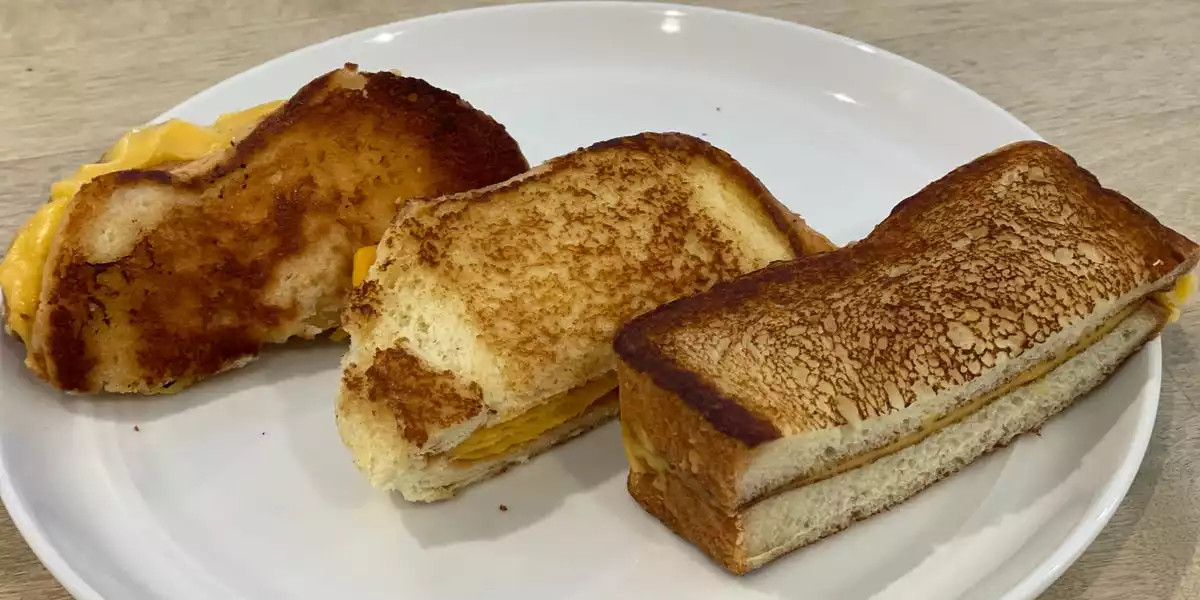

A grilled cheese taste test that doubles as a fast-food market signal
A three-way grilled cheese comparison—Sonic, Shake Shack, and Five Guys—reads like a simple comfort-food verdict on the surface. Underneath, it functions as a clean, almost laboratory-grade snapshot of the quick-service restaurant (QSR) vs fast-casual economy in 2026: consumers are more price-aware, operators are navigating stubborn input costs, and brands are being judged not just on flavor but on value credibility.
The headline outcome is straightforward: Sonic’s $3.25 grilled cheese is framed as the best price-to-quality performer, even with a cheese profile that leans “processed.” Shake Shack’s $6 version is positioned as premium in presentation but underwhelming in portion and value. Five Guys’ $7 grilled cheese wins on richness and ingredient quality—better bread, fresher melt—yet struggles to justify the premium when the category itself is culturally anchored as an inexpensive staple.
That tension—between what a product *is* (a basic comfort sandwich) and what brands *need it to be* (a margin-positive menu item)—is exactly why this small taste test matters. Grilled cheese becomes a proxy for how chains manage pricing power, operational complexity, and consumer trust.
Key takeaways reflected in the comparison:
- Sonic: wins on affordability and acceptable execution; a “good enough” product that aligns with inflation-era expectations.
- Shake Shack: risks a perception gap—premium price without premium satisfaction.
- Five Guys: demonstrates quality leadership, but the category ceiling limits willingness to pay.
The technology behind “ooze”: food processing, kitchen systems, and consistency economics
Grilled cheese is deceptively technical. The consumer experiences it as crunch, pull, and warmth. Operators experience it as throughput, consistency, and controllable cost.
Sonic’s performance highlights the industrial advantage of American-style processed cheese, engineered for predictable melt behavior. Emulsifiers and stabilizers aren’t just additives; they’re manufacturing tools that reduce variance across thousands of locations and shifts. When the sandwich “oozes,” it signals a system optimized for repeatability—critical in QSR environments where speed and standardization are the business model.
Five Guys, by contrast, appears to win on freshness and heat management—a result less about ingredients alone and more about kitchen infrastructure and process discipline:
- tighter griddle/broiler calibration
- better real-time temperature control
- staff training that protects texture (avoiding sogginess, under-melt, or uneven browning)
That operational edge is expensive. It implies higher CAPEX (equipment and layout) and OPEX (labor time, training, energy use). The taste test effectively captures the trade: premium mouthfeel often requires premium operations, and those costs must be recovered through pricing—whether the customer agrees or not.
A notable gap across all three brands is digital customization maturity. None fully leverages app-based ordering to turn grilled cheese into a configurable platform (cheese blends, bread swaps, add-on proteins). In an era where restaurant apps increasingly behave like product configurators, grilled cheese remains under-monetized as a high-frequency, high-attachment item.
Pricing strategy under inflation: value menus, brand positioning, and margin math
The strongest business insight in the comparison is how clearly it reflects consumer price sensitivity. With core inflation still shaping discretionary behavior, many diners are recalibrating what “worth it” means—especially for items historically associated with low cost.
Sonic’s sub-$4 price point fits the moment: it’s accessible, psychologically comfortable, and well-positioned for secondary and tertiary markets where value perception can outweigh brand prestige. The sandwich also functions as a classic traffic driver—potentially a break-even item that supports higher-margin add-ons.
Shake Shack’s challenge is structural. Its brand sits in a premium fast-casual lane, but grilled cheese is a product with a low willingness-to-pay ceiling. If portion size and satisfaction don’t scale with price, the item becomes a reputational risk: not because it’s “bad,” but because it violates the consumer’s internal reference price for the category.
Five Guys illustrates a different dynamic: loyalists will pay for quality, but the brand still faces the question of whether grilled cheese can credibly command $7 when a cheaper alternative delivers adequate comfort and convenience. The test suggests that even when quality is objectively higher, the value narrative can still lose.
Meanwhile, input costs complicate every decision. Bread and dairy have been volatile and, in many markets, have outpaced general food inflation. Chains using more artisanal bread or less commoditized dairy face sharper margin pressure unless they:
- raise prices (risking demand elasticity)
- redesign specs (risking quality perception)
- subsidize via bundles and cross-sell (protecting margins through basket economics)
Where the category goes next: AI-driven bundles, limited editions, and “comfort food platforms”
The most strategic opportunity hinted by this comparison is that grilled cheese can evolve from a static menu item into a modular comfort-food platform—a base product that supports profitable customization, limited-time variants, and dynamic pricing.
Several moves are increasingly plausible across QSR and fast-casual:
- Tiered grilled cheese architecture: a low-cost “classic” plus a premium line (better bread, cheese blends, add-ons) to protect both value seekers and margin needs.
- Limited editions for differentiation: seasonal cheeses, regional breads, flavored butters—designed for social media velocity and higher willingness to pay.
- AI-personalized offers and dynamic bundles: loyalty-driven discounts during off-peak hours, inventory-aware promotions, and bundle pricing that optimizes both demand and waste.
- Supply-chain resilience as competitive advantage: multi-year dairy contracts, bakery partnerships, or selective vertical integration to stabilize pricing on foundational inputs.
Ultimately, the taste test crowns Sonic not because it’s the most luxurious, but because it aligns best with today’s market reality: consumers are buying reassurance as much as flavor—reassurance that a simple comfort sandwich won’t come with premium regret. Brands that can pair operational consistency with smart pricing—and then layer in personalization and limited-edition excitement—will define the next phase of competition in the most deceptively important corner of the menu.

 By
By
 By
By
 By
By

 By
By

 By
By