

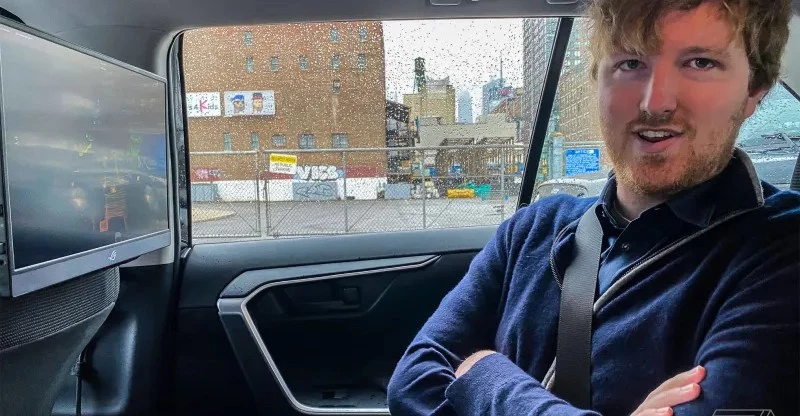

A Founder’s Gambit: Austin Russell’s High-Stakes Play for Luminar’s Future
In a move that has electrified the autonomous mobility sector, Austin Russell—the prodigious founder who steered Luminar to a $3.4 billion public debut—has initiated a bold campaign to reclaim full control of his embattled lidar company. Through the newly minted Russell AI Labs, Russell is seeking to acquire all outstanding Class A shares, a maneuver that arrives as Luminar weathers layoffs, a shrinking cash runway, and the haze of an unresolved ethics investigation following Russell’s own resignation as CEO. The timing is no accident: as the lidar industry faces existential pressures, Russell’s bid is both a vote of confidence in the company’s core technology and a calculated bet that founder-driven stewardship can restore Luminar’s luster.
Lidar’s Shifting Economics and the Rise of the Perception Platform
The lidar landscape is in flux. Once the darling of Wall Street’s SPAC boom, the sector has seen valuations tumble—median enterprise value among de-SPACed lidar firms has fallen by roughly 80% since 2020. Luminar, despite marquee partnerships with Mercedes-Benz, Volvo, and Caterpillar, has not been immune. Hardware average selling prices have plummeted by nearly 70% since 2018, compressing margins and forcing a reckoning: survival now hinges not on the sensor itself, but on the intelligence it enables.
Russell’s vision is unmistakably forward-looking. By transforming Luminar from a component supplier into a vertically integrated “perception platform,” he aims to bundle high-fidelity 3D sensing with onboard compute, mapping, and cloud analytics. This approach echoes the strategies of AI titans like NVIDIA and emergent players such as Wayve, who are fusing real-time spatial data with generative vision-language models. The implication is profound: Luminar’s lidar could become the backbone not just of safer vehicles, but of autonomous fleets, industrial robotics, and even digital twins of entire cities.
- Sensor commoditization is pushing lidar firms to capture value through software and data services.
- Integration with AI—as signaled by the “AI Labs” moniker—positions Luminar to ride the next wave of autonomy, where perception and decision-making are inseparable.
Governance, Ethics, and the Challenge of Rebuilding Trust
Yet, for all its technological promise, Luminar’s future will hinge as much on governance as on innovation. The unresolved ethics probe that led to Russell’s April departure lingers as a cloud over the company’s reputation. As Russell seeks to centralize control—supported, it seems, by a segment of the board and investor base—the composition of Luminar’s leadership will come under intense scrutiny.
- Board independence and robust audit mechanisms will be critical to reassure both institutional investors and blue-chip OEM partners.
- Talent retention is at stake: founder returns can galvanize employee loyalty, but may also unsettle recently installed executives.
- Transparency in resolving ethics allegations will be vital for Luminar’s eligibility in government programs and public-private partnerships, especially as regulatory scrutiny of autonomous systems intensifies.
Competitive Fault Lines: U.S. Innovation Amid Global Pressure
The competitive terrain is unforgiving. Tesla’s high-profile commitment to vision-only autonomy has cast lidar as optional in some quarters, but Mercedes-Benz’s Level-3 approvals in Germany and Nevada underscore a bifurcated market—one in which premium automakers demand lidar redundancy as a safety imperative. Meanwhile, Chinese upstarts like Hesai and RoboSense are driving sensor costs below $500, threatening U.S. incumbents on price and accelerating the need for IP-centric, software-augmented business models.
- Non-automotive channels—such as Caterpillar’s mining and industrial applications—offer a lifeline, where autonomy is valued for efficiency and safety, not just cost.
- Supply chain de-risking is now paramount, as OEMs push for dual-sourcing and U.S. policy incentivizes domestic manufacturing.
For decision-makers across the mobility ecosystem, Russell’s move is a clarion call. CTOs must weigh the benefits of a vertically integrated stack against the risks of supplier concentration. M&A strategists should anticipate renewed consolidation, as capital constraints squeeze sub-scale players. Investors face a complex calculus: short-term liquidity events may precede a protracted value-creation cycle, demanding patience and conviction.
As the sector stands at a crossroads, Russell’s audacious bid is more than a founder’s nostalgia—it is a strategic realignment, seeking to transform Luminar from a commoditized hardware vendor into a data-rich autonomy platform. Those who can navigate the convergence of sensor innovation, AI-driven software, and agile capital structures will shape the next era of autonomous mobility.

 By
By
 By
By

 By
By
 By
By
 By
By

 By
By







