
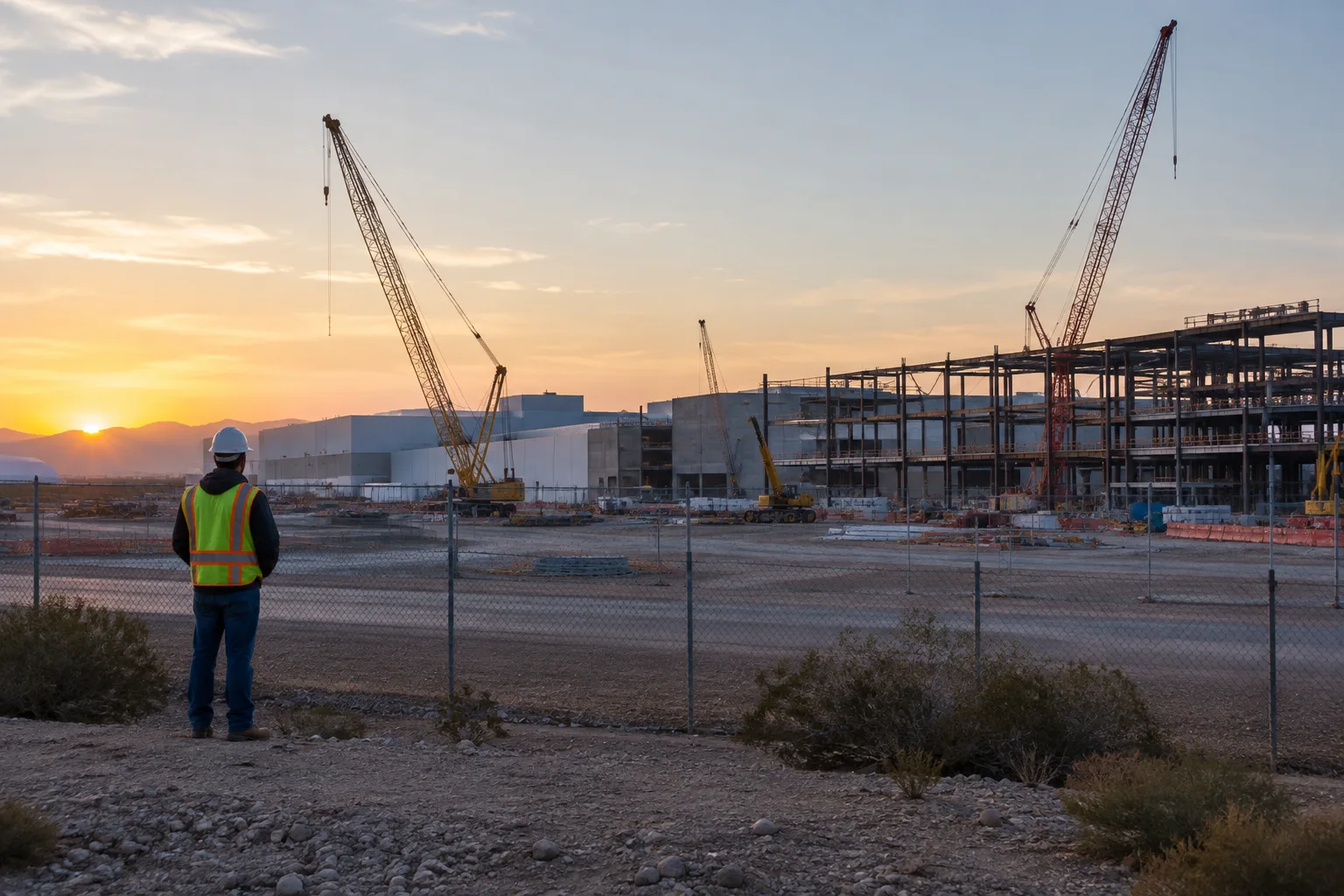

President Donald Trump will travel to Arizona on Dec. 4 to speak at the groundbreaking for the next phase of Taiwan Semiconductor Manufacturing Co.’s Phoenix-area expansion, according to The Associated Press. For the White House, it is a visible manufacturing and AI-policy moment. For chip buyers, it is a much narrower and more important test: whether TSMC’s vast Arizona buildout is moving from political headline to dependable advanced-chip supply.
This is not a new $265 billion pledge. TSMC said in July that it would add $100 billion to its U.S. investment plans, bringing the Arizona total to $265 billion. What is new is the construction milestone. AP describes the Dec. 4 event as the start of the fifth phase of TSMC’s Arizona expansion. The real question for readers is whether that headline number is turning into qualified, packaged chips on a schedule that AI-server, smartphone, and accelerator roadmaps can actually use.
What the Arizona milestone does — and does not — mean
The Arizona campus is no longer a pure promise. TSMC’s first Arizona fab entered high-volume production in the fourth quarter of 2024 using N4 technology. That matters because it shows the company has already crossed the hardest credibility threshold: getting one advanced fab in the state into volume output.
The next key waypoint is the second fab. TSMC has said it is built for 3-nanometer production and is expected to begin volume production in 2027, with company materials describing a pull-forward toward high-volume manufacturing in the second half of that year. A third fab began construction in 2025. In July, the Arizona Commerce Authority said the additional $100 billion was intended to fund four more fabs using 2-nanometer or more advanced process technologies. Its description of the full program lists 10 fabs, two advanced-packaging facilities, and an R&D center.
That scale is why the ceremony matters beyond local politics. If the full plan is completed, the state said, about 30% of TSMC’s 2-nanometer-and-beyond capacity would be in Arizona. AP reports that TSMC’s Phoenix-area operations manufacture chips for customers including Nvidia, Apple, AMD, Broadcom, and Qualcomm. The White House says the expansion would create 10,000 direct jobs and another 11,000 indirect jobs, while AP says the site already accounts for more than 12,000 construction jobs. TSMC Arizona currently employs more than 3,500 people.
But those figures do not change the practical timeline for customers. The current White House will use the event to underscore tariffs, AI, and domestic production. The physical buildout, though, began under the Biden administration, and TSMC’s own filings say up to $6.6 billion in CHIPS Act funding and access to up to $5 billion in government loans remain subject to conditions and milestones.
The operational gates between dirt-moving and deliverable chips
A leading-edge fab becomes economically meaningful only after several less photogenic steps go right. Construction is followed by equipment move-in, tool calibration, process qualification, and yield learning. Then come the supplier and utility questions: whether the site has stable access to the specialty materials, chemicals, power, water, replacement parts, and engineering support that advanced manufacturing consumes continuously. Any one of those stages can stretch a schedule even after a groundbreaking or topping-out ceremony.
That is why the second fab’s 2027 target matters more than next week’s optics. For most chip buyers, production qualification is the date that counts. Public materials do not spell out facility-by-facility capital timing, wafer volumes, yield curves, or the point at which each future Arizona fab reaches stable high-volume output. Nor do they say how much output will be allocated to any specific customer.
Packaging is another gate that investors and procurement teams should not treat as automatic. Advanced wafers do not become shippable AI accelerators or phone processors just because they leave the fab. They still need advanced packaging and test capacity. Arizona’s long-term plan includes two advanced-packaging facilities, but the public timeline and scale for that packaging buildout are not detailed. That leaves open an important question: how much of the value chain can stay near the new wafer capacity, and how much will still depend on a broader international network.
Labor is part of the same story. A multi-fab advanced campus needs experienced technicians, engineers, and construction workers at the same time that U.S. semiconductor projects are competing for similar talent. The announced job figures show ambition and local impact, but not how quickly TSMC can hire, train, and retain the staffing required for a 10-fab vision. The same is true for supplier localization. Arizona can reduce some geopolitical and logistics exposure for U.S. customers without becoming self-sufficient; the equipment, materials, and expertise chain remains global.
What businesses should watch from here
The case for Arizona is strong enough that this is more than ceremonial politics. TSMC already has one fab in volume production there, it has named a near-term 2027 target for the second fab, AI demand remains intense, and its customer relationships give the project far more credibility than an unproven greenfield foundry would have. For U.S. customers, even partial geographic diversification has value.
Still, resilience and readiness are not the same thing. Public announcements do not yet tell buyers which company gets what share of future Arizona output, at what price, or under what allocation terms. “2-nanometer or more advanced” describes an intended technology class, not a guaranteed delivery date for a specific chip program. Higher U.S. capacity also does not automatically mean lower cost; duplicating leading-edge production outside Taiwan may improve continuity while raising construction, labor, utility, and ecosystem costs.
So the useful scorecard after Trump’s visit is not the number of politicians onstage or the size of the pledged investment. It is whether TSMC stays on track for second-fab production in 2027, whether later fabs move from planned to built, whether packaging capacity appears in time to support front-end wafer output, whether CHIPS conditions are met, and whether customers can secure qualified allocation they can design around. Until those boxes are checked, Arizona is best understood as a promising supply-chain hedge — not yet a finished answer to America’s advanced-chip dependence.

 By
 By

 By
 By

 By