
Zipline has raised $1.5 billion at a $21.5 billion post-money valuation, turning what might look like another giant startup round into a much more consequential logistics test. The South San Francisco company said on Nov. 5 that it will use the money to expand U.S. manufacturing, hire more workers, and build out a nationwide drone-delivery network in partnership with major commercial channels that already have stores, customers, and order flow.
That is why this financing matters beyond venture capital. The reader’s real question is not whether drones can deliver a burrito or a carton of eggs faster than a car on the right route. It is whether Zipline can turn capital, retail density, and regulatory access into a repeatable network business before the fixed costs of aircraft, sites, maintenance, and compliance outrun demand.
Zipline is offering unusually concrete early signals for a private company. It says Walmart and Zipline are working on 300 additional sites under a new national, multiyear agreement. It says Uber is targeting one million Zipline deliveries per day by 2029. And it says it has already made more than one million deliveries in the Dallas-Fort Worth metroplex in 2026, with the median October order arriving 19 minutes after checkout, versus more than 30 minutes for traditional delivery.
Those numbers suggest there is something real to build on. They do not, by themselves, settle whether the model produces durable margins.
What the money is really buying
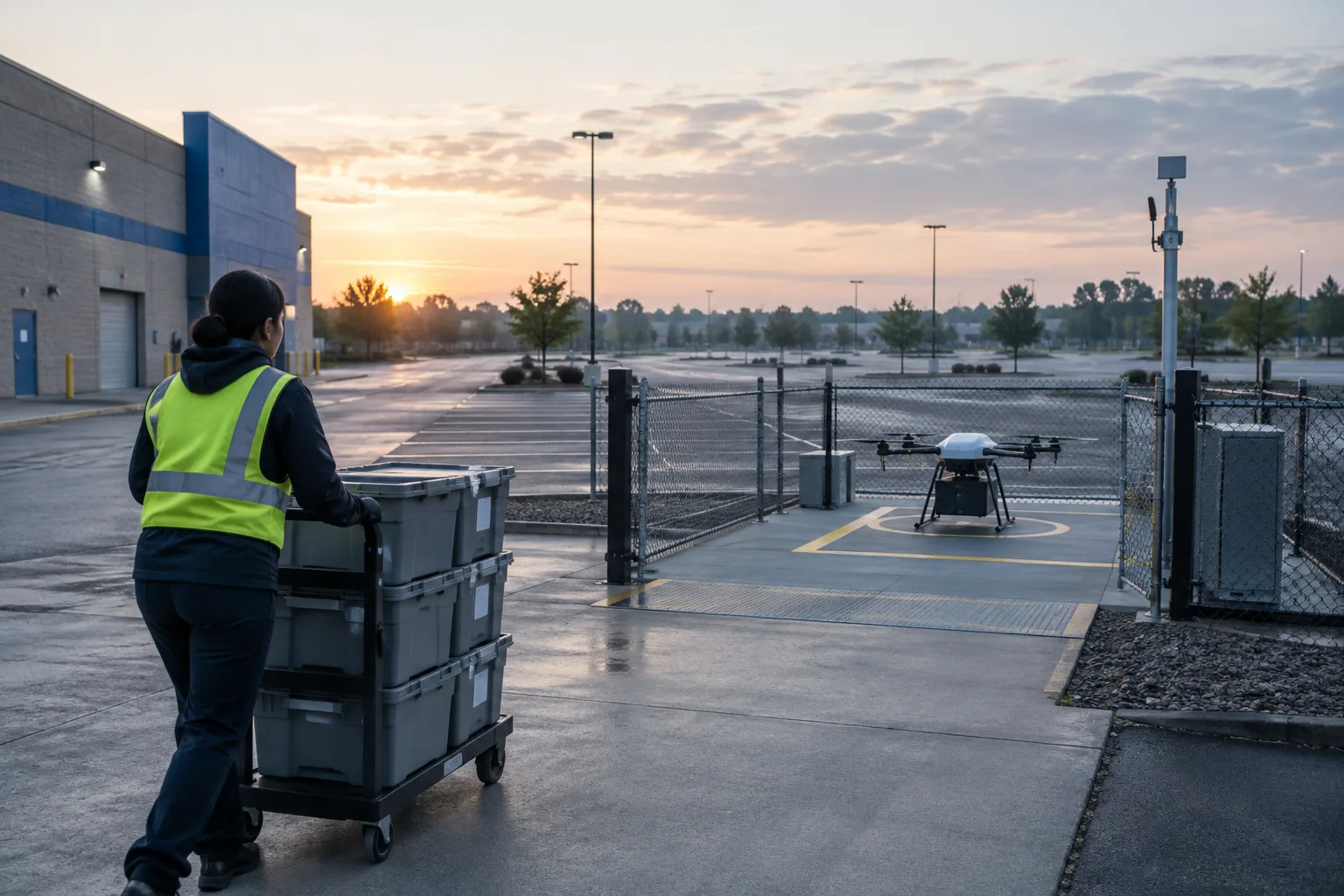
Drone delivery is often discussed as a product demo. In practice, it behaves more like infrastructure. A working network needs aircraft, batteries, launch-and-recovery equipment, merchant integrations, maintenance, routing software, operating staff, insurance, airspace permissions, and enough order density to keep the system busy.
That helps explain why Zipline is directing this round toward manufacturing and hiring, not just market expansion. According to Reuters, chief executive Keller Cliffton said the company had to build much of its own technology and manufacturing operation because there was no established drone-delivery supply chain to plug into. That is strategically powerful if it works; it also means higher fixed costs and more execution risk than a software marketplace faces.
The valuation raises the stakes further. Reuters reported that the new $21.5 billion figure nearly triples Zipline’s value from about $7.6 billion, when it raised $600 million earlier in 2026. Investors clearly see a chance to build a large new logistics layer. But a valuation jump that sharp also means the company will eventually need to show more than technical capability or partner enthusiasm. It will need to show that each route can contribute enough margin to support the network wrapped around it.
Scale helps only if permission keeps up
Zipline’s long history outside the U.S. is part of this story. The company operates across four continents, and Reuters noted that beyond-visual-line-of-sight restrictions kept it from launching commercially in its home market for years, pushing it overseas earlier on. That matters because the limiting factor in drone delivery has never been aircraft alone. It is whether regulators and local communities will allow sustained, routine operations at meaningful density.
More sites can improve the economics. A dense cluster of Walmart locations or restaurant partners can shorten routes, increase aircraft utilization, and make fast delivery more attractive to shoppers. If a drone is busy throughout the day, the fixed cost of the system is spread across more orders. If it flies only in peaks or in thinly demanded areas, capital turns into idle capacity.
Permissions can interrupt that compounding. Noise complaints, safety concerns, privacy worries, weather limits, and local airspace restrictions can all slow launches or reduce operating hours. The public record does not yet show the locations, construction timetable, or regulatory status for the 300 additional Walmart sites, and Zipline has not disclosed how the economics look route by route. That leaves the key question unresolved: whether scale arrives in the same places and at the same pace as regulatory approval.
Competition makes that timing more important. Reuters identified Amazon as another major player, with plans to expand its drone-delivery service from 11 locations to about 500 U.S. locales by the end of 2026. That does not prove Amazon will win, or that Zipline’s economics will fail. It does mean the fight is shifting from technical possibility to who can secure permissions, merchant density, and repeat demand quickly enough to create a self-reinforcing network.
Why Walmart and Uber matter — and why they are not enough
The strongest part of Zipline’s case is not the drone itself. It is access to demand. Walmart offers retail density and pickup points. Uber offers ordering traffic and an existing consumer habit around on-demand delivery. Those partnerships can solve two of the hardest startup problems at once: where orders come from and where operations begin.
For retailers and restaurants, the appeal is straightforward. Faster delivery can increase conversion, support higher order frequency, and help a merchant compete on convenience without adding another van or driver to every trip. Zipline’s reported 19-minute median October delivery time in Dallas-Fort Worth points to the customer value proposition in a concrete way.
But faster is not automatically cheaper, and partner announcements are not the same thing as proven unit economics. Zipline has not disclosed cost per delivery, utilization, maintenance expense, incident rate, insurance cost, operating margin, or the economics of its Walmart and Uber agreements. It has not shown how much of its Dallas-Fort Worth volume is repeat demand, how the system performs in bad weather or dense urban conditions, or how profitable any given delivery lane is.
That missing detail matters because route economics decide whether drone delivery becomes a real service layer or a capital-heavy race. A system can look impressive at the city level while still depending on subsidized routes, promotional demand, or undercounted operating burdens. Just as important, even a successful drone network would sit alongside ground delivery rather than replace it. Many trips will remain better suited to cars, bikes, or human couriers because of basket size, distance, weather, or neighborhood constraints.
The cleanest way to read this raise, then, is as financing for a high-stakes operational exam. Zipline now has the capital, partners, and investor backing to attempt a national U.S. buildout. What comes next is less cinematic: permits, launch schedules, manufacturing yield, route utilization, on-time performance, safety events, and customer retention. If those metrics improve together, the round will look like the funding of a new logistics network. If they do not, it will look more like expensive preparation for a market that scaled more slowly than the valuation did.

 By

 By

 By

 By


 By

 By