

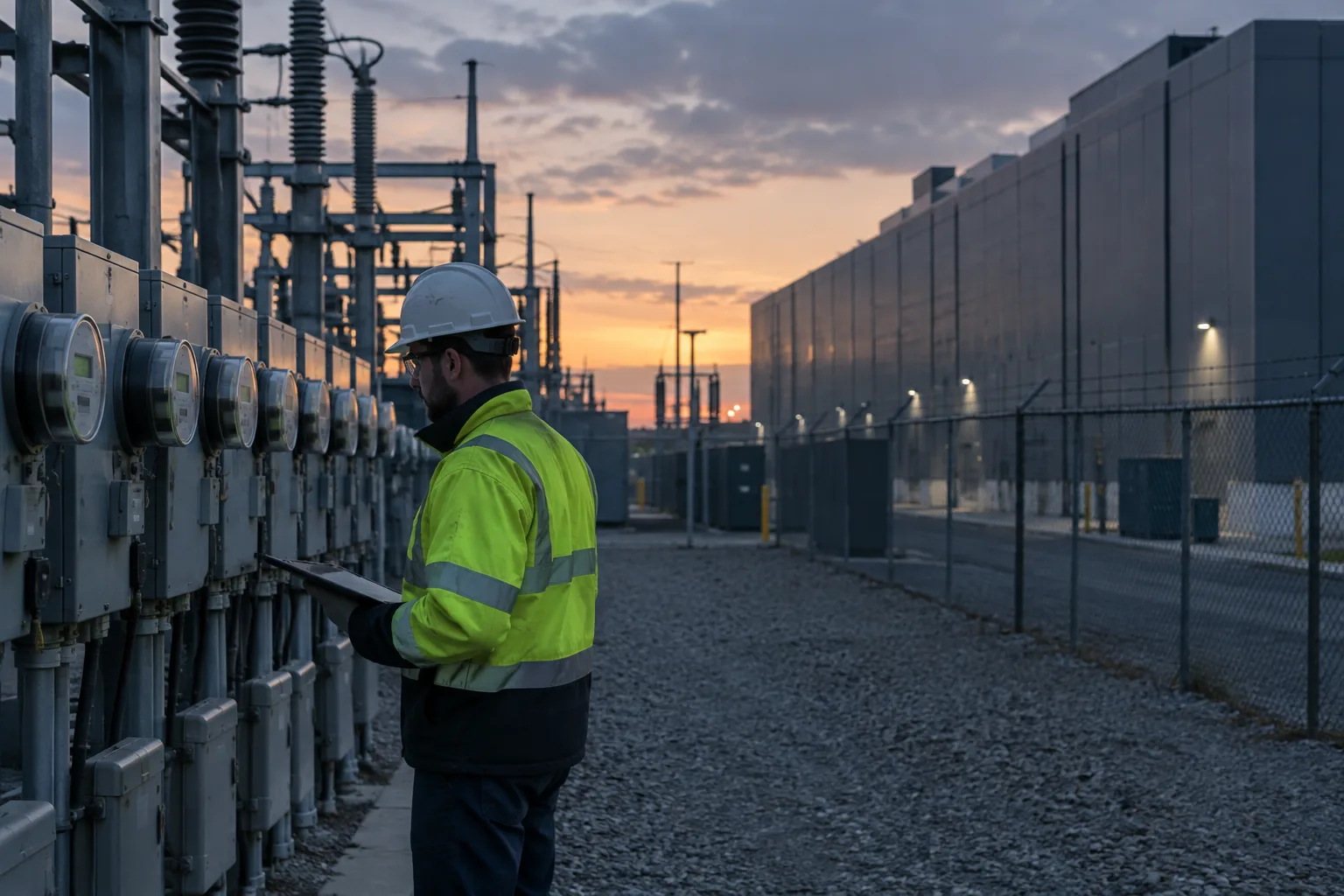

OpenAI is turning data-center power flexibility from a talking point into an operating commitment. As first reported by Axios, the company is launching a Grid Protectors Program for U.S. campuses it directly develops, promising utilities that those sites can cut electricity use when extreme weather or other emergencies strain the grid.
Why it matters: AI infrastructure is running into a hard physical constraint. Utilities are being asked to serve enormous new loads faster than they can add generation and transmission, while regulators and ratepayers want to know who absorbs the reliability risk. OpenAI’s program is an attempt to make a giant AI campus look less like an inflexible demand spike and more like a controllable industrial load.
The real question for readers is whether that bargain works in practice. Can an AI data center give up power on command without undermining the utilization, latency, and economics that justified building it? OpenAI’s answer is not that every workload can be switched off. It is that flexibility can be designed into some campuses from the start, then defined campus by campus in utility contracts. Whether that becomes a genuine grid resource or mostly a politically useful promise will depend on details that are still mostly private.
Georgia is the template, not the whole program
The clearest example is OpenAI’s planned Project Camellia campus in Effingham County, Georgia. Under a Georgia Power contract approved through the state process, the project is expected to require about 3,200 megawatts under a 25-year agreement and to provide up to 1,000 megawatts of flexible demand response. Georgia Power says it can reduce delivered power during certain periods to support grid stability and reduce the need for some new generation resources. Axios compared a 1-gigawatt load reduction with the electricity use of roughly 700,000 homes.
That framing is important because it puts a denominator under the flexibility claim. Even if the Georgia campus delivered the full 1,000-megawatt response, the project would still represent a vast remaining load at its planned scale. “Flexible” does not mean the campus disappears from grid planning; it means a portion of a very large load may be interruptible under defined conditions.
The Georgia agreement also clarifies one cost point. Georgia Power said OpenAI would pay the full infrastructure cost for that contract. That does not settle the broader question of who ultimately carries the cost of generation, transmission, storage, backup supply, or lower asset utilization across the system. But it does show why investors and regulators are paying attention: if large AI buyers shoulder more of the connection cost and offer demand response, utilities may be more willing to connect them sooner.
OpenAI has not said the same template automatically applies everywhere. The reported program covers campuses the company directly develops, not capacity it rents from cloud providers or third-party data-center operators. What “directly develops” means in ownership or operational terms is still unclear.
What interruptible AI actually looks like
This is a demand-response program, not a claim that AI data centers can become power plants. The utility or grid operator signals an emergency or high-demand event, and the campus reduces load according to pre-agreed rules on size, speed, and duration. OpenAI head of energy policy John McCarrick told Axios those terms will vary by campus.
For an AI site, the practical tools are familiar: delay batch training, shift workloads, throttle non-urgent inference, lean on on-site generation or storage, or temporarily idle some equipment. The likely tradeoff is just as familiar. The easier a workload is to interrupt, the easier it is to offer to the grid. Latency-sensitive services and revenue-critical jobs are harder to curtail than batch work that can resume later.
That is why the missing technical baseline matters so much. The public framework does not yet say which workloads are actually interruptible, how much notice a utility gets, how long an event can last, how often events are expected, or what minimum service level must remain available. Those are not minor implementation details. They determine whether the program is a real operating capability or a narrow emergency option that looks large on paper but rarely changes grid planning.
OpenAI’s own policy direction has pointed this way for a while. In a 2025 response to the White House OSTP, the company described its U.S. data centers as designed to be curtailable, potentially reducing their draw or even returning power during peak periods. The new program matters because it moves that idea closer to contract structure. It still does not provide operating data showing how often a campus has curtailed, how cleanly workloads restarted, or what the lost compute output cost.
The fight is really over reliability value and cost allocation
Utilities want flexible load because AI campuses are arriving faster than many systems can build the infrastructure to serve them. A 3.2-gigawatt project is large enough to influence generation procurement, transmission planning, rate design, and local politics on its own. If a utility can count on shedding part of that load during stressed hours, it may be able to connect a campus earlier or defer some capacity additions.
But the grid benefit is only one side of the ledger. Every megawatt made available during a peak event may imply delayed training runs, spare hardware, larger battery systems, backup generation, more complex scheduling software, or compensation payments. Those costs do not disappear just because the curtailment is framed as flexibility. They are either borne by the developer, shared through rates, or pushed into other parts of the system.
That is why utilities, regulators, and large customers should press for a short, practical checklist before treating interruptible AI as a proven model: which workloads can be cut; whether calls are limited to emergencies or include routine peak events; how response is metered, verified, and tested; what penalties apply if the campus cannot curtail; how quickly workloads recover; and who pays for the enabling infrastructure.
Those answers will determine whether OpenAI’s Grid Protectors Program becomes a template other hyperscalers are asked to match. For now, the significance lies less in a promise to use less electricity than in a more consequential offer: to make grid behavior part of how an AI campus is designed and financed. The next stage is not another pledge. It is event records, performance reports, and contracts that show whether a controllable AI load creates measurable reliability value without quietly moving the costs somewhere else.

 By
 By

 By

 By

 By