
NASA has taken a concrete step toward robot teams that do more than wait for instructions. In a summer 2026 field exercise described Sept. 15 by NASA Science, the agency’s ASTRA program tested a drone and two ground rovers at the Virginia Tech Transportation Institute in Blacksburg, Virginia, asking whether the fleet could pursue human-set science goals, react to a new discovery, reassign work, and keep the original mission moving. That matters because for lunar, Martian, and deep-space missions, the hard part of autonomy is not just spotting something interesting. It is deciding what to do next, with limited communications, finite tools, and mission priorities that cannot be improvised away.
The real question for readers is whether this shows a repeatable path to trustworthy science autonomy, or only that a carefully designed terrestrial fleet can handle a favorable scenario under human-defined constraints. Based on NASA’s account, the answer today is promising but incomplete: ASTRA appears to have demonstrated a useful decision architecture for coordinated robots, but NASA has not yet published the reliability, failure-case, or degraded-mode data that would tell a mission manager — or a commercial operator — how close that architecture is to operational trust.
What the test actually demonstrated
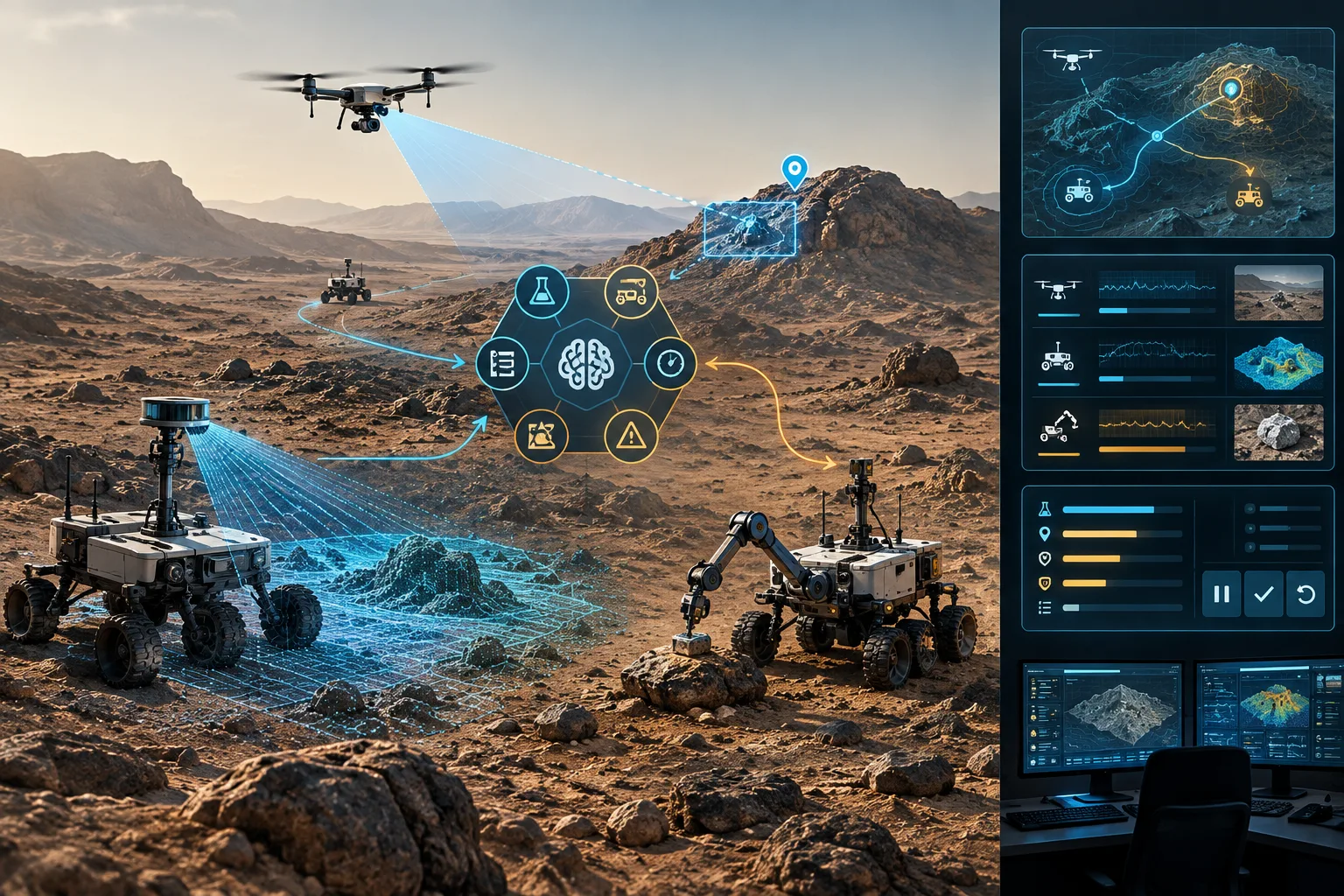
NASA’s setup was intentionally specialized. Human experts began each run by supplying science goals. A drone then scouted from above, using environmental and scientific sensors to choose an area of interest. The fleet’s software weighed the available robotic assets, their distance and speed, environmental hazards, expected scientific payoff, mission priorities, and risk. One rover contributed lidar-based mapping and navigation. The other carried a robotic arm for sample collection.
The key behavior came when the drone identified an additional point of interest. Rather than forcing human operators to micromanage a fresh plan or abandoning the original task, the fleet paused, evaluated the new opportunity, kept the first objective active, and assigned another robot to investigate the second question. NASA’s test was aimed at whether the system could change tasks when new information appeared without losing the higher-priority mission thread. By NASA’s description, that is what happened.
That is more substantial than a basic demo of navigation or target recognition. The interesting part is the decision loop: a human objective becomes machine sensing, then machine evaluation, then task allocation, while human managers stay informed and retain authority over priorities and acceptable risk. NASA says the system also handled subjective inputs — such as how valuable a new scientific observation might be and whether the risk was acceptable to planners — alongside objective facts like robot availability and travel time. Bethany Theiling of NASA Goddard led the campaign with Noblis, Aurora Engineering, and the University of Tulsa.
Why this is really a fleet-coordination story
The larger significance is not that one robot got smarter. It is that NASA is treating autonomy as a systems problem built around a team of specialized machines. A drone can search broadly and cheaply. A lidar rover can reduce terrain uncertainty. A manipulator rover can do the slower, higher-value work of collecting a sample. The autonomy layer’s job is to turn those differences into productive coordination instead of dead time.
That framing matters well beyond space science. For robotics suppliers, mission integrators, defense contractors, infrastructure operators, and field-science teams, the likely product is not a single general-purpose autonomous machine. It is a fleet with a shared mission state, interoperable sensors and tools, and software that can explain why it changed tasks. In that market, raw model accuracy is only part of the offer. Buyers also need to know whether mixed assets can share maps, whether priority rules are explicit, whether audit logs exist, and whether an operator can veto or recover a decision without collapsing the whole mission.
NASA’s use case makes those requirements unusually visible because the communications problem is so unforgiving. Deep-space and planetary missions deal with long delays, limited bandwidth, and conditions the ground team cannot inspect continuously. If a nearby robot can take the next useful measurement while preserving a higher-priority objective, a mission can spend more of its scarce time collecting science instead of waiting for commands. That same logic applies, at lower stakes, to industrial inspection and remote operations on Earth.
The proof still missing
What NASA reported is enough to show a credible architecture under field conditions. It is not enough to settle the harder trust question. The agency did not publish a numerical success rate, the number of scenarios tested, latency from discovery to reassignment, communication-loss performance, localization error, sample-collection accuracy, energy use, or the rate of unsafe or rejected actions. It also did not disclose how much of the system was learned versus rule-based, how the risk model was calibrated, or what level of autonomy a future flight mission would actually require before relying on it.
Those are not academic details. They are the difference between an impressive demo and a capability that can survive procurement review, mission assurance, or certification. A trustworthy path would need evidence that the same behavior repeats across many scenarios, not just one representative vignette. It would need off-nominal testing: what happens when a robot, sensor, communications link, or map becomes unreliable; how priorities are represented when two opportunities compete; what explanations are shown to human operators; and how a human can override, pause, or unwind a machine decision.
The terrestrial analog also matters. A field exercise in Virginia can validate workflow, software coordination, and the human-autonomy interface. It cannot stand in for lunar dust, Martian terrain uncertainty, radiation, thermal extremes, delayed communications, hardware faults, strict energy budgets, or planetary-protection constraints. Those are not small extensions of the same problem. They are the conditions that determine whether graceful fallback is real or theoretical.
For now, NASA’s ASTRA result is best read as a concrete milestone in decision-making architecture. It makes frontier autonomy less mystical and more testable. Organizations evaluating robotic fleets can already use the demo as a checklist: insist on a shared world model, explicit risk and priority policies, deterministic fallback modes, operator override, and logs that explain why a task changed when it did. NASA has shown that a three-robot science team can adapt in a controlled planetary analog. The next step is proving that the behavior is repeatable, bounded, and safe enough to trust when the script runs out.
 By
By
 By
By
 By
By
 By
By
 By
By