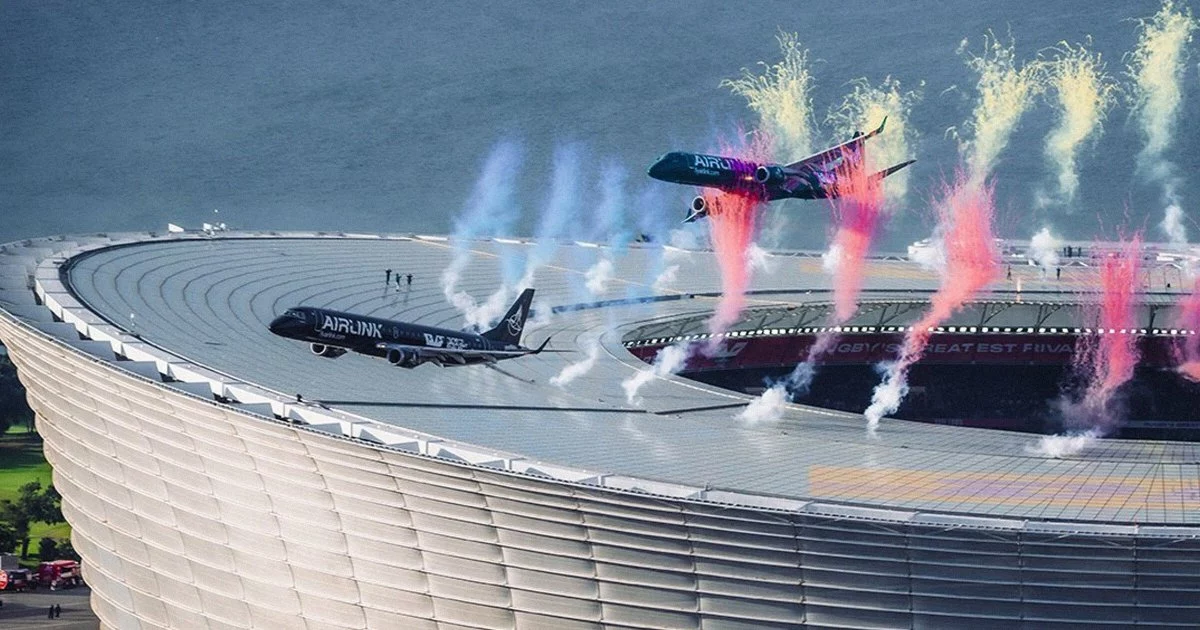

A stadium flyover that turned into a real-time stress test for airline safety governance
The viral footage from Cape Town’s 55,000-seat DHL Stadium did more than capture a dramatic moment at a high-profile rugby match—it exposed how quickly a promotional aviation spectacle can be reframed as a public safety controversy. Two Embraer regional jets operated by Airlink conducted a low-altitude flyover, with one aircraft reported to have passed within roughly 50 feet of the stadium roof. In the age of ubiquitous high-definition video, such proximity is not merely a technical detail; it becomes the entire story.
Airlink, which is backed by Qatar Airways, has emphasized that the maneuver was meticulously planned, staffed by three senior captains per aircraft, and approved by the South African Civil Aviation Authority (SACAA) and Air Traffic Navigation Services (ATNS). Yet the intensity of the reaction—among aviation professionals, regulators, and the public—signals that formal approval alone may no longer be sufficient to secure legitimacy in the court of public opinion.
This is the new reality for commercial aviation: high-visibility operations are judged simultaneously on regulatory compliance, engineering suitability, and perceived prudence. When those three drift out of alignment, the reputational consequences can arrive faster than any official investigation.
Why the aircraft type and operating envelope matter more than the choreography
A central fault line in the debate is not whether the flyover was planned, but whether it was appropriate for the aircraft category. Embraer regional jets are designed for efficient airline operations—optimized for climb, cruise, and descent within tightly regulated commercial profiles. They are not typically associated with the kind of “edge-of-envelope” low-altitude passes that the public associates with airshow-certified aircraft and demonstration teams.
Independent aviation consultants and observers have raised concerns that these jets are not certified for such extreme low-altitude flybys over dense crowds, where the margin for error compresses rapidly. Even if the flight path was technically achievable, critics argue that the risk calculus changes dramatically when:
- Turbulence or localized wind shear develops near a large structure
- A bird strike occurs at low altitude, where recovery options are limited
- A minor engine response lag or control input deviation happens close to obstacles
- Human factors—visual illusions, workload spikes, or timing errors—compound under pressure
This is where the episode becomes more than a single event. It becomes a lens on Safety Management Systems (SMS) and how airlines interpret “acceptable risk” when marketing objectives are involved. The most uncomfortable question for any carrier is not “Did we have approval?” but rather: Did we preserve a safety margin that is visibly and structurally defensible?
Because in commercial aviation, safety culture is often measured not by what an organization can do, but by what it chooses not to do.
Regulation, liability, and the global precedent risk for commercial flyovers
The Airlink flyover controversy also highlights a broader policy challenge: regulators must balance event spectacle with public risk tolerance, and those tolerances are trending downward as video evidence makes near-misses feel immediate and personal.
Even if SACAA and ATNS approvals were properly obtained, the incident may still trigger a regulatory backlash—not necessarily as a rebuke to one airline, but as a protective move to prevent normalization of similar stunts. The likely industry-wide effects include:
- Tighter altitude-and-distance minima for flyovers involving passenger aircraft
- More onerous permitting requirements, including third-party risk assessments
- Increased scrutiny of operator SMS documentation and decision trails
- Higher insurance premiums and more restrictive policy terms for aerial displays
The international dimension matters. Aviation regulators in Europe, North America, and Asia routinely monitor high-profile incidents abroad, especially those involving commercial jets near crowds. Emerging markets, where event marketing can be especially aggressive, may find themselves facing preemptive rulemaking designed to eliminate ambiguity: clear thresholds for altitude, lateral separation, aircraft type, and permissible maneuvering.
For airlines, that translates into a strategic constraint: the cost of a single controversial flyover may be paid not only in reputational capital, but also in future operational flexibility—for the entire sector.
Technology is making “narrative control” obsolete—and raising the bar for responsible spectacle
A decade ago, airlines could often shape the story around special operations. Today, platforms like Flightradar24, combined with synchronized multi-angle smartphone footage, create a near-instantaneous public audit. Every maneuver becomes a data-rich artifact that independent analysts can replay, measure, and critique.
This technological transparency also exposes a subtle but critical mismatch: avionics precision has advanced rapidly, while airframe design limits and real-world hazards—bird activity, microbursts, obstacle proximity—remain stubbornly physical. Modern flight decks can make low-altitude navigation look effortless, but that does not eliminate the underlying risk of operating large jets close to structures and crowds.
The forward-looking lesson is not that aviation marketing must become timid. It’s that spectacle needs a redesign—one that aligns brand ambition with modern risk governance. Airlines and event organizers increasingly have credible alternatives that can deliver impact without compressing safety margins, including:
- Augmented reality (AR) overlays in broadcast feeds
- Drone-based light choreography designed for controlled airspace
- Hybrid experiences that combine stadium effects with virtual flyover simulations
- More explicit board-level oversight when marketing intersects with flight operations
The Cape Town flyover has become a case study in how quickly a promotional moment can evolve into a referendum on airline judgment. In a sector where trust is the ultimate currency, the enduring question is not whether the pass was legal or even technically proficient—it is whether it reflected the kind of restraint that the public expects from commercial aviation operating above a full stadium.

 By
By


 By
By
 By
By
 By
By

 By
By