
Beijing’s robot kitchens move from spectacle to scaled deployment
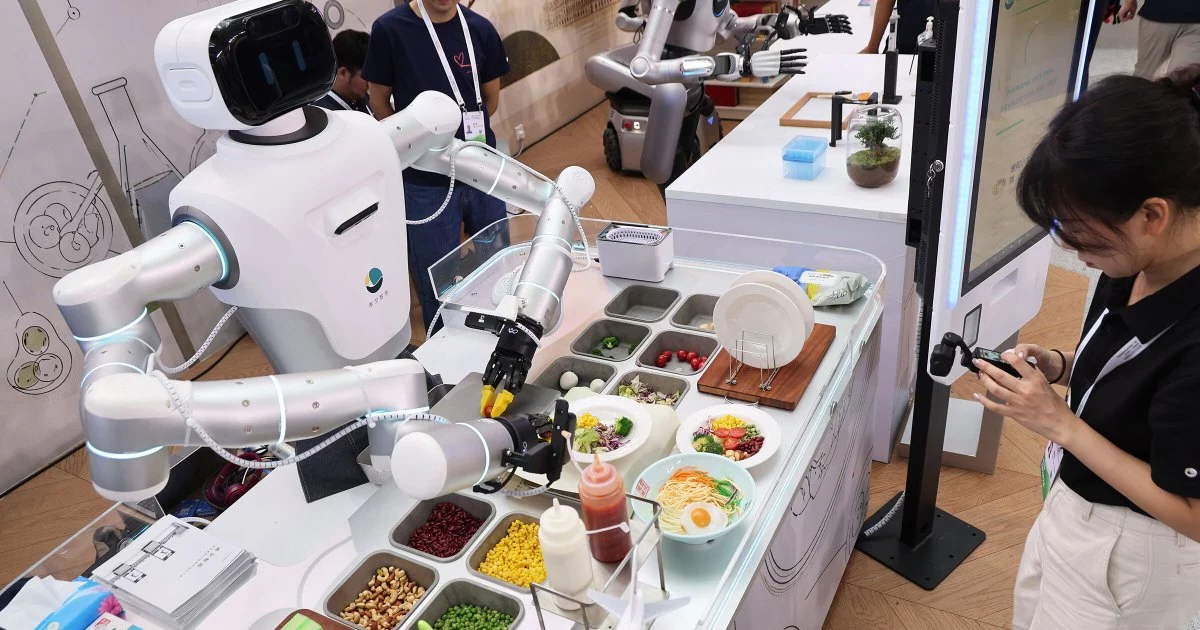
The World Robotics Conference in Beijing offered a clear signal that robotic cooking in China is shifting from prototype theater to operational infrastructure. What stood out was not only the sophistication of the machines, but the evidence of real-world rollout: Oak Deer Robotics—partially state-owned—presented a portfolio that has reportedly reached 300 cities and roughly 4,000 outlets, a scale that reframes “robot chef” from novelty into a repeatable commercial format.
The showcased systems map neatly onto the core layers of an automated food-service stack:
- CookingMuse, positioned as a *multimodal cooking AI*, points to software becoming the orchestrator of kitchen work—interpreting recipes, coordinating steps, and adapting to inputs.
- An AI-driven stir-fry robot featuring a 300°C wok and proprietary dispensing highlights the hard engineering required for Chinese cuisine’s high-heat, high-speed techniques.
- RobotCook, a humanoid chef integrated into a food cart, suggests a pathway toward compact, mobile retail formats that can be deployed where foot traffic is—rather than where kitchens are.
Alongside Oak Deer, Hikrobots demonstrated humanoid service robots assembling fast-food orders, while “Yujian Weilai,” described as Beijing’s first robot-powered noodle shop, illustrated a modular chain: noodle boiling, broth dispensing, and hand-off to delivery robots. Human labor remains in the loop—particularly for ingredient preparation and staging—but the direction is unmistakable: automation is expanding from single-task tools into coordinated, semi-autonomous kitchen workflows.
The technical inflection point: multimodal AI meets high-heat hardware
The most consequential development is the convergence of multimodal AI with resilient kitchen hardware. Historically, food robotics struggled because cooking is not a single repeatable motion; it is a sequence of decisions under uncertainty—timing, texture, temperature, and visual cues. Systems like CookingMuse imply a move toward AI that can integrate:
- Recipe semantics (what should happen next)
- Visual state (what is actually happening in the pan)
- Process control (heat, timing, dispensing, agitation)
This mirrors broader advances in large multimodal models, but the kitchen imposes stricter constraints: mistakes are physical, immediate, and potentially unsafe. That makes the 300°C wok demonstration more than a headline-friendly spec. High-temperature stir-frying demands:
- Thermal safety engineering (insulation, shielding, fail-safes)
- Materials durability under repeated heat cycles
- Real-time control algorithms that can maintain consistency despite variable ingredient moisture and batch size
- Precision dispensing to replicate “hand feel” in seasoning and oil timing
Meanwhile, the emergence of humanoid service platforms—from RobotCook to Hikrobots’ order-assembly units—signals a parallel bet: that flexible, human-shaped mobility and manipulation may eventually reduce the need to redesign every restaurant around fixed robotic arms. In practice, the near-term market is likely to remain hybrid:
- Stationary robotic arms for high-volume, standardized production
- Humanoid or mobile robots for front-of-house tasks, hand-offs, and adaptable workflows
The Yujian Weilai noodle shop concept underscores another key idea: modular automation chains. Rather than building one “do-everything” robot, operators can orchestrate specialized modules—cook, portion, package, dispatch—into an end-to-end system. That architecture is especially compatible with cloud kitchens and dark kitchen ecosystems, where throughput, predictability, and integration with delivery platforms matter as much as ambiance.
Business economics and state-industry dynamics reshape food service
The economic case for kitchen automation in China is tightening. Rising urban wages, shifting demographics, and service-sector labor volatility create pressure for consistent output with fewer staffing bottlenecks. Robotic cooking systems promise:
- Lower unit labor dependency and reduced scheduling fragility
- Consistency at scale, especially for chain operators
- Extended operating hours without proportional labor increases
- Faster service times through parallelized workflows
Oak Deer’s partial state ownership adds a strategic layer. In China’s industrial policy environment, state-industry synergy can accelerate commercialization through easier access to capital, pilot opportunities, and regulatory pathways—advantages that can compound quickly in a market where deployment scale becomes a moat.
Just as important is where value may accrue over time. The premium is likely to migrate from metal and motors toward software economics:
- AI-driven recipe libraries and localized menu tuning
- Real-time quality analytics (temperature curves, timing variance, waste rates)
- Subscription updates to models and process parameters
- Compliance tooling for hygiene monitoring and auditability
In other words, robotic cooking may follow the trajectory seen in other automation markets: hardware becomes the delivery vehicle, while data and continuous software improvement become the defensible advantage.
What to watch next: standards, trust, and exportable “kitchen platforms”
Several forward indicators will determine whether robotic cooking becomes a durable transformation or a segmented niche.
Standardization vs. localization will be a defining tension. Automation thrives on repeatability, yet food demand is culturally and regionally nuanced. The winners may be those who can standardize the *process* while localizing the *output*—using AI to adapt seasoning profiles, portioning, and timing without sacrificing reliability.
Regulatory and food-safety oversight will also rise in importance as autonomy increases. As robots move from assisted operation to higher degrees of independence, markets will likely demand clearer certification regimes—temperature logging, sanitation verification, traceability, and incident reporting. Larger players with compliance resources may benefit, potentially accelerating consolidation.
Workforce transformation is already implicit in the deployment model. As repetitive line tasks are automated, demand shifts toward:
- Robotics maintenance and field service
- AI model training and menu parameterization
- Experience design for human-robot interaction
- Operations roles focused on quality assurance and exception handling
Finally, China’s scale and manufacturing depth create a plausible export pathway. Turnkey robotic kitchen solutions—especially modular systems designed for fast deployment—could appeal to emerging markets facing similar labor constraints, enabling a form of service-automation leapfrogging.
What Beijing’s conference ultimately revealed is not a future of fully empty kitchens, but a near-term reality of software-defined cooking lines—where data, AI orchestration, and resilient hardware combine to make food production more measurable, repeatable, and scalable. The competitive battle now looks less like “robots versus chefs” and more like platforms versus restaurants—a shift that could redefine how food brands are built, operated, and expanded in the decade ahead.

 By
By
 By
By
 By
By
 By
By
 By
By


 By
By