
A warmer Mars below the surface: what “thermal asymmetry” signals about planetary evolution
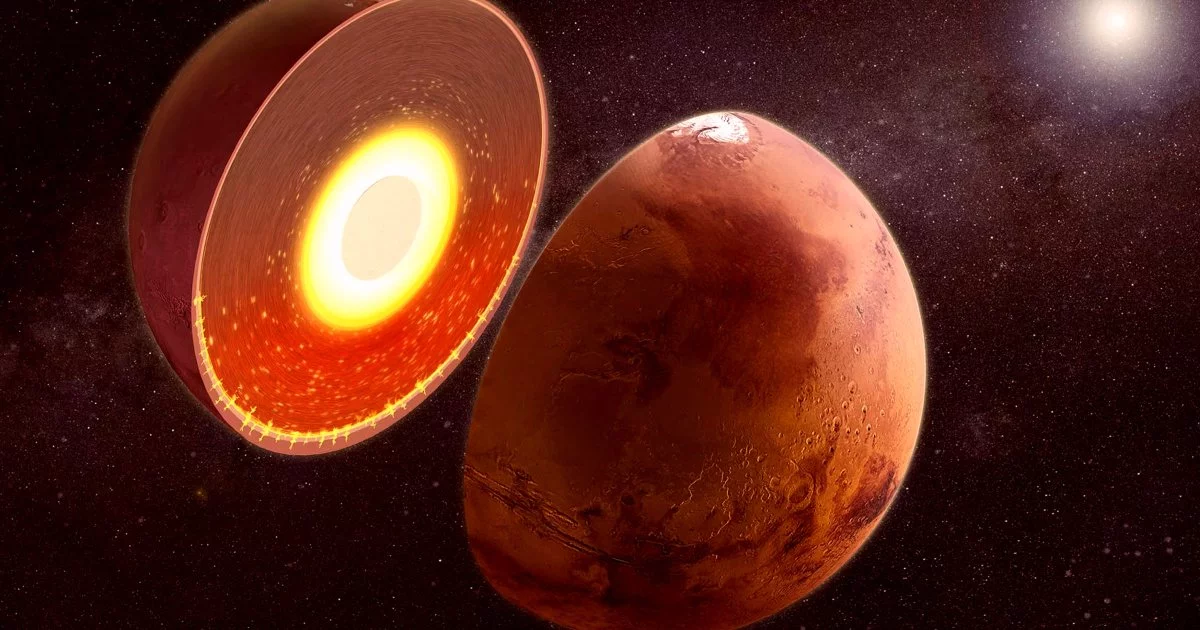
New research published in Nature is sharpening—and complicating—the picture of Mars’s interior. Using gravity data and geological constraints, the study reports a pronounced thermal asymmetry between hemispheres: the southern hemisphere appears to be roughly 400–750 °F (about 200–400 °C) hotter internally than the north. That finding challenges a foundational simplification in planetary science: the assumption that a planet’s interior can be treated as broadly spherically symmetric, with temperature and material properties varying mainly with depth rather than geography.
For Mars, the implications reach far beyond academic modeling. Internal heat governs mantle convection, volcanism, crust formation, and the conditions that may have once supported a global magnetic field—a key factor in atmospheric retention and surface habitability. If the Red Planet’s interior has been thermally lopsided for much of its history, then many “global” narratives about Mars may need to be reframed as hemisphere-dependent stories.
The study’s proposed drivers—ancient large impacts, long-lived mantle convection patterns, and the insulating effect of the southern highlands’ thicker crust—each point to a Mars that is not merely smaller and colder than Earth, but structurally more idiosyncratic. A thick southern crust could act like a thermal blanket, trapping heat and sustaining elevated temperatures over geologic time. Alternatively, deep mantle circulation could have organized into persistent patterns that keep one hemisphere warmer. And if a major early impact reorganized the mantle, it could have left a long-lived thermal scar that still shapes Mars today.
Gravity mapping meets 3D modeling: why this is also a technology story
The headline result rests on a modern toolkit: high-precision gravimetry, combined with three-dimensional inverse modeling and geological interpretation. Gravity anomalies—subtle variations in a planet’s gravitational field—encode information about subsurface density structure. When fused with crustal thickness estimates and surface geology, they can be used to infer interior temperature differences indirectly, because temperature influences density and rock behavior.
This is a reminder that planetary exploration is increasingly driven by data fusion rather than single-instrument breakthroughs. The next competitive edge will come from integrating multiple weak signals into a coherent physical model—an approach that is as relevant to Earth’s subsurface industries as it is to Mars.
Key technological implications highlighted by the research trajectory include:
- Advanced gravimetry and modeling pipelines
– Demand is rising for next-generation satellite gravimeters, improved orbital tracking, and machine-learning–assisted inverse methods that can quantify uncertainty rather than merely produce best-fit maps.
– Better 3D interior models for Mars can translate into improved techniques for Earth applications such as geothermal prospecting, volcanic monitoring, and earthquake hazard characterization, where gravity and deformation data are also fused to infer subsurface structure.
- Instrumentation for deep-subsurface probing
– If Mars’s heat flow varies strongly by hemisphere, then single-point measurements risk being misleading. That increases the value of distributed micro-seismic arrays, heat-flow probes, and potentially borehole sensors designed for low power and high reliability.
– Miniaturization and autonomy become central: Mars missions benefit from instruments that can self-calibrate, survive thermal cycling, and operate with intermittent communications—capabilities that also map well to remote terrestrial deployments.
In practical terms, the study reinforces a strategic shift: Mars science is moving from “Is there heat?” to “Where is the heat, how deep is it, and how stable is it over time?” Those are engineering questions as much as scientific ones.
The business case: ISRU, geothermal prospects, and dual-use innovation
A hotter southern interior does not automatically mean accessible geothermal energy at human-useful depths, nor does it guarantee concentrated reservoirs. But it does elevate Mars’s subsurface from a passive boundary condition to an active variable—one that could influence in situ resource utilization (ISRU) strategies and mission economics.
From an investment and industrial perspective, several threads stand out:
- Space economy acceleration through targeted prospecting
– If thermal anomalies correlate with volatile-rich regions or past hydrothermal systems, they could guide precursor reconnaissance missions aimed at identifying water ice, hydrated minerals, or other strategically valuable materials.
– A more nuanced thermal map could reshape supply chains around deep-drilling systems, thermal management, and subsurface robotics, especially for operations in the southern highlands where crustal properties may differ markedly from northern terrains.
- Dual-use technology spin-offs
– Instruments and algorithms developed for Martian gravimetry and thermal inference can be repurposed for Earth markets:
– Oil and gas and critical minerals exploration (subsurface characterization)
– Geothermal site screening (heat-flow and permeability proxies)
– Natural hazard monitoring (volcanoes, calderas, rift systems)
– This dual-use pathway helps de-risk R&D by expanding the addressable market beyond space agencies and a small number of prime contractors.
The broader economic signal is that planetary interior science—once considered “pure research”—is becoming a platform for commercially relevant sensing, modeling, and robotics.
Mission planning and geopolitics: a new variable in where—and how—we go next
Thermal asymmetry introduces a planning constraint and an opportunity. Landing-site selection has traditionally balanced safety, science return, solar availability, and communications geometry. A hemisphere-scale heat difference adds another layer: subsurface temperature gradients can affect drilling feasibility, instrument performance, and long-duration infrastructure design.
Strategically, the research points toward several forward-leaning priorities:
- High-resolution Mars gravity missions to resolve anomalies at finer spatial scales, enabling more targeted identification of potential geothermal hotspots or hydrological basins.
- In situ thermal drilling demonstrators—not as full-scale mining efforts, but as proof-of-concept systems to validate model predictions with direct heat-flow and crustal measurements.
- Cross-planet comparative interior studies linking Mars, the Moon, and Earth to derive general principles of mantle evolution and crustal insulation—knowledge that can inform both planetary science and resilient habitat engineering.
As Mars exploration matures into a contest of sustained capability—orbital infrastructure, autonomous surface operations, and eventually human-tended assets—planetary interior intelligence becomes a form of strategic advantage. The teams that can map heat, infer structure, and translate models into operational decisions will shape not only the next decade of Mars science, but the emerging rules of engagement for a transplanetary space economy.
 By
By
 By
By
 By
By
 By
By

 By
By