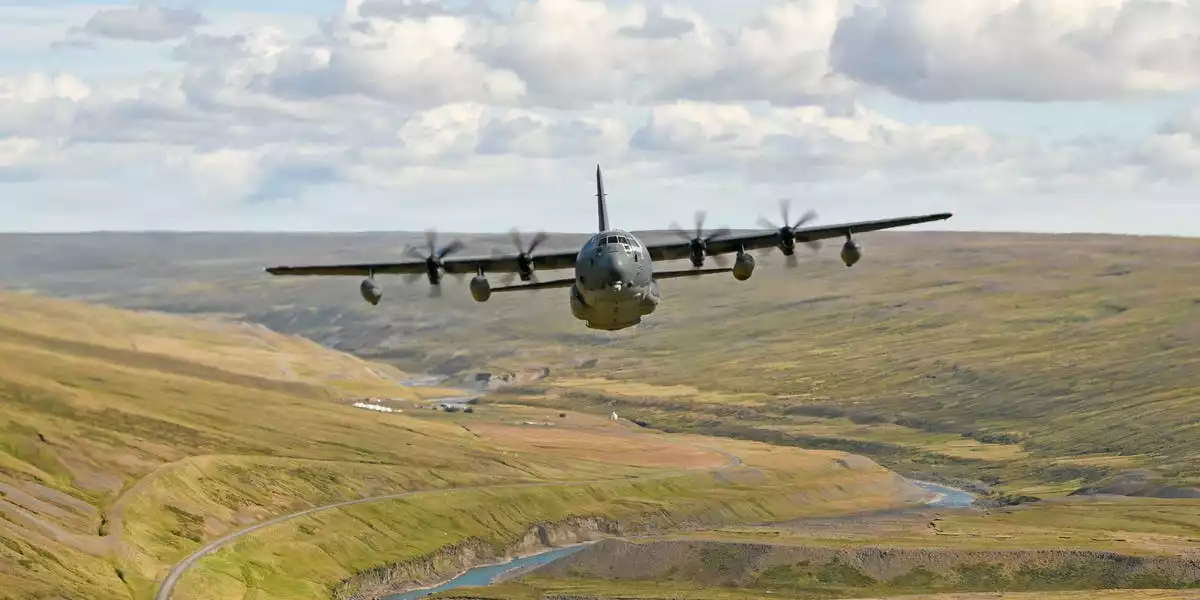

Northern Viking 2026 and the quiet reinvention of contested resupply
Exercise Northern Viking 2026 in Iceland has become a revealing testbed for an emerging logistics idea: powered gliders—unpowered or lightly powered aircraft designed to deliver cargo over long distances with a low acoustic, thermal, and electromagnetic signature. For U.S. Air Force Special Operations forces, the appeal is straightforward but strategically significant: sustain small, distributed teams in austere terrain without advertising their location through the very logistics meant to keep them alive.
Unlike traditional parachute drops that can be imprecise, weather-sensitive, and conspicuous, a powered glider concept can be released from an overhead “mothership” aircraft and then navigate quietly to a designated point, carrying mission-critical payloads such as:
- Medical supplies and blood products
- Batteries, communications gear, and spare parts
- Rations and water purification equipment
- Construction and shelter materials for temporary positions
The Air Force has not publicly named the model under evaluation, but the effort clearly builds on earlier U.S. Army Special Forces experimentation with glider drones such as “Grasshopper.” The connective tissue between these initiatives is the Pentagon’s broader push to make logistics viable when air superiority is uncertain, GPS is degraded, and electronic emissions are hunted.
Why powered gliders matter: stealth logistics meets autonomy and modular design
At a technical level, powered gliders sit at the intersection of three trends reshaping aerospace and defense innovation: composites, electric or hybrid propulsion, and autonomous navigation software. Their value proposition is not raw speed or payload mass; it is the ability to move essential cargo in ways that are harder to detect, track, and disrupt.
Key technological implications stand out:
- Low-signature delivery profiles
Powered gliders can reduce the operational “noise” of resupply—less engine heat, fewer radio transmissions, and near-silent glide phases. In contested environments where adversaries deploy persistent ISR and electronic warfare, this matters as much as range.
- Precision without heavy logistics overhead
Rotary-wing aircraft provide flexibility but impose steep costs in fuel, maintenance, and risk. Gliders extend the reach of fixed-wing platforms without requiring the same forward basing footprint, offering a lighter logistics tail—a central requirement for distributed operations.
- Autonomy that adapts under pressure
Modern autonomy—much of it matured in the civilian drone ecosystem—enables rerouting around threats, terrain, or no-fly zones. Even when GPS is denied or spoofed, multi-sensor navigation and preplanned guidance can support high-accuracy deliveries with reduced operator exposure.
- Modular payload architecture
A modular bay design supports rapid mission reconfiguration, allowing the same airframe concept to deliver medical kits one day and engineering supplies the next. That modularity also makes the platform attractive for coalition standardization—common cargo interfaces and handling procedures become feasible across NATO partners.
The deeper point is that logistics is increasingly treated as a survivability problem, not merely a transportation problem. In modern conflict, the resupply route is often the most predictable—and therefore the most targetable—part of an operation. Powered gliders are an attempt to make resupply less predictable, less detectable, and more distributed.
The Arctic business case: procurement signals, supply chains, and dual-use spillover
The Arctic context is not incidental. As melting ice opens new sea lanes and intensifies resource competition, the region’s strategic salience is rising—and with it, the need to sustain forces operating far from dense infrastructure. That requirement is pushing defense procurement toward niche, scalable systems that can be fielded quickly, iterated rapidly, and purchased in smaller batches than traditional aircraft programs.
From an economic and industrial perspective, powered gliders align with several procurement realities:
- “Small acquisitions, rapid fielding” momentum
Rather than betting exclusively on large programs of record, defense buyers are increasingly funding adaptable systems that can be tested, refined, and deployed in cycles. Powered gliders fit that model: relatively modest unit economics, fast iteration, and mission-specific customization.
- A widening supplier ecosystem
Demand concentrates in areas where commercial innovation is already accelerating:
– Lightweight composite materials
– Electric propulsion components and power electronics
– High-reliability batteries suited for cold-weather performance
– Secure communications modules and resilient navigation stacks
– AI-enabled flight controllers and autonomy toolchains
- Cost-benefit dynamics beyond sticker price
While early unit costs may exceed simple parachute-drop systems, the total-cost-of-ownership argument strengthens when factoring in reduced cargo loss, improved precision, and stealth attributes that lower operational risk in high-end missions.
The dual-use potential is also difficult to ignore. Many of the same capabilities—precision delivery to remote locations, minimal infrastructure requirements, and autonomy—translate into civilian applications such as humanitarian relief, resupply of remote scientific stations, and logistics support for energy infrastructure maintenance in harsh environments. As reliability data accumulates, insurance and regulatory pathways for analogous civilian systems may become more favorable, reinforcing commercial adoption.
Strategic implications: distributed operations, NATO interoperability, and the next logistics frontier
Powered gliders are best understood as a logistics enabler for a broader doctrinal shift: distributed operations. Concepts such as Expeditionary Advance Base Operations (EABO) and Distributed Maritime Operations (DMO) depend on small units that can move, hide, and persist—without relying on predictable supply lines.
In that context, low-signature resupply becomes a deterrence tool. It signals that forward teams can be sustained even when adversaries attempt to interdict conventional logistics through:
- Anti-access/area-denial (A2/AD) systems
- Electronic warfare and GPS disruption
- Persistent ISR and targeting networks
Northern Viking’s coalition setting adds another layer: interoperability. Joint trials in Iceland can help align standards for cargo interfaces, flight-control protocols, and data-link security—practical foundations for coalition logistics in the High North and other contested theaters.
Looking ahead, the most consequential evolution may be functional convergence. Powered gliders could become more than delivery vehicles—potentially serving as expendable carriers for sensors, communications relays, or other payloads that extend situational awareness while sustaining the force. If paired with swarming UAV concepts, they hint at a future where logistics itself becomes a networked, semi-autonomous system—less a convoy, more a distributed chain of airborne nodes.
What’s unfolding in Iceland is not simply a new way to drop supplies. It is a measured attempt to redesign the logistics equation for an era where detection is cheap, disruption is constant, and endurance depends on staying quiet while remaining supplied.

 By
By
 By
By
 By
By
 By
By

 By
By

 By
By