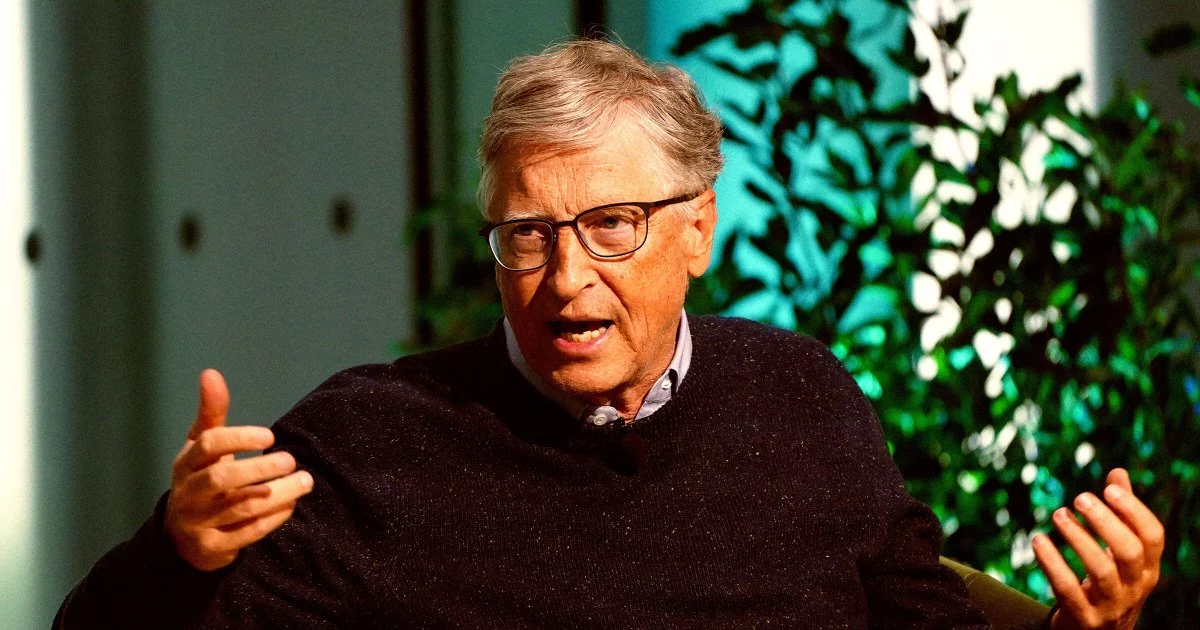

Gates’s warning reframes AI as a systemic shock, not a software upgrade
Bill Gates has long been associated with technology’s capacity to expand opportunity, but his recent remarks strike a markedly different register: artificial intelligence may generate “unprecedented turbulence” across labor markets, economic stability, and even global security. The significance is not that a prominent technologist is urging caution—many do—but that Gates is arguing the current AI wave is qualitatively different from prior industrial revolutions, with a credible risk of *net job losses across virtually every field*, not merely job churn between sectors.
At the center of this argument is a shift from automation to autonomy. Generative AI systems are no longer confined to repetitive tasks or narrow prediction problems; they increasingly function as general-purpose cognitive tools that can draft, code, summarize, plan, and coordinate. In business terms, this expands AI’s addressable impact from “process efficiency” to workflow redesign, where entire job architectures can be reassembled around machine capabilities.
This is where Gates’s critique of industry posture lands: he suggests a dangerous complacency among tech executives, reinforced by financial incentives to emphasize upside and minimize disruption. Whether one accepts the full severity of his forecast, the underlying governance question is difficult to avoid: if AI is becoming a foundational layer of economic activity, then downplaying second-order effects—employment displacement, security externalities, social backlash—becomes not just a communications risk, but a strategic miscalculation.
Key implications for business and technology leaders include:
- AI diffusion is broad, not vertical: unlike mechanization or early IT, generative AI targets cognitive and creative tasks across functions.
- The speed of adoption compresses adjustment time: labor markets and institutions typically adapt slowly; AI capabilities are scaling quickly.
- Public tolerance is finite: visible harms—mass layoffs, safety failures, misuse—can trigger regulatory and consumer backlash that constrains long-term innovation.
Labor-market disruption and the new economics of “middle-skill” work
Gates’s most provocative claim is that AI may not simply “augment” workers but replace them at scale, including in roles historically protected by judgment, communication, and domain nuance. This points to a structural challenge: if AI systems can perform a widening range of white-collar tasks at marginal cost, then the traditional career ladder—entry-level to mid-level to leadership—can be destabilized from the bottom and hollowed out in the middle.
The likely near-term pattern is not uniform unemployment, but polarization:
- A premium on roles that orchestrate AI (model governance, AI product management, workflow engineering, security, compliance).
- Downward pressure on roles where work is text- and decision-heavy, standardized, or easily decomposed into repeatable components.
- A growing cohort of workers facing retraining cycles that lag market needs, especially where credentials, licensing, or institutional pathways move slowly.
Gates also gestures toward a macroeconomic tension that many executives underestimate: even if AI boosts productivity, aggregate demand can weaken if wages stagnate or employment contracts faster than new categories of work emerge. This is the “productivity paradox” in a new form—where output per worker rises, but the distribution of gains and the pace of labor absorption determine whether growth feels broadly shared or socially destabilizing.
For companies, the strategic question becomes less “Should we adopt AI?” and more: How do we adopt AI without eroding the human capital pipeline that sustains the enterprise? Practical steps increasingly discussed in boardrooms include:
- Skills inventories tied to task-level mapping (what is automated, what is augmented, what is redesigned).
- Internal talent marketplaces to redeploy workers into AI-adjacent roles.
- Partnerships with public agencies and educators for credentialed reskilling, not ad hoc training.
Bio-digital convergence: AI-enabled biothreats move from fringe to board-level risk
Perhaps the most consequential element of Gates’s warning is not economic but security-related: the prospect that AI could accelerate engineered pandemics and bioterrorism. His forthcoming work on AI-enabled biothreats underscores a convergence that many corporate risk frameworks still treat as distant—computational power meeting life-science capability in ways that shorten the path from intent to execution.
The risk is not that AI “creates a pathogen” in isolation, but that it can:
- Speed up biological design and optimization through modeling and simulation.
- Lower barriers to expertise by making complex protocols more accessible.
- Increase the scale and sophistication of malicious experimentation when paired with available lab infrastructure.
This shifts biosecurity from a niche government concern to a cross-sector resilience issue, especially for industries tied to supply chains, healthcare, travel, food systems, and critical infrastructure. It also reframes “AI safety” beyond model hallucinations or bias, toward dual-use capability management—the uncomfortable reality that the same tools that accelerate drug discovery can also accelerate harmful design.
The governance response implied by Gates’s argument is more integrated than today’s typical compliance playbook:
- Real-time monitoring and threat intelligence that treats AI misuse as a dynamic risk.
- Stronger laboratory controls and auditability where AI intersects with sensitive biological work.
- Cross-disciplinary “red teaming” that includes biosecurity expertise, not only cybersecurity.
The corporate governance test: social license, regulation, and competitive positioning
Gates’s critique of tech leadership—suggesting internal alarms are muted to protect investment flows—lands on a central tension in modern corporate governance: risk externalities versus shareholder returns. As AI becomes embedded in products and operations, boards will be pressed to treat AI risk as a fiduciary matter, not a reputational afterthought.
This is also where competitive dynamics sharpen. Companies that move early on responsible AI practices can build a durable advantage—what might be called a trust moat—through:
- Transparent third-party audits and model evaluations
- Documented impact assessments for high-risk deployments
- Operationalized incident response for AI failures and misuse
- Clear accountability structures, such as board-level AI oversight committees
Meanwhile, the geopolitical environment is fragmenting. The EU’s risk-based regulatory approach, China’s model-centered controls, and evolving U.S. frameworks create a complex compliance map for global firms—alongside export controls, data localization, and security-driven procurement. In that environment, “move fast” strategies can become liabilities, while disciplined governance becomes a route to market access.
Gates’s intervention ultimately reads as a bet on realism: that AI’s promise—productivity, discovery, improved services—will only endure if institutions and companies treat disruption and misuse as core design constraints. The firms that navigate this moment best will not be those that simply deploy the most models, but those that engineer resilience into their workforce strategy, security posture, and governance architecture as AI reshapes the operating landscape.

 By
By
 By
By


 By
By
 By
By

 By
By