
America’s shifting tech mood: from awe to scrutiny of AI and data center expansion
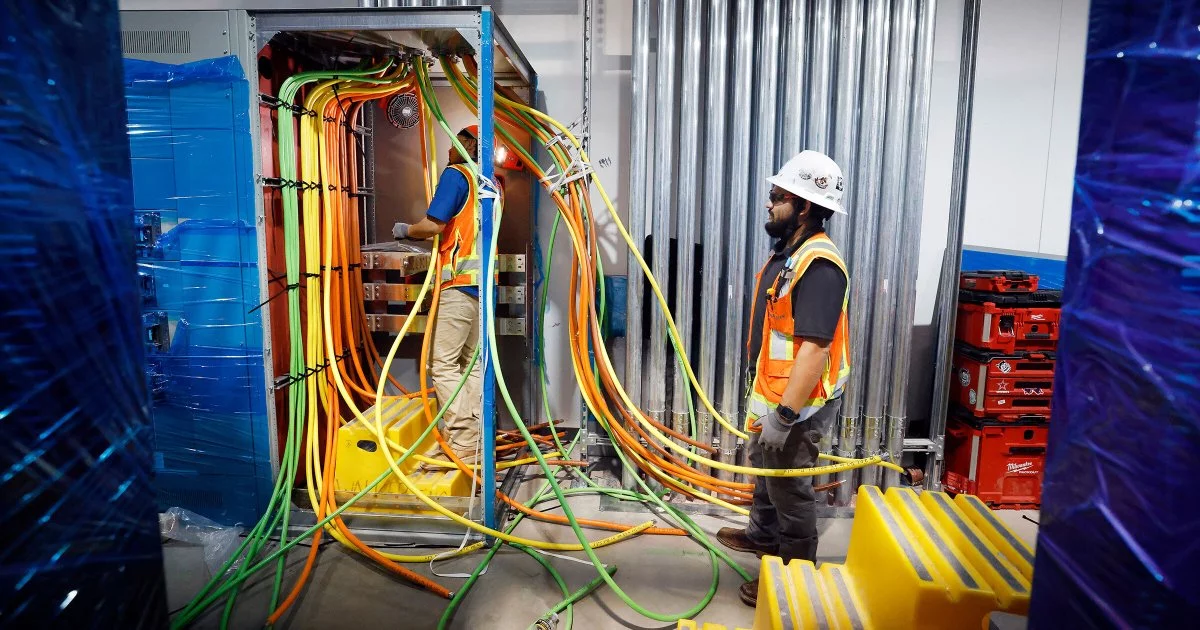
The United States is entering a more skeptical phase of its relationship with Big Tech—one shaped less by fascination with breakthrough demos and more by a practical accounting of who bears the costs of AI. The flashpoint is not only the behavior of algorithms, but the physical and civic footprint of the AI economy: hyperscale data centers, transmission upgrades, water-intensive cooling, land use, and the perception that communities are being asked to accommodate industrial-scale infrastructure without commensurate local benefit.
Political strategists are already treating the emerging backlash as a live risk—something to be managed before it hardens into durable anti-tech coalitions. Capital markets are also beginning to price in a new variable: public animus as a constraint on growth, particularly for projects that require permits, zoning approvals, and long-term power contracts. This is a notable evolution from the last decade, when tech’s expansion often appeared frictionless, buoyed by consumer enthusiasm and a broad assumption that digital growth was inherently “cleaner” than traditional industry.
Against that backdrop, optimistic executive messaging—such as Meta CEO Mark Zuckerberg’s vision of AI-driven productivity unlocking a world of leisure—lands differently than it once did. The public’s question is increasingly not “What can AI do?” but “What will AI demand from our grids, our water, our jobs, and our institutions—and what do we get back?”
The credibility gap: why AI optimism is colliding with environmental and social realities
A growing faction of AI leaders acknowledges the disillusionment, but the debate over causality matters. Some, including Anthropic CEO Dario Amodei, have pointed to external critics and misunderstanding as drivers of distrust, while advocating for transparency and ethical guardrails. Those measures are important, but they do not fully address the deeper grievance: a widening hype-to-reality gap in which promised societal gains feel abstract while the downsides feel immediate and local.
Several dynamics are converging:
- Infrastructure footprint vs. innovation imperative: AI capability is being pursued through scale—more compute, more energy, more specialized chips—at the very moment when communities and regulators are more sensitive to emissions, water use, and grid reliability.
- Unmet societal promises: Productivity gains are often discussed at a macro level, while households experience inflationary pressure, job insecurity, and a sense that corporate power is consolidating rather than distributing opportunity.
- Perceived corporate overreach: The combination of ubiquitous data collection, opaque model behavior, and concentrated market power can read as a governance problem, not merely a technology problem.
In this environment, governance becomes a product feature. Not in the narrow sense of compliance checklists, but as a competitive differentiator: companies that can demonstrate energy discipline, auditability, and community accountability may find themselves better positioned than those that treat trust as a marketing layer applied after the fact.
Capital, regulation, and the “social license to operate” as a balance-sheet variable
For investors and lenders, the emerging backlash is not just reputational—it is operational. Data centers and AI infrastructure are long-lived assets with multi-decade assumptions about power prices, utilization, and regulatory stability. If local opposition delays projects, if municipalities tighten zoning, or if carbon and water constraints become binding, the economics shift quickly.
Key economic implications now coming into focus include:
- Cost of capital and regulatory externalities: Community resistance can translate into higher permitting costs, stricter environmental reviews, local carbon levies, or requirements to fund grid upgrades. These are no longer edge cases; they are becoming plausible base-case scenarios in project finance.
- Valuation re-anchoring: If sentiment continues to sour, tech valuations may increasingly reflect conservative assumptions about growth ceilings, regulatory headwinds, and the cost of maintaining legitimacy. In practical terms, “social license to operate” starts to resemble a line item in discounted cash flow models.
- Partnerships as de-risking mechanisms: Alliances with utilities, healthcare systems, and agricultural operators can convert AI from a generalized promise into measurable outcomes—while distributing oversight and reducing the perception of unilateral corporate control.
This is also where the AI industry’s dependence on the broader U.S. digital economy becomes a constraint. The country’s competitiveness narrative is now intertwined with compute capacity, but that same dependence can incentivize a “build at all costs” posture—precisely the approach most likely to intensify public resistance.
The strategic pivot that could reset AI’s trajectory: proof, participation, and sustainable compute
If the industry wants to avoid a prolonged legitimacy crisis, it will likely need to shift from persuasion to demonstration—moving beyond visionary claims toward verifiable, community-visible wins. That pivot has three pillars.
AI leaders can narrow the credibility gap by prioritizing pilots with measurable outcomes in high-trust domains, such as:
- healthcare diagnostics and hospital workflow optimization
- renewable energy forecasting and grid demand-response
- precision agriculture and predictive yield platforms
- disaster-response mapping and public safety logistics
Authentic stakeholder engagement is not a town-hall formality; it is a design input. Companies that embed third-party audits, transparency reporting, and community-centric data governance into their operating model will be better positioned to shape emerging standards rather than scramble to meet them.
The next frontier is not only smarter models, but smarter compute—energy efficiency, advanced cooling, and architectures that reduce grid strain. Modular and edge-ready deployments can lower land-use conflict, improve resilience, and reduce the visibility of “AI buildout” as a single, imposing industrial project.
The industry’s central challenge is straightforward: AI cannot remain a story about future abundance while its present-day footprint feels extractive. The companies that treat sustainability, transparency, and shared value as core engineering and investment constraints—not peripheral ESG messaging—are the ones most likely to preserve momentum, retain political room to operate, and earn durable public consent in the next phase of the AI economy.

 By
By

 By
By
 By
By
 By
By

 By
By