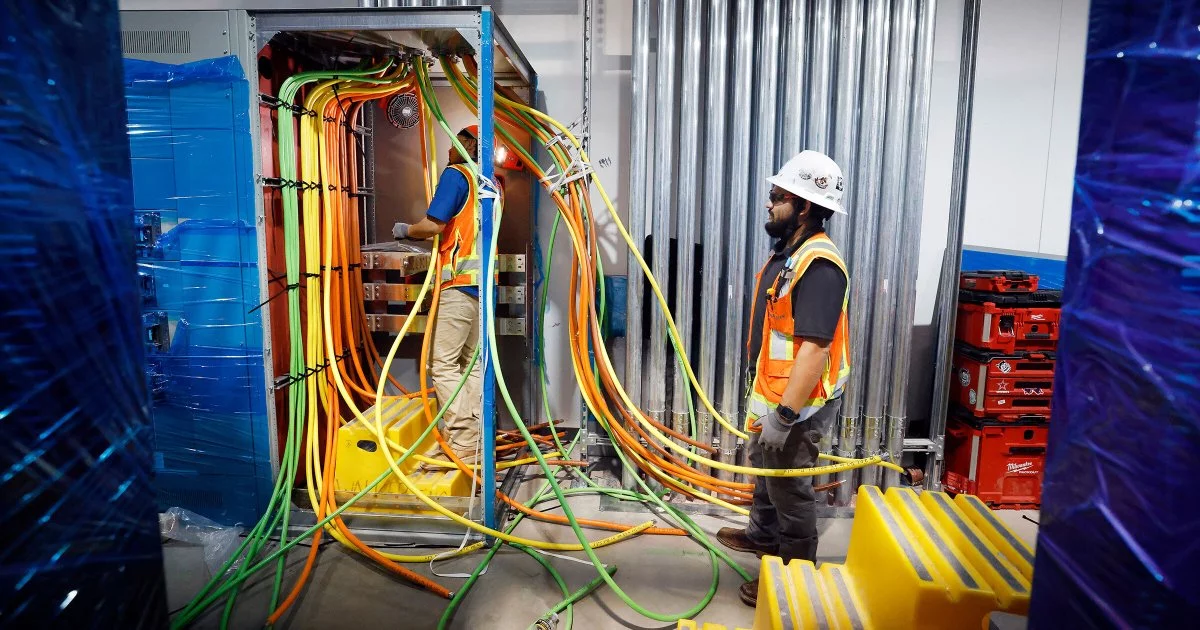

Trump’s data-center push meets a new kind of local power politics
President Donald Trump’s recent endorsement of accelerated data-center construction—and his blunt critique of communities that resist it—lands in a moment when hyperscale computing has become both critical infrastructure and a flashpoint of local governance. The political subtext is hard to miss: what once looked like a straightforward pro-growth, pro-technology position is now colliding with voter concerns about land use, water, energy prices, and perceived corporate overreach.
The emerging tension is not simply “tech versus towns.” It is a three-way negotiation among national industrial ambition, regional utility constraints, and community expectations about what economic development should deliver. In swing-state environments such as Ohio, where data-center proposals can be highly visible and locally contentious, the issue is increasingly electoral: Republican strategists worry that an unqualified pro-expansion posture could alienate constituents who otherwise align with the party on jobs, cost of living, and local autonomy.
For business leaders, the message is equally direct: the era when a data center could be framed as an unambiguous civic win is fading. The sector’s “social license to operate” is becoming conditional—measured not by press releases, but by grid impacts, water accounting, and credible community benefits.
The AI compute boom: hyperscale demand, edge alternatives, and infrastructure stress
The underlying driver is structural: the global AI arms race and the rapid deployment of generative AI models have created unprecedented demand for compute capacity. Hyperscale data centers—often built around dense GPU clusters and specialized accelerators—are now mission-critical to cloud providers, enterprise AI programs, and research labs. In practical terms, this is the physical layer of modern digital competitiveness.
Yet the industry’s architectural debate is widening. Alongside hyperscale campuses, strategists are exploring edge computing and distributed designs to reduce latency, improve resilience, and place compute closer to end users and industrial systems. Local opposition to large facilities can accelerate this shift, making modular and containerized micro-data centers more attractive where zoning, water availability, or transmission constraints limit hyperscale expansion.
What is changing most quickly is the public visibility of infrastructure strain. Communities and regulators are focusing on:
- Power grid load and peak demand: Large campuses can reshape regional load profiles, triggering upgrades, interconnection delays, and scrutiny of who pays for transmission and distribution improvements.
- Water use and cooling technology: Evaporative cooling, closed-loop systems, and emerging approaches such as liquid immersion cooling are no longer technical footnotes—they are central to permitting and public acceptance.
- Carbon and renewable integration: Claims of “clean” growth increasingly hinge on verifiable renewable procurement, on-site generation, and storage—especially as AI workloads drive higher utilization and round-the-clock demand.
This is why the data-center conversation is migrating from economic development offices to utility commissions, planning boards, and environmental review processes—institutions designed to arbitrate tradeoffs, not celebrate growth.
Economic reality check: taxes, jobs, and the subsidy calculus
Trump’s argument emphasizes job creation and tax revenue, and it is true that data centers can raise assessed property values and generate meaningful facilities-use taxes. But the local economic multiplier is often more nuanced than political messaging suggests.
Operational headcount is typically modest relative to capital intensity. Construction phases can employ large numbers of workers, but those jobs are temporary, and the long-term staffing footprint can be comparatively small—often centered on facilities maintenance, security, and network operations. That gap between headline investment and permanent employment is a key reason some communities question whether the tradeoffs are worth it.
The fiscal story is equally complex because many jurisdictions compete aggressively for projects through incentives, including:
- Property-tax abatements and exemptions
- Utility rate concessions or credits
- Land-use accommodations and expedited permitting
This can create a subsidy race that compresses long-term public revenue, especially if incentives outlast the period when localities absorb the most disruption (construction traffic, land conversion, infrastructure upgrades). For residents, the question becomes less “Is investment coming?” and more “Who captures the value, and who carries the costs?”
Environmental externalities sharpen that calculus. Without credible clean-energy alignment, large-scale deployments can increase regional emissions and intensify water stress—particularly in areas where drought risk, watershed limits, or competing industrial demand already exist. In that environment, community skepticism is not inherently anti-technology; it is often a demand for transparent accounting and enforceable commitments.
What executives and policymakers will be forced to negotiate next
The political implications are not confined to one party, but Trump’s endorsement spotlights a growing identity tension inside the GOP: free-market expansionism versus populist localism. That split mirrors a broader bipartisan shift in which voters increasingly evaluate technology projects through the lens of control, fairness, and resilience, not just innovation.
For the tech sector, the reputational stakes are rising. Data centers are becoming symbolic of a wider narrative about tech’s footprint—touching privacy anxieties, corporate influence, and environmental stewardship. That makes community engagement a strategic function, not a public-relations afterthought.
Several forward-looking moves are likely to define the next phase of U.S. data-center growth:
- More rigorous site selection that treats water availability, grid capacity, and community infrastructure as first-order constraints.
- Hybrid infrastructure portfolios, blending hyperscale with edge nodes and smaller footprints to reduce siting friction and improve service performance.
- Clean-energy and resilience alignment, leveraging federal incentives—such as Inflation Reduction Act pathways—to integrate renewables, storage, and demand-response capabilities.
- Regulatory evolution, including tighter water-use permitting, zoning restrictions, and grid-interconnection requirements, as municipalities seek predictable guardrails.
- Electoral mapping and policy engagement, as data-center policy becomes a campaign issue in battleground districts and statehouses.
The strategic takeaway is that the data-center boom is no longer just a technology story—it is a governance story. The winners will be operators and policymakers who can translate AI-era infrastructure into verifiable local value, while proving that growth does not come at the expense of grid stability, water security, or democratic consent.

 By
By


 By
By
 By
By


 By
By