
Housing’s latest warning lights: demand softens as supply capacity tightens
Fresh indicators from the U.S. housing market are flashing a dual signal: buyer demand is weakening while the industry’s ability to add supply is deteriorating. Pending home sales have fallen to a three-year low, and new residential starts have slid to their weakest level in roughly 3½ years. These are not isolated data points; they reflect a market caught between affordability constraints and a production pipeline that is increasingly fragile.
On the demand side, the familiar culprits remain firmly in place. Persistent inflation has eroded household purchasing power, while real wage growth has struggled to keep pace, leaving many would-be buyers unable—or unwilling—to absorb today’s monthly payment realities. Even where mortgage rates stabilize, the affordability equation remains unforgiving: elevated prices, higher insurance and tax burdens in many regions, and tighter household budgets combine to suppress transaction volume.
Yet the more structural concern is emerging on the supply side. Land costs and permitting delays have long been the industry’s slow-moving bottlenecks. Now, labor scarcity is becoming the binding constraint, introducing a new ceiling on how quickly builders can respond even if demand returns. The result is a housing market that risks staying “undersupplied by design,” not because developers lack interest, but because the workforce required to build at scale is being pulled elsewhere.
The AI data center boom and the new labor premium reshaping skilled trades
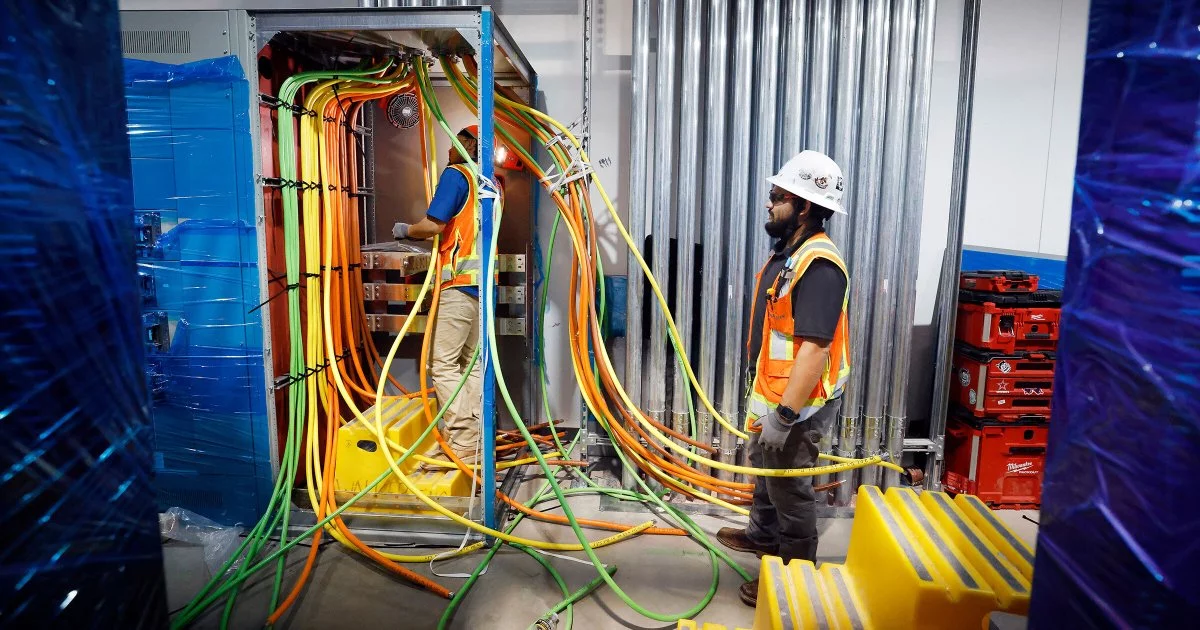
The most consequential “elsewhere” is the rapid build-out of artificial intelligence data centers—a capital-intensive infrastructure race that is creating a powerful wage and career gravity for skilled tradespeople. With an estimated 300,000 vacancies across the trades, the migration of electricians, HVAC specialists, and structural installers from residential construction into tech-adjacent projects is intensifying a labor squeeze that began after the Great Recession and never fully healed.
Several dynamics make AI infrastructure uniquely competitive in the labor market:
- Cross-sector labor arbitrage: Data center projects often offer higher wages, stronger benefits, and clearer long-term pipelines than cyclical residential work. For tradespeople weighing stability, the tech ecosystem can look like a safer bet.
- Compressed build cycles: Tech firms are pushing to deploy AI capacity quickly, relying on turnkey construction models and prefabricated modules. Speed becomes a strategic advantage, and speed requires labor—immediately.
- Talent siphoning from modular expertise: The same prefabrication and modular construction skills that could help housing scale faster are being recruited into data center assembly, where standardization and repeatability are already deeply embedded.
This is not merely a story of “construction vs. tech.” It is a story of which end-market can pay more for the same scarce capabilities, and how that competition reorders priorities across the real economy. Data centers, in effect, are bidding up the price of the very labor housing needs to expand supply and ease affordability.
Inflation, project delays, and regional fault lines: the macro impact of a micro labor shift
When skilled labor becomes scarce, the consequences cascade through costs, timelines, and ultimately consumer outcomes. Builders facing thin labor availability encounter:
- Project delays and sequencing failures, where one missing trade (electrical, HVAC, framing) stalls multiple downstream tasks
- Cost overruns, as contractors raise bids to reflect scarcity and overtime
- Downscoped or canceled communities, particularly where margins are already pressured by financing costs and regulatory delays
These pressures can feed an inflationary feedback loop. Higher construction wages and longer timelines translate into higher delivered home prices and rents. That, in turn, sustains affordability challenges and can restrain broader consumer spending—an underappreciated linkage between housing supply constraints and macroeconomic resilience.
The labor reallocation is also geographically uneven. Sunbelt markets—notably states such as Texas and Arizona, which have aggressively courted data center investment—are experiencing some of the sharpest trade-offs in labor allocation. These regions often combine rapid population growth with heavy infrastructure expansion, making them especially sensitive to workforce shortages. Coastal markets are not immune, but they may draw on more diversified labor pools and, in some areas, stronger apprenticeship participation.
For executives and policymakers, the key point is that the housing slowdown is not simply cyclical. The labor market is introducing a structural limiter: even if demand rebounds, the capacity to build may not rebound at the same speed.
Strategic responses: building a shared workforce pipeline without slowing digital infrastructure
The emerging challenge is to avoid a zero-sum outcome where AI infrastructure accelerates while housing supply stalls. The most credible path forward is a portfolio of workforce, productivity, and policy measures that expand capacity rather than merely reallocating scarcity.
Priority actions gaining traction across industry discussions include:
- Workforce development at scale: Expand apprenticeships and vocational programs with digital construction competencies and dual-track certification that applies to both residential building and data center assembly. Joint funding models—combining municipal financing tools, federal workforce grants, and private-sector contributions—can align incentives.
- Modular and off-site construction acceleration: Housing developers can reduce on-site labor dependency through factory-built wall panels, MEP racks, and plug-and-play modules, shifting work into controlled environments with repeatable processes. This also creates a different value proposition for trades: shorter cycles, clearer task standardization, and potentially safer working conditions.
- Cross-industry collaboration platforms: A consortium approach—uniting homebuilders, tech firms, equipment manufacturers, unions, and training providers—can establish shared standards, safety protocols, and portable credentials that make the workforce more fluid without destabilizing housing supply.
- Targeted incentives with reciprocity: Tax credits for residential projects that employ locally trained apprentices, paired with conditional incentives for data centers that sponsor housing workforce initiatives, can rebalance the ecosystem without undermining AI investment momentum.
- Better leading indicators: Companies should track regional labor availability indices, data center pipeline metrics, and apprenticeship enrollment trends to detect labor flow accelerations early—before backlogs and cancellations become unavoidable.
What’s unfolding is a defining test of economic coordination: the United States is simultaneously trying to expand housing availability and AI-era infrastructure. Both are strategic, both are labor-intensive, and both depend on the same scarce skilled trades. The next phase will be shaped by whether leaders treat this as a bidding war—or as an opportunity to modernize training, industrialize construction, and build a workforce pipeline large enough to support both the homes people need and the compute capacity the economy is racing to deploy.


 By
By
 By
By
 By
By
 By
By

 By
By