

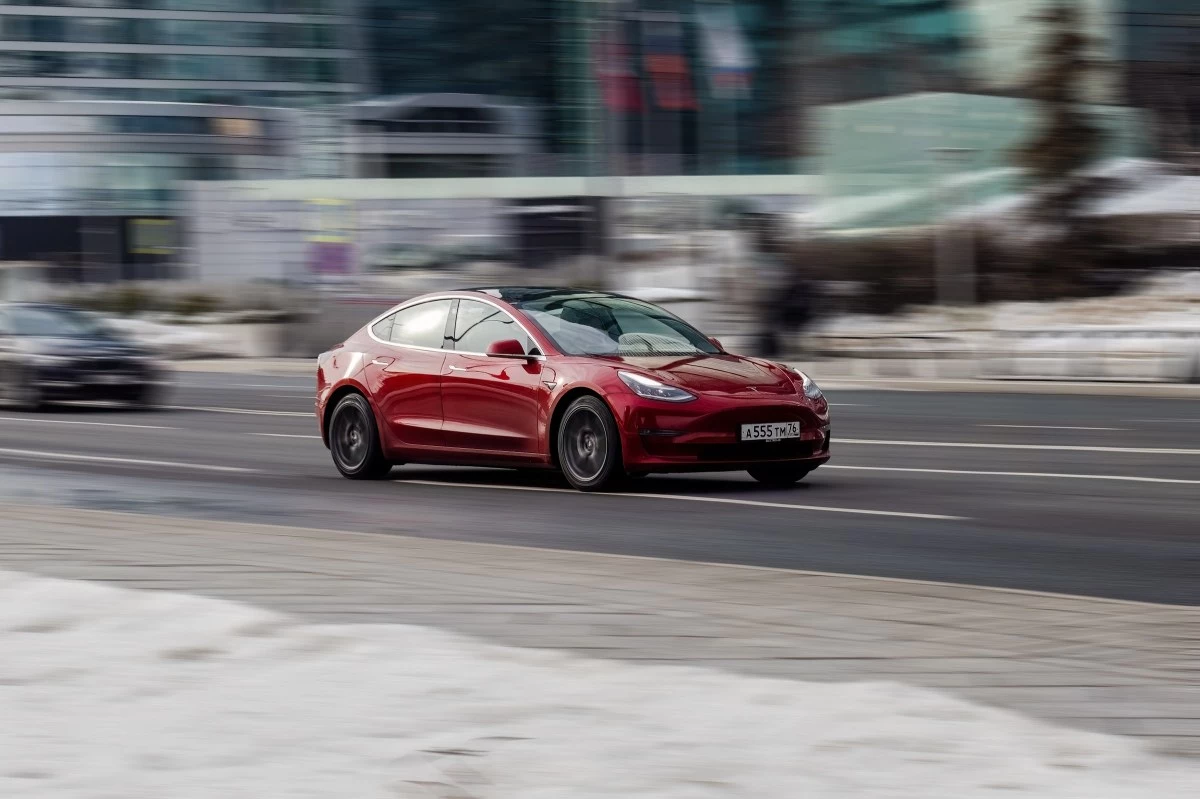

A near-miss on Quebec asphalt exposes the fragility behind “mostly works” autonomy
Fred Lambert’s account of a near-miss in Quebec—his Tesla running Full Self-Driving (Supervised) v14.3.6 unexpectedly signaling and steering toward a shoulder exit he had already passed—lands with particular force because the conditions were not adversarial. The vehicle was traveling around 68 mph, in clear weather, with freshly marked lanes and no obvious visual ambiguity. Yet the system initiated an unsupervised maneuver that, without immediate human intervention, could have sent the car into a ditch.
That contrast—ideal environment, high-speed stakes, sudden incorrect intent—is precisely what keeps advanced driver-assistance systems (ADAS) under sustained scrutiny. The incident also arrives amid a broader pattern of publicized failures and litigation involving Tesla’s driver-assist features, including reports of near-collisions and fatal crashes, and allegations tied to vehicles attempting unsafe trajectories. While each event has its own context, the cumulative effect is to sharpen a central question for regulators, insurers, and consumers: how safe is “supervised autonomy” when supervision is human, intermittent, and psychologically brittle?
For Tesla, the reputational sensitivity is heightened by branding. The phrase “Full Self-Driving”—even when paired with “Supervised”—sets an expectation that the system’s competence is near-complete, and that the driver’s role is secondary. In practice, the driver remains the primary safety layer, and Lambert’s experience illustrates how quickly that layer must reassert itself when the software’s confidence diverges from reality.
The trust paradox: why 99% reliability can be the most dangerous number
Autonomous and semi-autonomous driving systems are often evaluated by aggregate performance: miles driven, interventions per mile, crash rates per million miles. Those metrics matter, but Lambert’s near-miss underscores a more uncomfortable dynamic in machine learning safety: high average reliability can breed low moment-to-moment vigilance.
This is the trust paradox:
- When a system performs correctly “almost all the time,” drivers tend to relax attention, even if they intellectually understand the supervision requirement.
- The remaining fraction—often framed as the “1%”—contains edge cases where errors are abrupt, non-intuitive, and high consequence.
- The handoff is not gradual; it can be instantaneous, demanding a driver response measured in fractions of a second.
Technically, Lambert’s description points to a plausible failure mode in perception-to-planning logic: the vehicle appears to have misinterpreted an exit/shoulder geometry or over-weighted a transient cue (lane boundary, map prior, or visual artifact) and committed to a path that no longer matched the roadway context. Even in clear conditions, autonomy stacks can be tripped by corner cases such as:
- Ambiguous lane topology near exits and shoulders
- Temporal mismatch between map priors and real-world markings
- Overconfident classification of drivable space at highway speeds
- Planning inertia, where a late correction becomes a decisive wrong turn
Just as important is the human–machine interface (HMI) dimension. A turn signal activation is not merely a courtesy indicator; in an ADAS context it can be a behavioral alarm—a sign the system has committed to a lane change or exit. Yet many interfaces still struggle to communicate uncertainty in a way that is actionable. The driver often learns the system is wrong only when the vehicle is already moving into the wrong trajectory.
Business, liability, and brand equity: the hidden balance sheet of autonomy incidents
The economic implications of high-profile ADAS failures extend beyond a single automaker. They ripple through insurance pricing, litigation exposure, fleet operating costs, and consumer willingness to pay for autonomy packages.
Key pressure points now converging:
- Liability and insurance recalibration: As incidents accumulate and lawsuits test responsibility boundaries, underwriters are incentivized to reprice risk for vehicles equipped with advanced automation features. Even absent definitive fault, uncertainty itself can raise premiums.
- Brand equity and valuation narrative: Tesla’s market perception has long been intertwined with leadership in autonomy. Repeated public failures—especially those that appear inexplicable to lay observers—can erode the “technology premium” that supports pricing power and investor confidence.
- Resale value and adoption curves: If consumers begin to view autonomy packages as a liability rather than a benefit, depreciation dynamics may shift, influencing total cost of ownership calculations and potentially slowing broader EV adoption.
- Data network externalities under threat: Tesla’s approach depends heavily on fleet-scale data collection to capture rare edge cases. But if regulators constrain deployments or consumers opt out, the data flywheel slows—reducing the very feedback loop needed to improve reliability.
Competitors, meanwhile, may find opportunity in restraint. A more conservative rollout—paired with clearer operational design domains (ODDs), redundancy, and third-party validation—can become a differentiator, particularly for enterprise buyers and commercial fleets where risk is quantified and contractual.
What leaders should watch next: regulation, assurance lifecycles, and safety-by-design differentiation
For business and technology leaders, Lambert’s near-miss is less a Tesla-specific anecdote than a case study in how software-defined vehicles can fail at the exact moment confidence peaks. The strategic response is not simply “slow down” or “speed up,” but to professionalize autonomy deployment with governance models closer to aerospace and medical devices.
Practical moves that are gaining urgency across the industry:
- Regulatory escalation readiness: Expect tighter incident reporting, more explicit testing requirements, and stronger scrutiny of marketing language that could imply autonomy beyond the system’s validated capability.
- Assurance lifecycle discipline: Implement end-to-end traceability—from data labeling and model training to OTA release gates—so each update meets documented thresholds before broad deployment.
- Holistic safety layers: Redundancy (sensor fusion strategies, constrained route planning, explicit uncertainty estimation, and fail-safe behaviors) can reduce reliance on a single perception stack and create auditable safety arguments.
- Human-override KPIs: Track not only disengagement frequency, but driver response time, minimum safety margin at takeover, and contextual triggers (exits, merges, construction zones). These metrics are often more predictive of catastrophic risk than average miles-per-intervention.
- Insurance-aligned risk instruments: For fleets, structures such as parametric coverage or insurance-linked securities can align incentives and contain downside—provided the underlying telemetry and governance are robust.
Lambert’s intervention prevented a crash, but the episode still delivers a clear signal to the market: autonomy’s next competitive frontier is not who demos the smoothest highway drive—it’s who can prove, repeatedly and transparently, that the system behaves safely when the road stops being predictable and the software stops being right.

 By
By
 By
By


 By
By
 By
By
 By
By
 By
By







