
Prime Day pricing as a signal: why a $59.99 smart screwdriver matters
Amazon Prime Day has increasingly become less about one-off bargains and more about market signaling—a compressed window where brands test price elasticity, accelerate review velocity, and reshape category expectations. The Hoto PixelDrive cordless screwdriver, discounted to $59.99 (down $20) and positioned as a “best price ever” moment, is a telling case study in how mid-market hardware is being redefined by consumer-electronics playbooks.
At face value, the PixelDrive is a compact electric screwdriver aimed at furniture assembly and light repairs. But the deeper story is how a sub-$60 tool can now credibly offer features that would have read as premium only a few years ago:
- 6 Nm adjustable torque with six power settings
- Two speed modes: 80 RPM (precision) and 200 RPM (efficiency)
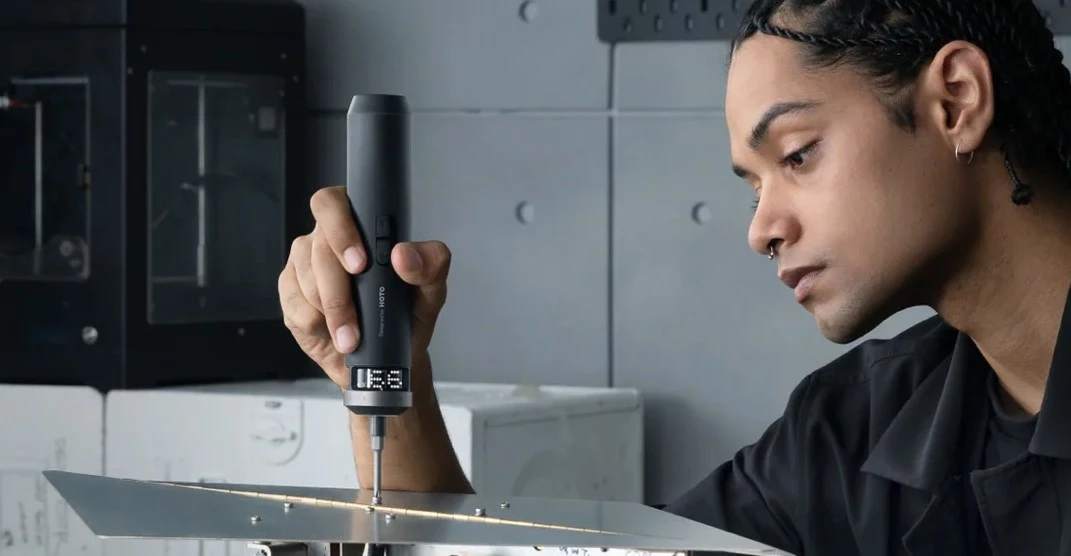
- A pixelated OLED display for real-time torque and battery feedback
- USB-C charging powering a 2,000 mAh battery
- Integrated LED lighting
- An organizer case with 30 common bits
Prime Day discounts often reward the biggest brands, yet they also create openings for digitally native challengers to gain algorithmic traction. For Hoto, the price drop is not merely promotional—it is a strategic bid to become a default choice in a category where “good enough” is being replaced by feature-validated value.
The digital interface arrives in hand tools—incremental, but consequential
The PixelDrive’s most distinctive element is not torque or RPM; it’s the on-tool OLED display. That screen represents an incremental but meaningful shift: hand tools are adopting the user experience patterns of consumer electronics, where feedback, status visibility, and guided control are part of the product’s perceived quality.
In practical terms, real-time torque and battery readouts reduce guesswork—especially for casual users who may strip screws, over-tighten fasteners, or run out of power mid-assembly. In strategic terms, the display is a gateway feature that points toward a broader evolution:
- Diagnostics and reliability cues: visual indicators can reduce misuse and returns, improving customer satisfaction and lowering support costs.
- Standardized power and accessories: USB-C and common bit compatibility align the tool with modern device ecosystems, supporting longer lifecycles and easier replacement.
- A pathway to software-defined tooling: once a tool has a display and electronics stack, the leap to firmware tuning, usage analytics, and app pairing becomes more plausible—even if not yet present.
This is how categories transform: not through a single disruptive leap, but through small interface upgrades that reset expectations. When consumers become accustomed to feedback-rich tools, competitors are pressured to match the baseline—much as screens and sensors became standard in appliances, wearables, and automotive dashboards.
E-commerce economics and the new mid-tier: feature density under macro pressure
The PixelDrive’s pricing also reflects the current retail environment. With discretionary spending under pressure, shoppers are gravitating toward products that feel “future-proof” without crossing into professional-grade pricing. A sub-$60 smart screwdriver hits a sweet spot: affordable enough for impulse purchase, but differentiated enough to justify selection over cheaper generics.
Several macro and industry dynamics converge here:
- Price sensitivity and margin compression: Prime Day-style events reward aggressive pricing, often at razor-thin margins, to capture share and climb rankings.
- Component commoditization: displays, LEDs, battery management circuits, and efficient motors have become cheaper and easier to source, enabling “smart” features without premium pricing.
- Remote and hybrid work as a durable driver: home offices, shelving, monitor mounts, and flat-pack furniture keep assembly tools in steady demand. The screwdriver becomes part of the home’s operational toolkit, not a once-a-year purchase.
This is also where traditional power-tool incumbents face a subtle challenge. Brands like Bosch or Black+Decker have deep trust and distribution, but digitally native entrants can compete on feature density, packaging, and online merchandising—the elements that convert fastest on Amazon. In a search-driven marketplace, the product that communicates value most clearly in thumbnails and bullet points often wins the click.
From product to platform: data, sustainability, and the next competitive battleground
While the PixelDrive is not positioned as an IoT device today, its electronics-forward design hints at where the category could go next: tools as nodes in a broader ecosystem. The strategic opportunity is not just selling a screwdriver—it’s building an installed base that can support recurring revenue and deeper customer lock-in.
Potential forward paths include:
- Tool-as-a-service models: bit replenishment subscriptions, extended warranties, or guided project bundles tied to usage patterns.
- Telemetry-driven product refinement: anonymized usage insights could inform torque presets, durability improvements, and accessory design—if the brand builds the data pipeline.
- Integration with DIY platforms: future workflows could link assembly instructions to recommended torque settings, or pair video walkthroughs with tool feedback loops.
Sustainability is also becoming a competitive differentiator in this space, and the PixelDrive’s USB-C rechargeable battery plays well in an era of reduced disposable-battery tolerance. For consumers and institutional buyers alike, rechargeable designs and modular accessories can support ESG narratives around lower e-waste and longer product lifetimes—especially if brands back those claims with repairability and parts availability.
Prime Day may have supplied the headline—$59.99 for a smart electric screwdriver—but the more enduring takeaway is structural: the hand-tool aisle is being reshaped by digital UX expectations, e-commerce competition, and electronics-driven cost curves, and the brands that treat “small tools” as smart hardware platforms are positioning themselves for the next cycle of category leadership.

 By
By
 By
By
 By
By