
A live-TV detour that exposed fault lines in enterprise AI confidence
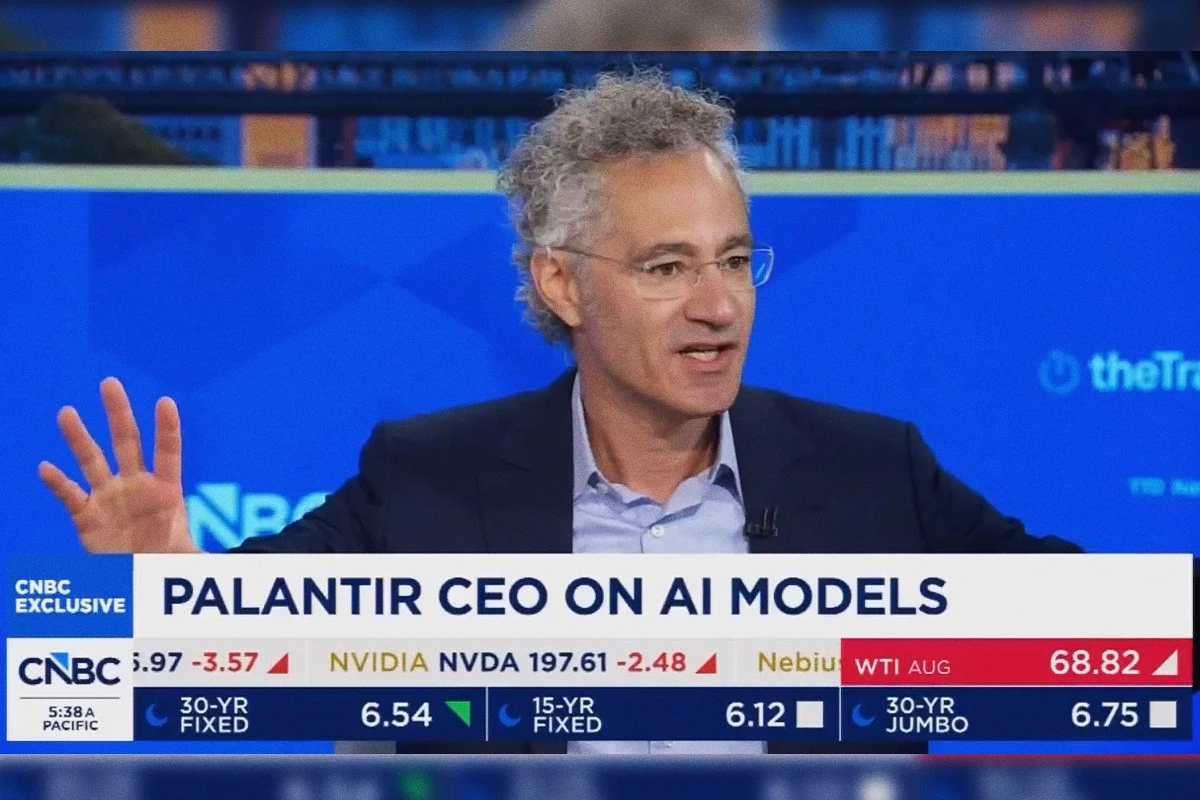
Palantir CEO Alex Karp’s unexpected turn on CNBC’s “Squawk Box” was notable less for what it revealed about any single partnership and more for what it surfaced about the current psychology of the AI market. The segment was positioned to spotlight a strategic AI-infrastructure collaboration with Nvidia aimed at U.S. government use cases—exactly the kind of concrete, procurement-oriented narrative investors and public-sector stakeholders tend to reward. Instead, viewers saw a prolonged, visibly strained monologue that veered into warnings about an AI investment “bubble,” the hazards of deploying immature systems in military contexts, and personal asides that diluted the intended message.
In modern capital markets, executive presence is not merely optics; it is a proxy signal for strategic clarity, operational control, and governance maturity. That is why the moment resonated. The substance of Karp’s skepticism—especially the claim that U.S. enterprises are prioritizing pragmatic, ROI-driven AI over theoretical promises—aligns with a real shift in buyer behavior. Yet the delivery risked eclipsing the insight, leaving the market to debate not only Palantir’s positioning, but also the broader question of whether AI’s commercial narrative is outrunning its deployment reality.
Key dynamics the episode brought into focus include:
- Hype versus hardening: a market transitioning from experimentation to mission-critical expectations
- Defense AI scrutiny: rising sensitivity to safety, oversight, and accountability in dual-use systems
- Messaging discipline as strategy: the growing cost of ambiguity when partnerships hinge on trust and execution
Why “AI bubble” talk lands differently when it comes from a government-tech insider
When a consumer-tech executive warns about hype, it can read as contrarian branding. When a CEO whose business is deeply intertwined with government analytics, defense-adjacent deployments, and high-stakes operational environments raises similar alarms, it carries a different weight. Karp’s critique implicitly echoes what many enterprise and public-sector buyers have been signaling: AI must be reliable, auditable, secure, and measurable before it can be scaled into workflows where failure has material consequences.
This is the maturation phase of the AI cycle. Buyers are increasingly asking:
- Can the system perform under data constraints and messy real-world conditions?
- Does it have governance controls, logging, and explainability suitable for regulated environments?
- What are the failure modes, and who is accountable when models drift or hallucinate?
- Can it be deployed in air-gapped or sovereign compute environments with strict security requirements?
Karp’s on-air emphasis on the potential dangers of unvetted AI in military or intelligence scenarios also intersects with a widening policy debate around autonomous decision-making, algorithmic bias, and rules of engagement. In that context, his warning is less a rejection of AI than a demand for deployment discipline—a stance that many procurement officers and regulators may privately share, even if markets prefer more celebratory soundbites.
The Palantir–Nvidia angle: strategic logic, undermined by narrative drift
The missed opportunity in the segment is that the Palantir–Nvidia partnership could have been framed as a practical answer to the very concerns Karp raised. On paper, the combination is straightforward: Palantir’s strength in data integration, operational workflows, and decision-support platforms paired with Nvidia’s dominance in GPU-accelerated AI infrastructure. For U.S. government clients, that pairing could speak directly to current procurement priorities—performance, security, and deployability—rather than speculative AI theater.
A clear articulation might have emphasized:
- Reference architectures for secure, on-prem or sovereign AI stacks
- Performance benchmarks and workload profiles relevant to federal missions
- Data governance and access controls suited to classified or sensitive environments
- Operational outcomes (e.g., logistics optimization, predictive maintenance, fraud detection) rather than abstract model capability
Instead, the segment ended without meaningful engagement on the collaboration itself. That matters because partnerships of this kind are not just technology integrations; they are go-to-market commitments that require crisp messaging to reassure multiple audiences at once: investors, agency buyers, prime contractors, and internal teams tasked with delivery. When the narrative becomes unmoored, the market’s default response is to price in uncertainty—about execution, alignment, and organizational control.
Leadership signaling, board oversight, and the new standard for AI stewardship
The most durable takeaway from the episode may be how it illustrates the tight coupling between AI credibility and leadership credibility. In an era of constant live media and instantaneous market reaction, executive communication is effectively part of the product—especially for companies selling into government and regulated enterprises where stability and predictability are core selection criteria.
For Palantir, the reputational risk is not simply embarrassment; it is the possibility that stakeholders interpret the moment as a sign of:
- Inconsistent corporate messaging around AI strategy and partnerships
- Insufficient governance scaffolding for high-stakes deployments
- Execution risk in joint ventures that require disciplined coordination
- Erosion of institutional trust, which can influence renewals, procurement momentum, and coalition-building across agencies
At the same time, the episode underscores a broader market inflection point: AI leaders are increasingly judged not only on innovation, but on stewardship—how they communicate risk, define guardrails, and translate capability into accountable operations. The next phase of enterprise AI adoption will reward companies that can pair technical power with measurable outcomes, rigorous safety frameworks, and calm strategic coherence—because in government-grade AI, confidence is not a vibe; it is a requirement.



 By
By
 By
By
 By
By
 By
By
 By
By