


When “Made With AI” Enters the Family Album, Authenticity Becomes a Business Variable
Elon Musk’s 55th birthday should have been a familiar social-media vignette: affectionate family imagery, celebratory captions, and the soft power of a public figure’s private life. Instead, the episode became a compact case study in how artificial intelligence is reshaping trust, even in moments that are ostensibly intimate and non-commercial.
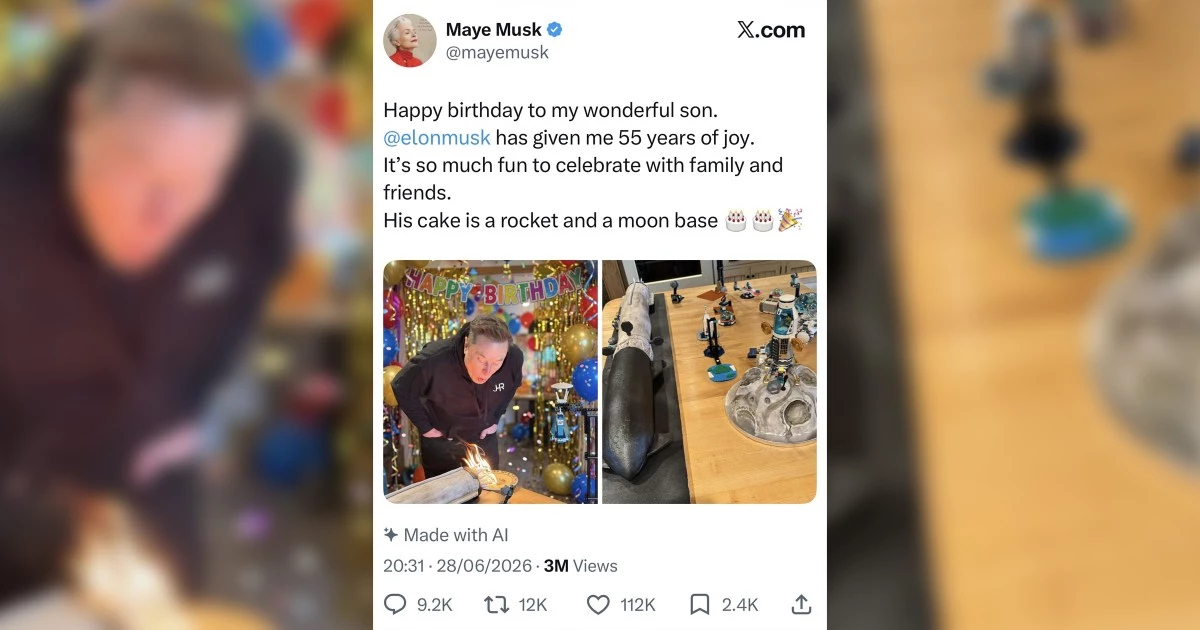
The spark was deceptively small: images shared by Musk’s mother, Maye Musk, reportedly carried a “Made With AI” tag that was later removed. That sequence—label, then no label—proved more consequential than the images themselves. It invited a spectrum of interpretations: were the photos fully synthetic, lightly retouched, or mislabeled by automated tooling? The ambiguity is the point. In an AI-saturated media environment, audiences increasingly treat uncertainty as evidence, and the absence of a clear disclosure standard becomes a reputational accelerant.
For business leaders, the deeper signal is that AI attribution is no longer a niche concern limited to advertising compliance, deepfake fraud, or political misinformation. It is migrating into everyday identity construction—where a “family post” can function as brand reinforcement, and where perceived manipulation can trigger backlash even if no deception was intended.
Key dynamics emerging from this incident include:
- Authenticity is now a product feature of communication. Stakeholders—customers, employees, investors—evaluate not only what is said, but whether it appears “human-made.”
- Disclosure is becoming part of the narrative. A label can legitimize content through transparency, but it can also provoke suspicion when audiences assume AI implies fabrication.
- Personal content is no longer purely personal for high-profile executives. For founders whose persona is intertwined with corporate value, private moments can behave like public relations assets—whether planned or not.
Platform Labeling, Watermarking, and the Coming Compliance Reality for AI Media
The removal of the “Made With AI” tag underscores a structural problem: platforms are still experimenting with AI labeling, and the rules are neither consistent nor easily interpretable by users. Was the label removed because it was inaccurate, because it was optional, or because it was undesirable? Each explanation carries different implications, yet the public rarely gets a definitive answer.
This is where the story intersects with policy. Regulators in the EU and multiple U.S. jurisdictions are moving toward mandatory AI disclosure and watermarking regimes, especially for synthetic media. The Musk birthday episode foreshadows a broader compliance environment in which:
- Attribution standards will harden (what must be labeled, how prominently, and under what thresholds of AI involvement).
- Auditability will matter (whether organizations and platforms can prove how an image or video was produced).
- Enforcement will extend beyond campaigns into influencer ecosystems, executive communications, and potentially even “personal” accounts when they function as commercial channels.
For enterprises, the operational takeaway is straightforward: AI governance cannot remain confined to product teams. Communications, legal, HR, and investor relations increasingly need a shared framework for when AI tools are allowed, how outputs are disclosed, and how disputes are handled when content is challenged.
A practical governance posture many boards are now exploring includes:
- Internal labeling norms that exceed platform minimums, reducing ambiguity during controversy
- Content provenance tooling (metadata retention, watermarking, and chain-of-custody practices)
- Clear escalation paths when a post triggers reputational risk, even if it originates outside official corporate accounts
The Musk Paradox: Lighthearted AI Aesthetics Against a Backdrop of Humanitarian Allegations
The birthday imagery controversy did not unfold in a vacuum. It landed amid severe criticism directed at Musk for actions linked—by detractors—to the dismantling of USAID programs and alleged downstream humanitarian harm. Whether one accepts those causal claims or disputes them, the juxtaposition is strategically revealing: public tolerance for playful AI experimentation shrinks when a leader is simultaneously framed as a geopolitical actor with real-world consequences.
This is the modern executive reality at scale. A founder-CEO can be perceived as:
- an innovator advancing frontier technologies, and
- a power broker whose decisions influence public institutions, aid flows, and global stability
That duality intensifies ESG scrutiny. Investors increasingly treat reputational volatility as a cost of capital issue, not merely a communications problem. Allegations tied to humanitarian outcomes—especially those involving global health, food security, or institutional capacity—can ripple into:
- brand trust and employee retention, particularly among values-driven talent pools
- regulatory attention, as policymakers respond to public pressure and media narratives
- supply-chain risk, if instability rises in regions dependent on aid-supported infrastructure
The strategic lesson for corporations is not about any single individual’s politics; it is about the fragility of the “social license to operate” when leadership identity becomes inseparable from governance debates. In such conditions, even an AI-enhanced birthday post can be interpreted as tone-deaf, performative, or manipulative—because audiences read it through the lens of larger moral narratives already in motion.
What Business and Technology Leaders Should Learn About the New “Digital Emotional Economy”
This episode highlights an emerging marketplace of trust: a digital emotional economy where sentiment, authenticity, and perceived sincerity function like scarce assets. AI tools can amplify warmth, polish, and intimacy—but they can also introduce a suspicion tax, especially when disclosure is inconsistent or unclear.
For executives and boards, several forward-looking implications stand out:
- Personal branding is now an enterprise risk surface. Family-adjacent content, lifestyle posts, and “off-duty” messaging can influence corporate credibility.
- Stakeholders want authentic engagement, but also transparent mediation. The public may accept retouching or generative enhancement—if it is clearly framed and consistently labeled.
- Narrative control is increasingly time-sensitive. A celebratory meme can rapidly collide with allegations of humanitarian harm, creating a reputational compound event that demands real-time monitoring and fact-based response discipline.
The Musk birthday controversy ultimately reads less like celebrity gossip and more like a signal flare: AI has crossed into the most trust-sensitive layer of public life—personal identity—and it is doing so at the exact moment society is renegotiating the responsibilities of powerful technology leaders. In that environment, the smallest label can become the biggest story, and the most casual image can carry the weight of governance.

 By
By
 By
By
 By
By

 By
By

 By
By
 By
By







