

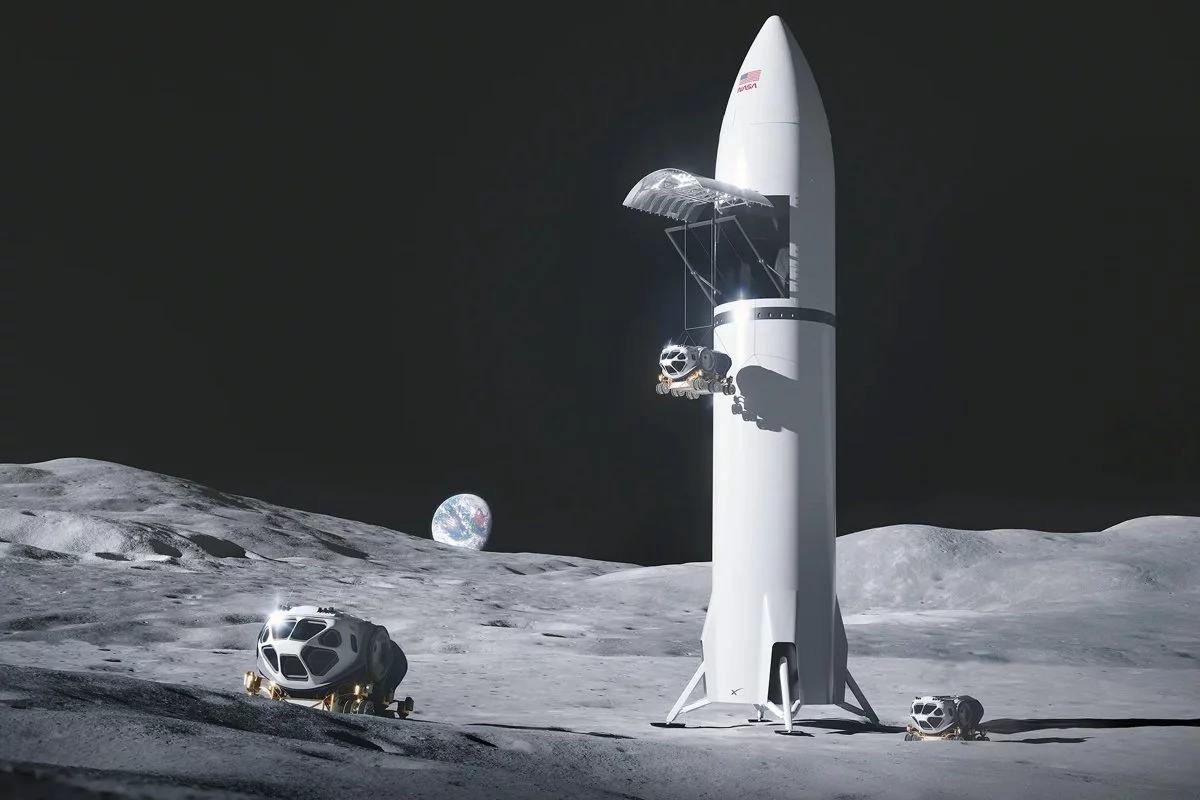

Artemis 4’s hidden constraint: cadence, not capability, may decide the 2028 landing
NASA’s plan to return astronauts to the Moon under Artemis 4 (targeted for 2028) increasingly hinges on a variable that rarely captures the public imagination: launch cadence. SpaceX’s Starship is slated to serve as the mission’s Human Landing System (HLS), but the architecture depends on building and filling an orbital propellant depot at a tempo that would redefine modern space operations. The requirement—at least 15 Starship launches within roughly eight days to stage the fuel needed for lunar descent—turns Artemis 4 into a stress test of rapid reusability, precision landings, and high-throughput ground operations.
That cadence is not merely ambitious; it is structurally different from how NASA has historically executed human spaceflight. Even if Starship’s core design ultimately proves sound, Artemis 4’s success depends on a tightly coupled chain: launch, recovery, refurbishment, relaunch, rendezvous, transfer, and repeat—without the slack that typically cushions complex programs. The implication for schedule and cost is straightforward: a single bottleneck becomes a multiplier, because delays compound across a multi-launch campaign rather than remaining isolated to one vehicle.
This is why Starship’s current maturity matters in a very specific way. The question is not only whether Starship can fly, but whether it can fly often, with predictable turnaround, and with mission-assurance-grade repeatability—a standard that has not yet been demonstrated at the tempo Artemis 4 demands.
Starship’s orbital refueling plan: a moonshot inside the moonshot
The Starship-based HLS approach represents a generational leap: a fully reusable, super-heavy system paired with on-orbit propellant logistics. If it works, it could establish a template for a future cislunar supply chain—something closer to maritime bunkering than traditional “single-shot” exploration missions. But Artemis 4’s refueling depot concept also introduces a new class of operational risk: complexity at scale.
Key technical pressure points include:
- Rapid reusability as an operational requirement: Reuse is no longer a cost-saving aspiration; it becomes a schedule-critical dependency.
- Precision and reliability across many sequential launches: A high flight rate magnifies the impact of small reliability shortfalls.
- Depot choreography and propellant transfer: On-orbit rendezvous and transfer must be executed repeatedly, under tight timelines, with minimal anomalies.
- System-of-systems coupling: Launch vehicles, tankers, depot operations, range scheduling, and ground commodities must all align—leaving little tolerance for disruption.
For NASA, this creates a delicate governance challenge. The agency has embraced commercial partnerships to accelerate innovation, yet Artemis 4’s architecture concentrates risk in a single operational concept. The more the mission depends on a rapid sequence of launches, the more NASA must ensure that contract oversight, contingency planning, and mission assurance evolve to match a tempo that resembles commercial aviation more than legacy spaceflight.
Ground systems are now a strategic chokepoint at Kennedy and Wallops
While Starship’s readiness draws attention, NASA’s own Office of the Inspector General (OIG) has highlighted a parallel vulnerability: aging and capacity-constrained ground infrastructure at major launch sites, including Kennedy Space Center and Wallops Flight Facility. The reported shortcomings—electrical distribution issues, insufficient support for fuel components such as nitrogen and helium, roadways not suited for heavy transport, and limited space for new pads—read less like routine maintenance notes and more like constraints on national launch throughput.
This matters because the U.S. launch ecosystem is entering a period of simultaneous demand growth:
- SpaceX scaling operations across multiple programs
- Blue Origin’s New Glenn increasing competition for pad time and shared resources
- A broader commercial pipeline spanning satellite constellations, science missions, and national security launches
In that environment, underinvestment in ground systems behaves like port congestion in global trade: it doesn’t merely slow one ship—it reduces the throughput of the entire harbor. Every day of pad downtime or commodity shortfall can translate into lost commercial revenue, delayed science returns, and schedule ripple effects across multiple customers. The OIG’s warnings also underscore a deeper mismatch: 21st-century launch vehicles are colliding with mid-20th-century infrastructure, and the gap is widening as launch cadence expectations rise.
Economic and geopolitical stakes: infrastructure is policy, not plumbing
The Artemis program is not only a technical endeavor; it is an instrument of industrial policy and geopolitical signaling. A credible U.S. lunar landing capability by 2028 supports coalition-building around cislunar standards, partnerships, and future infrastructure—ranging from gateway-like nodes to surface logistics. Conversely, visible schedule slips or an inability to sustain cadence could create openings for rival programs, including China’s, to shape perceptions of momentum and leadership.
Economically, the trade-offs are equally stark. Declining maintenance budgets amid surging demand create a classic deferred-cost trap: postponing upgrades can appear fiscally prudent in the short term, yet it raises the probability of expensive, disruptive fixes mid-program—precisely when schedule pressure is highest. The supply-chain angle is also underappreciated. Dependence on specialized commodities—particularly helium and nitrogen provisioning, large-scale cryogenic storage, and heavy-haul logistics—introduces vulnerabilities similar to those seen in semiconductors and rare-earths: few qualified suppliers, limited surge capacity, and cascading downstream delays.
What emerges is a clear strategic picture. Artemis 4 is becoming a referendum on whether the United States can align three timelines at once: Starship’s maturation curve, NASA’s ground modernization cycle, and the market’s accelerating launch demand. If those timelines converge, Artemis gains a scalable logistics model for the cislunar economy. If they diverge, the Moon won’t be the only destination that slips—the broader promise of high-frequency, cost-efficient access to space will, too, remain just out of reach.

 By
By
 By
By

 By
By
 By
By

 By
By
 By
By







