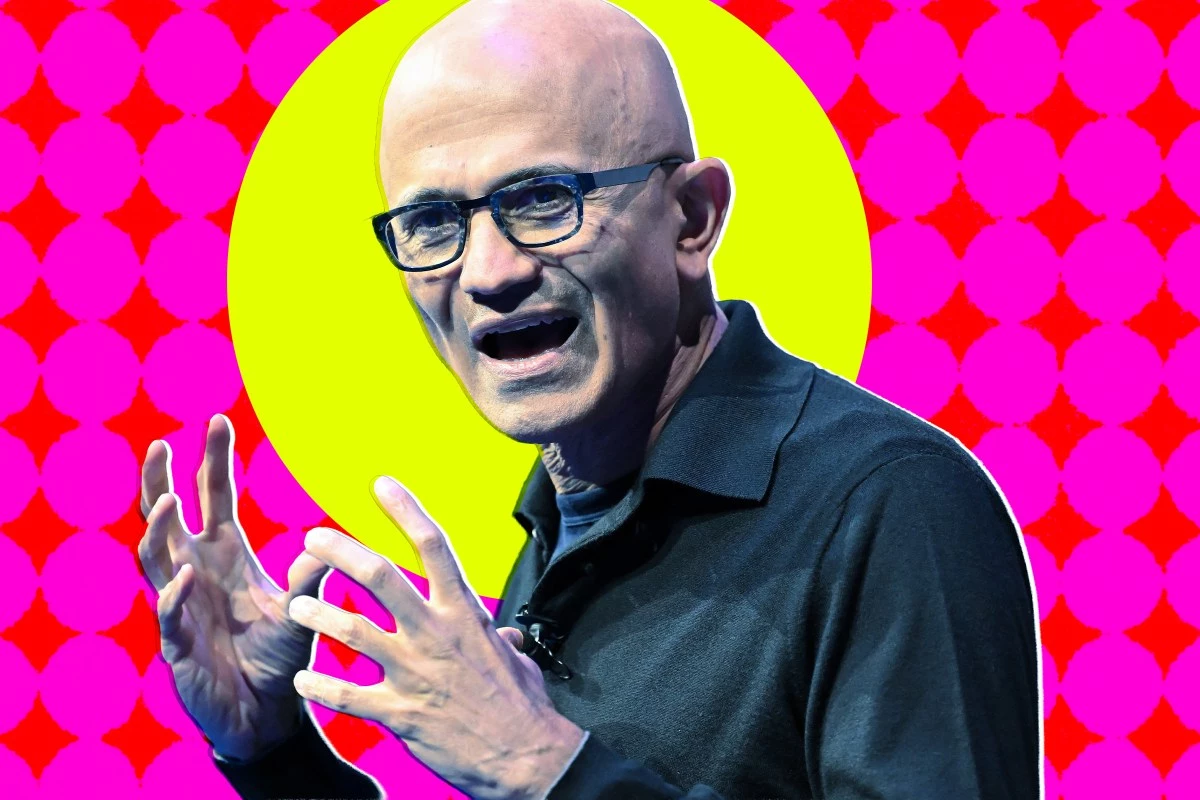

Nadella’s reality check: when AI narratives outpace AI capabilities
Satya Nadella’s recent remarks to *The Wall Street Journal* land as a pointed corrective to the prevailing generative-AI storyline—one that has oscillated between utopian productivity promises and apocalyptic warnings about mass white-collar displacement. By criticizing alarmist claims that AI could “wipe out” knowledge work or become a weapon, the Microsoft CEO is not merely disputing rhetoric from prominent industry figures; he is implicitly challenging a market psychology that has rewarded the loudest forecasts rather than the most verifiable outcomes.
At the heart of Nadella’s critique is a widening gap between AI marketing and AI maturity. While large language models have demonstrated impressive fluency, their real-world deployment still hinges on constraints that rarely feature in hype cycles: data governance, reliability, security, integration costs, and the operational reality that many workflows are socio-technical systems—not isolated tasks waiting to be automated. Overpromising full automation of complex knowledge work risks a familiar pattern in enterprise technology: inflated expectations followed by disillusionment when implementation proves slower, messier, and more expensive than the pitch deck suggested.
For Microsoft, this recalibration also functions as strategic positioning. The company sells AI as infrastructure—through cloud platforms, developer tools, and enterprise software—where trust and continuity matter as much as novelty. Tempering doomsday scenarios can reduce pressure for abrupt regulatory intervention, while also signaling to customers that Microsoft’s approach is oriented toward deployable, governable AI rather than speculative futurism.
“Social permission” as strategy: workforce redesign over celebratory layoffs
Nadella’s most consequential framing may be his insistence that companies must “earn the social permission” to deploy AI—especially by resisting the impulse to celebrate AI-driven layoffs. This language is notable in a sector that has often treated workforce reduction as a proxy for efficiency and shareholder discipline. Instead, Nadella is advocating a more operationally grounded view: the near-term value of AI is more likely to come from job redesign and augmentation than from wholesale elimination of roles.
That stance aligns with what many enterprises are discovering in practice. Generative AI can accelerate drafting, summarization, coding assistance, and customer support triage—but these gains frequently require:
- Human-in-the-loop oversight to manage errors, compliance, and edge cases
- Process reengineering so AI outputs flow into decision systems responsibly
- Reskilling and role evolution to convert time saved into higher-value work
- Institutional knowledge retention, which layoffs can inadvertently destroy
From a business perspective, redeployment is not just a moral posture; it can be a competitive advantage. Firms that invest in workforce resilience can preserve domain expertise, reduce rehiring costs, and maintain customer trust—particularly in regulated industries where accountability cannot be automated away. Nadella’s message also anticipates a reputational reality: as AI becomes more visible in daily work, companies will be judged not only by productivity metrics, but by whether AI adoption appears socially constructive or extractive.
Defense ties, dual-use AI, and the reputational calculus reshaping Big Tech
Nadella’s humanitarian emphasis arrives amid a broader shift in Microsoft’s public posture, following high-profile decisions such as canceling certain Israeli defense contracts and leadership changes in Microsoft Israel amid employee protests over military ties. Regardless of one’s view of these specific events, they underscore a central tension in modern AI: dual-use capability. The same systems that improve logistics, cybersecurity, and intelligence analysis can also support surveillance, targeting, and coercive applications.
This is not a Microsoft-only dilemma. Across the industry, competitors are increasingly staking claims to ethical leadership—Anthropic among them—while simultaneously navigating controversies over military and government use. The pattern suggests an emerging truth about AI governance: ethical positioning is becoming a market differentiator, but it is also becoming harder to sustain without transparent policies, enforceable controls, and credible oversight.
For Microsoft, the reputational calculus is unusually complex. The company operates at the intersection of:
- Enterprise trust (customers demand stability, compliance, and auditability)
- Government partnerships (including defense and national security contracts)
- Employee activism (internal legitimacy increasingly shapes external brand equity)
- Regulatory scrutiny (AI safety, privacy, and competition policy)
Nadella’s “social permission” framing can be read as an attempt to unify these pressures into a coherent doctrine: deploy AI, but do so in a way that remains defensible to customers, regulators, employees, and the public. In an era where internal dissent can become external headlines within hours, governance is no longer a back-office function—it is brand strategy.
Valuations, consolidation, and what a post-hype AI market may reward
Nadella’s warning about an “unsustainable financial bubble” speaks directly to today’s AI capital cycle. Sky-high valuations have been fueled by projections that assume rapid, near-total automation of knowledge work. If those assumptions fail to materialize on expected timelines, the market could face a classic correction—less a rejection of AI than a repricing of how quickly value can be captured and by whom.
A more disciplined AI market would likely reward companies that can demonstrate measurable outcomes rather than sweeping claims. Signals of durability may include:
- Clear revenue models tied to enterprise adoption, not just user growth
- Proven deployment pathways (security, compliance, integration, support)
- Strong data rights and governance that reduce legal and operational risk
- Documented productivity gains with accountable human oversight
This environment could also accelerate consolidation. As cloud infrastructure costs rise and model development becomes more capital-intensive, smaller players may struggle to compete on scale. That creates openings for mergers and acquisitions—particularly for niche AI firms with sector-specific workflows, proprietary data partnerships, or defensible distribution.
Nadella’s intervention ultimately reframes the AI moment as a test of institutional credibility. The next phase of competition will not be won solely by the most powerful models, but by the companies that can translate AI into reliable systems, sustainable economics, and workforce outcomes that society is willing to accept.

 By
By
 By
By

 By
By

 By
By
 By
By
 By
By