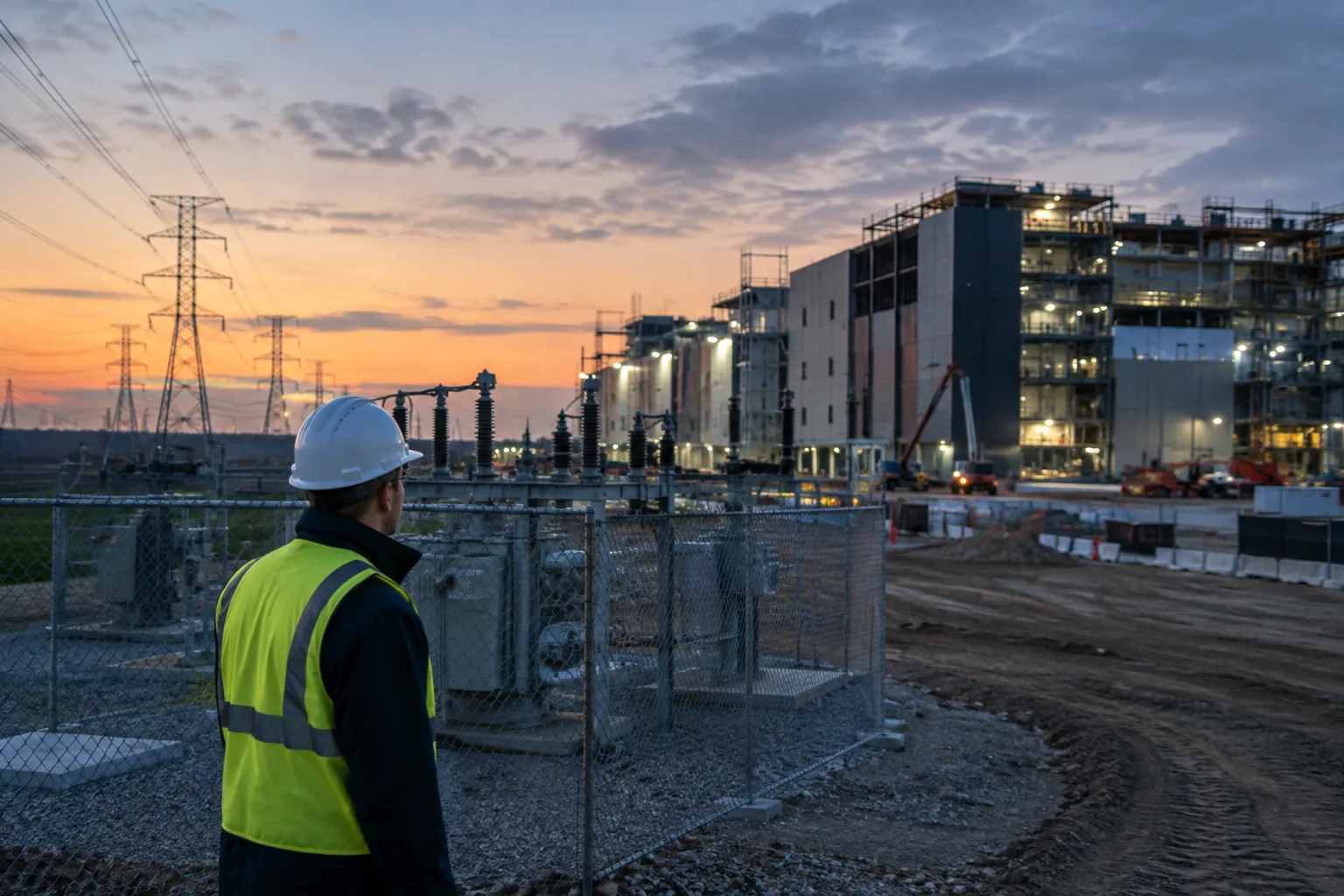

A hyperscale bet in Utah that reframes “power resilience” as a climate variable
The proposed Stratos Project in Box Elder County, Utah—publicly associated with venture capitalist Kevin O’Leary—is not merely another large data-center announcement. It is a stress test for how far the digital economy can push energy density, thermal management, and environmental tolerance in a single location. At the center of the debate is a striking figure: up to 9 gigawatts (GW) of continuous power demand, a scale that would exceed many national grids and, as described, surpass Utah’s statewide electricity demand by more than twofold.
What distinguishes Stratos is not only its magnitude, but its off-grid posture. The plan to rely on on-site gas generators aims to guarantee uptime and sidestep grid congestion—an increasingly attractive proposition as utilities struggle to interconnect new loads and as AI compute clusters demand predictable baseload power. Yet this architecture also concentrates the project’s externalities. With estimates of 7–8 GW of waste heat and roughly 16 GW of total thermal output, the facility’s heat rejection becomes a regional-scale phenomenon, not a background engineering detail.
Utah State University physics professor Robert Davies has warned that this level of localized heat could raise temperatures by ~5°F during the day and up to 28°F at night, effectively shifting Hansel Valley’s semi-arid conditions toward hyper-aridity. Whether the precise magnitude holds under full mesoscale modeling, the direction of travel is clear: hyperscale compute is evolving into a microclimate actor, and the industry’s traditional assumption—that heat can be “dumped” into the atmosphere without consequence—looks increasingly outdated.
The thermodynamics of AI: when waste heat becomes an operational risk, not just an externality
Data centers have always been heat engines in disguise. The difference now is density: AI training, inference at scale, and high-performance computing compress enormous electrical loads into tight footprints, shrinking the margin for thermal error. In this context, Stratos’ design choice—reciprocating gas engines on-site—offers resilience but sacrifices system efficiency. Every incremental point of inefficiency becomes additional heat that must be rejected, and in a basin-like geography that can trap warm air, the facility risks creating the very ambient conditions that undermine its own performance.
This is where the story becomes as much about reliability engineering as environmental impact. A “thermal feedback loop” is plausible:
- Rising local ambient temperatures reduce the effectiveness of air-side economizers and other “free cooling” strategies.
- Cooling systems work harder, increasing electricity consumption and heat rejection, reinforcing the heat island effect.
- Elevated temperatures raise the probability of thermal throttling, equipment stress, and service disruption.
The industry has already seen how heat can translate into downtime. A widely cited example is Amazon Web Services’ heat-related shutdown in Virginia, illustrating that waste heat is not an abstract sustainability metric—it can directly degrade PUE (power usage effectiveness) and threaten service-level commitments. For hyperscale operators selling reliability as a product, a site that trends hotter over time is not just an ESG concern; it is a balance-sheet risk.
This is also why next-generation cooling—liquid cooling, immersion, and two-phase systems—is moving from pilots to production. But advanced cooling does not eliminate heat; it primarily moves it more efficiently. The question becomes: where does the heat go, and what happens when millions of megawatt-hours of rejected thermal energy are concentrated in one valley?
Capital markets, fuel economics, and the coming scrutiny of off-grid data centers
From a business perspective, Stratos embodies a growing strategic impulse: decouple from the grid to avoid interconnection delays, transmission constraints, and policy obligations. Off-grid generation can also reduce exposure to curtailment and locational capacity charges. But the trade is a new set of vulnerabilities—particularly fuel-price volatility and regulatory risk.
At 9 GW continuous, annual gas consumption has been estimated on the order of 80–90 billion cubic feet. That scale invites questions that financiers and insurers increasingly ask early:
- Pipeline capacity and deliverability: Can regional infrastructure supply steady volumes without bottlenecks, especially during winter peaks?
- Operating cost sensitivity: How does the project perform under high gas-price scenarios, or under basis blowouts tied to regional constraints?
- Carbon liability: Even if today’s rules allow it, what happens under future carbon pricing, emissions performance standards, or tightened permitting?
Institutional capital is also shifting. A gas-fired hyperscale build may face higher financing friction as investors demand credible decarbonization roadmaps and as “green” capital pools narrow eligibility. Meanwhile, the policy environment is moving toward greater scrutiny of data-center energy use. Across the U.S. and Europe, proposals ranging from energy-linked data-center taxes to locational grid charges signal that the era of frictionless expansion is ending—especially for projects that externalize heat and emissions at scale.
The Great Salt Lake watershed and the strategic case for heat reuse as a license to operate
The environmental context in northern Utah is unusually sensitive. Ecology professor Ben Abbott has highlighted risks to the already stressed Great Salt Lake watershed, where hydrology, dust, and land exposure interact in ways that affect public health and regional economics. As playa expands, dust storms can intensify—carrying particulates and potentially toxic constituents—while hotter, drier conditions can accelerate ecological decline.
For executives, the most actionable insight may be that mitigation is not only defensive. Waste-heat valorization—capturing and selling heat—has become a competitive lever in parts of Northern Europe, where data centers feed district heating networks and greenhouse agriculture. Utah lacks that infrastructure today, but Stratos’ scale could justify new industrial ecosystems:
- Greenhouse and controlled-environment agriculture using recovered heat
- Aquaculture and water-treatment partnerships where thermal energy has value
- Industrial heat off-take that converts a permitting liability into a revenue stream
- Longer-horizon options such as geothermal integration or even SMR-enabled microgrids, if policy and economics align
The deeper lesson is that hyperscale data centers are no longer just real estate plus servers. They are energy projects, thermal projects, and increasingly regional environmental actors. Stratos, if it proceeds, will likely become a landmark case for how communities, regulators, and capital markets price the intersection of AI growth with the water-energy-climate nexus—and whether the industry can evolve from simply managing heat to being held accountable for where that heat ultimately lands.

 By
By
 By
By
 By
By

 By
By

 By
By
 By
By