
Cardboard as a strategic material: why AirKamuy 150 is more than a novelty
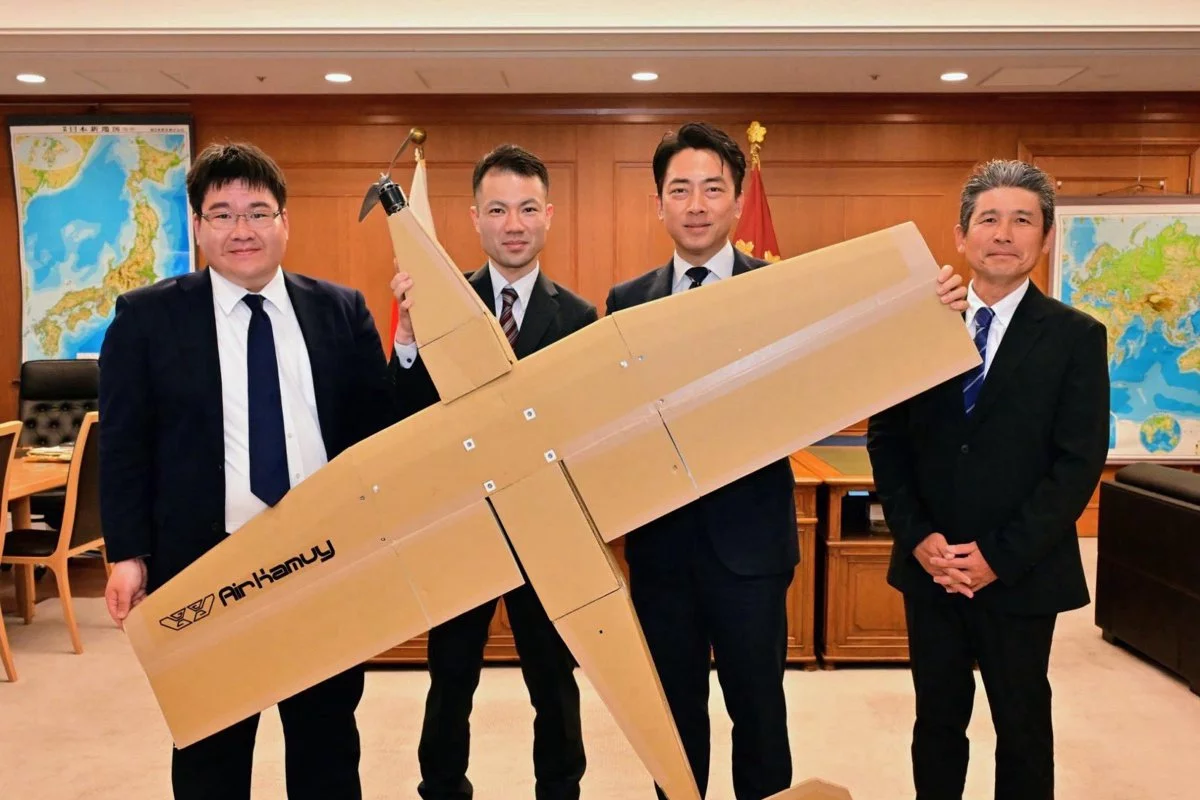
Japan’s Ministry of Defense has put an unexpected material at the center of a very modern defense conversation: corrugated cardboard. The newly unveiled AirKamuy 150, attributed to startup AirKamuy and highlighted by Defense Minister Shinjirō Koizumi, reframes what “advanced” can mean in unmanned systems. Rather than chasing exquisite airframes and costly composites, the program appears to prioritize scale, speed of production, and operational disposability—attributes increasingly decisive in drone-centric conflicts.
The platform’s reported characteristics—foldable assembly in roughly five minutes, up to 80 minutes of flight time, and speeds near 62 mph, at a unit cost of $2,000–$2,500—signal a deliberate pivot toward attritable unmanned aerial vehicles (UAVs). That price point is especially consequential when contrasted with widely referenced loitering munitions and one-way attack drones, including Iran’s Shahed family, which are often discussed as low-cost benchmarks. If the AirKamuy 150 truly undercuts comparable systems by an order of magnitude, it forces a reassessment of what constitutes “affordable mass” in airpower.
Just as important is the program’s early operational framing: the Japan Maritime Self-Defense Force (JMSDF) has reportedly used these units in limited fashion as flying targets or decoys. That is a telling entry point—because decoys and targets are where cost-per-sortie and rapid replenishment matter more than prestige engineering.
Manufacturing disruption: commodity tooling meets defense procurement reality
The AirKamuy 150’s most disruptive feature may not be aerodynamic—it may be industrial. Production reportedly relies on standard cardboard die-cutters rather than specialized aerospace tooling. In practical terms, this lowers barriers across three dimensions that typically constrain defense manufacturing:
- Capital expenditure: shifting from aerospace-grade fabrication to commodity equipment compresses the upfront investment needed to start or expand production.
- Throughput and surge capacity: die-cutting and modular assembly can be scaled quickly, potentially enabling rapid output increases during crises.
- Geographic flexibility: production can be distributed across multiple sites, reducing reliance on a small number of high-value factories.
This is where the AirKamuy story intersects with broader business and technology trends. The drone’s design logic resembles the playbook of open hardware and modular manufacturing: simplify the bill of materials, reduce specialized steps, and make assembly repeatable by a wider labor pool. In defense terms, that can translate into resilience under disruption—whether from supply chain shocks, sanctions, or wartime targeting of industrial nodes.
The material choice also suggests a quiet maturation of computational design and stress modeling. Cardboard is not “strong” in the conventional aerospace sense, but it can be engineered—through geometry, corrugation orientation, internal bracing, and controlled load paths—to meet defined tolerances for specific mission profiles. The implication is not that cardboard replaces composites broadly, but that mission-specific engineering can unlock unconventional substrates where the performance envelope is well understood and the risk is acceptable.
Operational logic: swarm economics, decoys, and the changing cost of air defense
The AirKamuy 150’s value proposition appears rooted in what strategists increasingly call swarm economics: the idea that the unit cost of an aircraft matters less than the aggregate effect of many aircraft operating together—especially when the defender’s interceptors, radar time, and command bandwidth are expensive and finite.
In that context, a low-cost fixed-wing drone can be operationally meaningful even with limited payload sophistication. Key roles implied by the reporting include:
- Decoy operations: presenting credible radar or visual tracks that compel an adversary to reveal sensors, expend interceptors, or reposition air defenses.
- Saturation and probing: forcing defenders to manage volume—tracking, prioritizing, and engaging multiple contacts—where the attacker’s cost is low and the defender’s response cost is high.
- Training realism: JMSDF use as targets suggests a shift toward high-volume training that better reflects modern threat environments, where air defense systems must perform under stress and ambiguity.
This is also where the AirKamuy 150 becomes relevant to the counter-drone market. As inexpensive drones proliferate, the economics of defense tilt toward solutions that can scale at similar rates. That dynamic tends to reward:
- Electronic warfare and jamming systems that can affect many targets per activation
- AI-enabled detection and tracking to reduce operator burden
- Lower-cost intercept options (from nets to directed energy to cheaper kinetic interceptors), because using premium missiles against disposable drones is rarely sustainable
In other words, the AirKamuy 150 is not just a platform story; it is a systems-of-systems story that pressures every layer of air defense doctrine and procurement.
Business, ESG, and dual-use spillovers: packaging meets autonomy
Cardboard introduces an unusual but increasingly relevant dimension: lifecycle and sustainability. While defense procurement is not primarily driven by ESG, the operational reality of mass drones raises questions about recovery, disposal, and environmental impact. A recyclable, bio-based airframe could reduce certain end-of-life burdens—though any sustainability claim ultimately depends on adhesives, coatings, embedded electronics, and mission usage.
Japan’s strong corrugated packaging and logistics ecosystem also hints at a non-obvious industrial linkage: a mature domestic sector with deep expertise in die-cutting, structural design, and high-throughput production may now find dual-use adjacency in unmanned systems. That could open new commercial pathways beyond defense, including:
- Disaster response and rapid assessment drones designed for short missions and easy field assembly
- Environmental sensing platforms where the airframe is intentionally disposable or recoverable
- Agricultural monitoring where low-cost airframes reduce operational friction for frequent flights
Minister Koizumi’s emphasis on partnering with agile startups underscores a broader procurement signal: competitive advantage may increasingly come from integration speed—the ability to iterate designs, scale production, and adapt payloads—rather than from airframe prestige alone. If the AirKamuy 150 program continues to mature, it will stand as a case study in how “low-tech” materials, paired with modern design methods and pragmatic doctrine, can produce a high-impact shift in the economics of unmanned capability—one that competitors, suppliers, and counter-drone providers will have to price into their strategies.

 By
By
 By
By
 By
By
 By
By
 By
By

 By
By