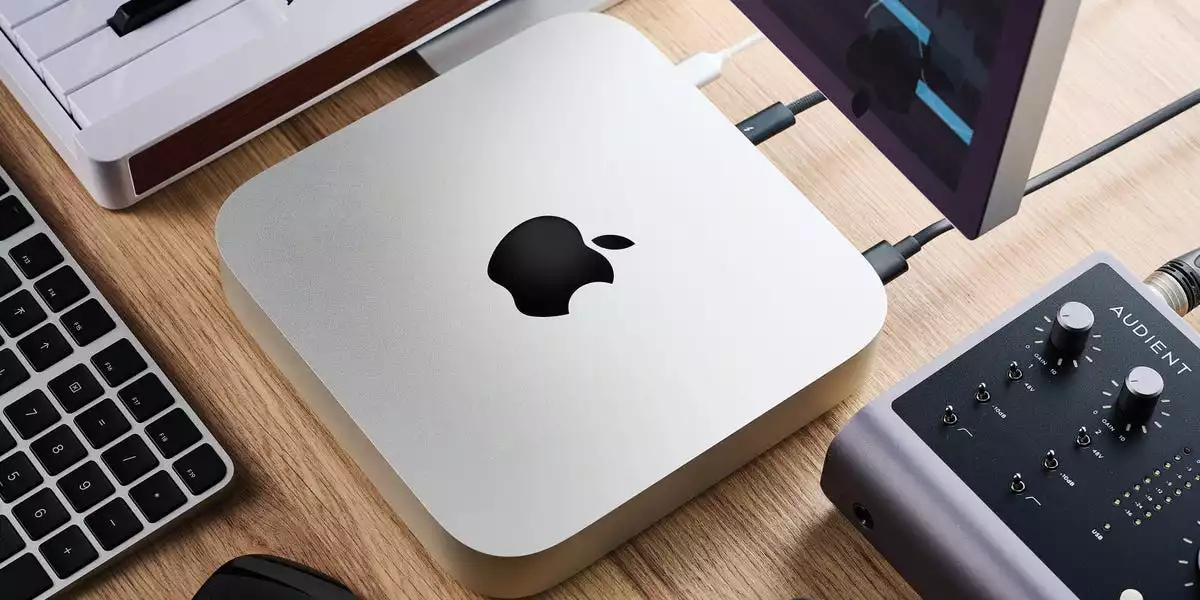

Apple’s Mac Mini price reset signals a new baseline for “local AI compute”
Apple’s decision to raise the Mac Mini’s entry price from USD 599 to USD 799—while doubling base storage from 256 GB to 512 GB—reads less like routine product-line housekeeping and more like a strategic acknowledgment that the Mac Mini is no longer behaving like a traditional entry-level desktop. The removal of the former lowest-cost configuration from Apple’s online store effectively redefines what “most affordable Mac” means, and it does so at a moment when demand is being pulled by an unexpected constituency: developers and small teams using the Mac Mini as a compact platform for AI development and inference.
CEO Tim Cook’s remarks on the earnings call—that Mac Mini demand has accelerated “faster than anticipated”—provide a rare, explicit confirmation that this is not merely a pricing experiment. It is a response to a market signal: the Mac Mini is being adopted as an edge AI node, including for open-source agentic workflows such as OpenClaw, and Apple is now managing the operational reality of that adoption. The company is also signaling that supply constraints may persist for months, implying production planning that was calibrated for consumer and general productivity use cases—not for sustained AI workloads and developer-driven purchasing patterns.
For business and technology leaders, the key takeaway is not simply that the Mac Mini costs more. It’s that Apple is up-tiering a product that has quietly crossed into a different competitive set—one that overlaps with entry workstations, compact servers, and on-premises AI experimentation rigs.
Why the Mac Mini is emerging as an edge-AI workhorse
The Mac Mini’s newfound relevance in AI workflows is rooted in architectural choices that Apple has been compounding for years. Apple Silicon’s integrated Neural Engine, high-bandwidth Unified Memory, and tightly optimized software stack create a developer experience that can feel unusually “complete” for local experimentation—especially for teams trying to avoid the cost, latency, and governance friction of cloud GPU environments.
Several technical dynamics are converging:
- Performance-per-watt as a product feature, not a footnote: Continuous inference and iterative development cycles reward efficiency and thermal stability. The Mac Mini’s compact form factor, power profile, and thermal headroom make it attractive for always-on or near-always-on workloads.
- Unified Memory as a practical advantage for certain ML tasks: While it does not replace high-end discrete GPU memory in every scenario, unified memory can reduce bottlenecks between CPU/GPU/Neural Engine pathways, improving responsiveness for prototyping and smaller-scale inference.
- Framework and tooling gravity: Apple’s ML ecosystem—Core ML, Create ML, Metal Performance Shaders, and the broader macOS developer toolchain—lowers the friction for building, testing, and packaging AI-enabled applications, particularly when the end target includes Apple platforms.
This is where Apple’s vertical integration becomes more than a branding phrase. Unlike PC OEMs that assemble systems from third-party CPUs, GPUs, and drivers, Apple can align silicon allocation, memory architecture, and OS-level acceleration around repeatable workloads. In an AI era increasingly defined by matrix operations and throughput efficiency, that control can translate into a consistent, predictable developer platform—often more valuable than peak benchmark performance alone.
The business logic: premiumization, margins, and a portfolio that’s shifting upward
From a commercial standpoint, the Mac Mini price increase is a classic Apple move executed with a contemporary twist. By lifting the starting price by roughly 33%, Apple increases average selling price (ASP) and potentially strengthens gross margin dynamics—even if unit growth moderates. Doubling base storage helps justify the new floor, but the more consequential shift is psychological and strategic: Apple is effectively declaring that the Mac Mini is no longer a “budget Mac,” but a serious compact desktop.
This has several implications:
- Portfolio rebalancing toward prosumers and SMBs: Removing the lowest-cost SKU narrows appeal for casual buyers, but it aligns with a market where “good enough” general-purpose computing is abundant, while AI-capable local compute is becoming a differentiator.
- Demand-driven pricing power: Cook’s acknowledgment of unexpectedly strong demand suggests Apple believes the Mac Mini can sustain a higher price without triggering disproportionate churn—particularly if buyers are using it as a tool, not a discretionary household purchase.
- A subtle redefinition of value: The Mac Mini’s value proposition is shifting from “small and affordable” to “small, efficient, and AI-ready.” That’s a different story, and it supports a different price.
For competitors, the signal is uncomfortable but clear. If compact desktops are increasingly evaluated as on-prem AI endpoints, then Dell, HP, and other incumbents may need to defend not just on price or manageability, but on hybrid orchestration, modular scalability, and enterprise deployment narratives that Apple does not traditionally emphasize—yet may increasingly encroach upon.
Strategic ripple effects: ecosystem lock-in, supply constraints, and what Apple may do next
The Mac Mini’s AI adoption also amplifies Apple’s ecosystem leverage. A Mac Mini used as an AI development node naturally pulls developers deeper into Apple’s tooling and distribution channels—Xcode, Apple-optimized ML runtimes, and ultimately the App Store pathway for AI-powered applications. That creates a “sticky” loop: hardware enables development; development reinforces platform commitment; platform commitment drives future hardware and software spending.
At the same time, Apple’s warning of ongoing supply constraints highlights a practical risk: if the Mac Mini becomes a default recommendation for local inference and agent experimentation, availability and lead times become part of the product’s reputation. In AI infrastructure, reliability of procurement can matter nearly as much as performance.
Looking ahead, several moves would be consistent with Apple’s incentives and the market’s direction:
- AI-forward SKU segmentation: A higher-end Mac Mini variant—positioned explicitly for AI workflows—could capture additional willingness to pay and reduce pressure on the base model.
- Deeper optimization with major ML frameworks: Stronger alignment with PyTorch and TensorFlow ecosystems would accelerate credibility among enterprise and research users who standardize on those stacks.
- Privacy-first positioning for on-prem AI: As regulation and data sovereignty concerns rise, Apple can credibly market local compute as a way to keep sensitive datasets off third-party clouds, reinforced by Secure Enclave and platform security messaging.
Apple’s Mac Mini repricing is ultimately less about charging more for a small desktop and more about recognizing that AI is changing what “entry-level” means. In a market where compute is being redistributed from centralized clouds to desks, labs, and small offices, the Mac Mini is evolving into a compact instrument of that shift—and Apple is pricing it like it intends to stay there.

 By
By

 By
By

 By
By

 By
By