
A new class of ocean infrastructure takes shape off China’s research frontier
Shanghai Jiao Tong University’s decision to begin construction of the Deep-Sea All-Weather Resident Floating Research Facility—widely dubbed the “Open-Sea Floating Island”—signals more than an ambitious engineering project. It marks a bid to redefine what “presence” in the deep ocean looks like: persistent, industrial-scale, and increasingly data-centric.
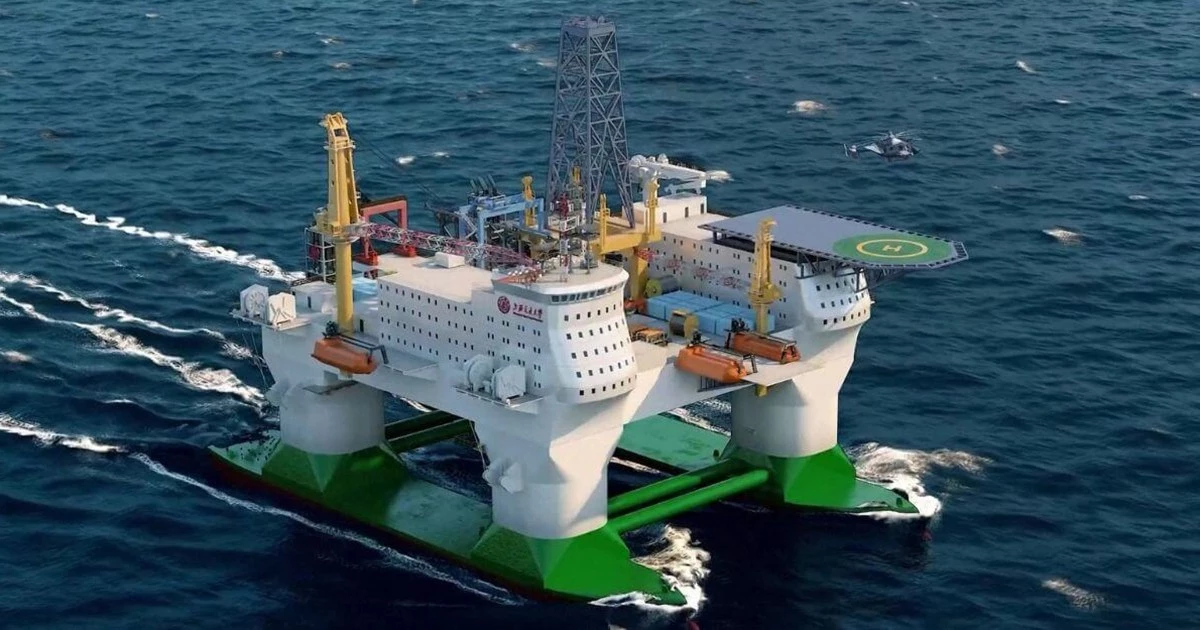
Planned for completion by 2030, the platform is positioned to become the world’s largest semi-submersible scientific research platform, with a deck area comparable to two football fields and a moon pool described as large enough to accommodate a blue whale. Those headline dimensions matter because they translate into operational capacity: the ability to host 238 researchers and sustain long-duration missions while supporting deep-ocean work down to 10,000 meters—a depth range that reaches the hadal zone and the most technically punishing environments on Earth.
What makes the initiative strategically notable is its explicit attempt to bridge two historically separate models:
- Oil-and-gas semi-submersibles, optimized for stability and endurance in rough seas
- Oceanographic research vessels, optimized for mobility, sampling, and instrument deployment
If executed as described, the Open-Sea Floating Island becomes a hybrid: a station-keeping, all-weather base that can still behave like a launch-and-recovery hub for submersibles, autonomous systems, and heavy instrumentation—effectively turning deep-sea science into a more continuous, less expeditionary enterprise.
Engineering the “all-weather” deep sea: why the platform design is the story
The platform’s promise rests on a deceptively hard requirement: reliable operations in adverse weather while conducting delicate, high-risk deployments. Semi-submersible architecture is attractive precisely because it dampens wave motion, enabling safer crane work, instrument handling, and submersible launch cycles. That stability is not a luxury; it is often the difference between collecting usable data and losing a multi-million-dollar vehicle to sea state.
The facility’s planned six major laboratories—including marine disaster analysis and heavy-ocean equipment testing—also point to a broader shift: deep-ocean research is increasingly inseparable from systems engineering and operational readiness. A platform that can test heavy equipment in realistic conditions shortens the path from prototype to deployment for technologies such as:
- Long-endurance ROVs and AUVs capable of extended missions at extreme depth
- Pressure-tolerant materials and coatings for housings, connectors, and sensor packages
- Real-time or near-real-time telemetry pipelines that can move high-value data from remote ocean regions into analytics environments onshore
These capabilities tend to spill outward. Advances needed for 10,000-meter operations can cascade into adjacent sectors—offshore wind foundation monitoring, subsea cable inspection, and even the enabling toolchain for future deep-sea mineral exploration. The platform’s “resident” concept also hints at a less discussed innovation vector: closed-loop life-support and logistics optimization, where sustained habitation forces improvements in energy management, waste handling, and autonomous resupply—technologies with relevance to other extreme environments, including space analog habitats.
The business and geopolitical logic: data, resources, and negotiating leverage
China’s own assessment of a shortfall in marine research infrastructure provides the immediate rationale, but the broader implications are economic and strategic. Deep-sea capability is increasingly a form of competitive advantage in the Blue Economy, where the scarcest asset is not ships or steel, but high-resolution data: bathymetry, current profiles, geochemical signatures, and biological baselines.
From a governance standpoint, enhanced deep-ocean access intersects with the growing interest in polymetallic nodules and cobalt-rich crusts in areas beyond national jurisdiction. The more capable a nation is at surveying, sampling, and characterizing seabed environments, the stronger its hand can become in future debates around:
- International Seabed Authority (ISA) rulemaking and licensing norms
- Environmental thresholds and monitoring requirements for any prospective extraction
- The evidentiary basis for “responsible development” claims in contested policy arenas
At the same time, the platform’s scale and persistence will likely sharpen existing concerns in Western capitals about data asymmetry. Oceanographic data can be commercially valuable—supporting offshore engineering and insurance models—while also being strategically sensitive, especially where seabed mapping and subsea infrastructure awareness overlap with naval and security interests. Even when missions are civilian-led, the dual-use perception can shape funding decisions elsewhere, potentially catalyzing new investment cycles for U.S., European, and Japanese ocean science institutions and their private-sector partners.
For industry, the signal is clear: deep-sea operations are moving toward an era of platform-based continuity, where long-duration presence enables faster iteration, richer datasets, and more standardized measurement regimes—advantages that compound over time.
What to watch between now and 2030: collaboration, standards, and regulatory stress tests
As construction progresses, the Open-Sea Floating Island is likely to become a focal point for both international collaboration and competitive positioning. The most consequential developments may be less about the platform’s size than about the ecosystem it attracts—universities, sensor manufacturers, robotics firms, satellite and subsea communications providers, and climate and disaster-modeling teams.
Key watchpoints for executives and policymakers include:
- Data-sharing frameworks and standards: who gets access, at what resolution, and under what licensing terms
- Autonomy and connectivity: whether the platform becomes a proving ground for networked AUV fleets, edge AI analytics, and high-bandwidth subsea-to-surface links
- Environmental governance pressure: whether expanded access accelerates regulatory debates on deep-sea environmental protection, baseline science requirements, and enforcement mechanisms
- Commercial spillovers: transfer of semi-submersible know-how into adjacent floating infrastructure, including wave-energy, floating solar, and next-generation offshore industrial platforms
For business leaders, the strategic posture is less about reacting to a single facility and more about preparing for a world where deep-ocean science is increasingly industrialized—with persistent platforms, standardized instrumentation, and faster cycles from discovery to application. The Open-Sea Floating Island, if delivered as envisioned, will not merely extend China’s reach into the hadal depths; it will raise the baseline expectations for what “serious” ocean capability looks like in the global technology and maritime economy.

 By
By
 By
By
 By
By
 By
By
 By
By
 By
By

 By
By