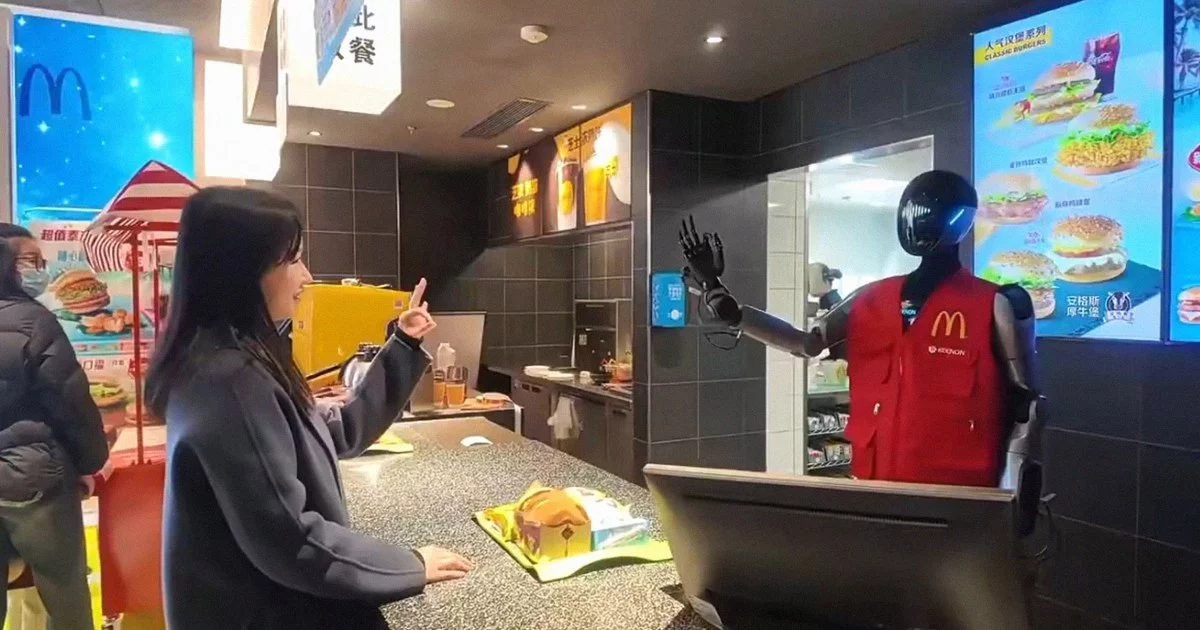

Viral humanoid robots at McDonald’s Shanghai: what happened—and what didn’t
A short video from a McDonald’s outlet at the Shanghai Science and Technology Museum showing humanoid robots in staff uniforms greeting guests ricocheted across social media, quickly attracting sensational interpretations about fast food jobs being replaced overnight. The reality is more prosaic—and more instructive. McDonald’s clarified that the robots were part of a time-limited promotional activation in collaboration with Keenon Robotics, and that they performed no operational duties such as taking orders, handling payments, cooking, or assembling food.
That distinction matters because it highlights a recurring dynamic in business and technology coverage: the optics of automation often move faster than the economics and engineering. Humanoid robots are uniquely potent symbols. They look like “workers,” so audiences naturally map them onto labor displacement narratives—even when the deployment is essentially brand theater.
Yet dismissing the moment as mere spectacle would also miss the strategic signal. Global quick-service restaurant (QSR) brands increasingly use flagship locations as living laboratories for emerging technologies, testing public reaction, collecting interaction data, and refining vendor partnerships. The Shanghai activation sits squarely in that pattern: a controlled environment designed to generate attention, measure sentiment, and showcase a future-facing posture without committing to operational dependence.
Humanoid robotics vs. task automation: the gap between fascination and feasibility
The public imagination gravitates toward humanoids, but restaurant operations reward something else: reliability, repeatability, and cost efficiency. That is why the most successful forms of restaurant automation to date tend to be narrowly scoped:
- Self-service kiosks that standardize ordering and reduce queue pressure
- Mobile ordering and AI chatbots that shift demand to digital channels
- Tray-running or delivery robots that operate on predictable routes in semi-structured spaces
Humanoid robots, by contrast, face stubborn constraints in real-world QSR environments. A high-throughput restaurant is a chaotic system: spills, crowds, children, strollers, shifting furniture, and constant micro-exceptions. To move from a scripted greeting demo to genuine labor substitution, humanoids would need major advances in:
- Real-time perception (understanding cluttered, dynamic scenes)
- Safe navigation (operating around unpredictable human movement)
- Dexterous manipulation (handling varied objects at speed without error)
- Uptime and maintainability (performing reliably across long shifts)
The Shanghai robots appear to illustrate progress in human-robot interaction (HRI)—gestures, conversational cues, and social presence—while remaining constrained to a limited, pre-defined role. That is not a failure; it is a realistic snapshot of where the technology is commercially strongest today: experience enhancement and controlled engagement, not end-to-end restaurant work.
For Keenon Robotics, the collaboration also reflects an emerging go-to-market model: robotics vendors partner with globally recognized chains to accelerate iteration and credibility. The upside is rapid learning and brand association. The downside is brand-risk coupling—a viral misunderstanding can create reputational turbulence for both parties, regardless of what the robots actually did.
The economics behind QSR automation: margin defense, not science fiction
The deeper story is not whether a greeting robot can “take a job,” but why QSR operators keep exploring automation in the first place. The sector faces a convergence of pressures:
- Rising labor costs and tighter staffing markets in many regions
- Inflationary input costs that squeeze already-thin margins
- Consumer expectations for speed and consistency shaped by digital commerce
- Post-pandemic emphasis on hygiene, contact reduction, and throughput
Automation is often framed as replacement, but in practice it is frequently deployed as capacity insurance—a way to keep service levels stable when staffing is volatile. Still, the financial case for advanced robotics remains uneven. Humanoid systems are capital-intensive, and the total cost of ownership can be difficult to justify once maintenance, software updates, downtime, training, and integration are accounted for.
This is why many operators pursue hybrid automation first: technologies that reduce friction without demanding a full redesign of workflows. Over time, that incremental approach can reshape labor demand—less repetitive task work, more exception handling and customer-facing problem solving. It can also create new roles, including:
- Robot maintenance and field service technicians
- Systems integrators and operations analysts
- In-store “automation supervisors” who manage edge cases and uptime
Whether those new roles offset displacement depends on execution: reskilling pathways, internal mobility, and local labor market conditions. The anxiety triggered by the Shanghai video is therefore not irrational—it reflects a legitimate uncertainty about how quickly institutions can adapt compared with how quickly technology is marketed.
Brand signaling, stakeholder trust, and the next phase of restaurant robotics
Promotional robotics activations sit at the intersection of innovation strategy and public trust. A uniformed humanoid can project a futuristic brand identity, but it can also invite backlash if audiences infer hidden intentions. For global brands, the communications challenge is to avoid ambiguity—especially when viral content compresses nuance into a few seconds.
The most durable approach is tiered transparency: clearly separating what is a short-term showcase, what is a pilot with measurable operational goals, and what remains long-horizon R&D. That clarity matters across stakeholders:
- Employees want reassurance that technology is augmentation, not surprise substitution
- Franchisees need evidence of ROI, reliability, and operational fit
- Regulators will increasingly scrutinize safety, liability, and data practices
- Customers respond to novelty, but punish perceived inauthenticity
There is also a less visible layer: data. Even a greeting-focused humanoid demo can generate valuable insights into foot traffic patterns, dwell time, engagement cues, and customer sentiment—inputs that can inform personalization, store layout, and digital channel design. In that sense, the robot is not only a “character” at the door; it is a sensor platform embedded in a high-value consumer environment.
The Shanghai episode ultimately reveals a sector moving in two speeds: fast-moving narratives about humanoids replacing workers, and slower-moving operational reality where automation succeeds by targeting specific bottlenecks. The companies that benefit most will be those that treat robotics not as a headline, but as a disciplined capability—measured in uptime, safety, customer experience, and credible workforce transition plans that can withstand the next viral clip.

 By
By
 By
By
 By
By


 By
By
 By
By
 By
By