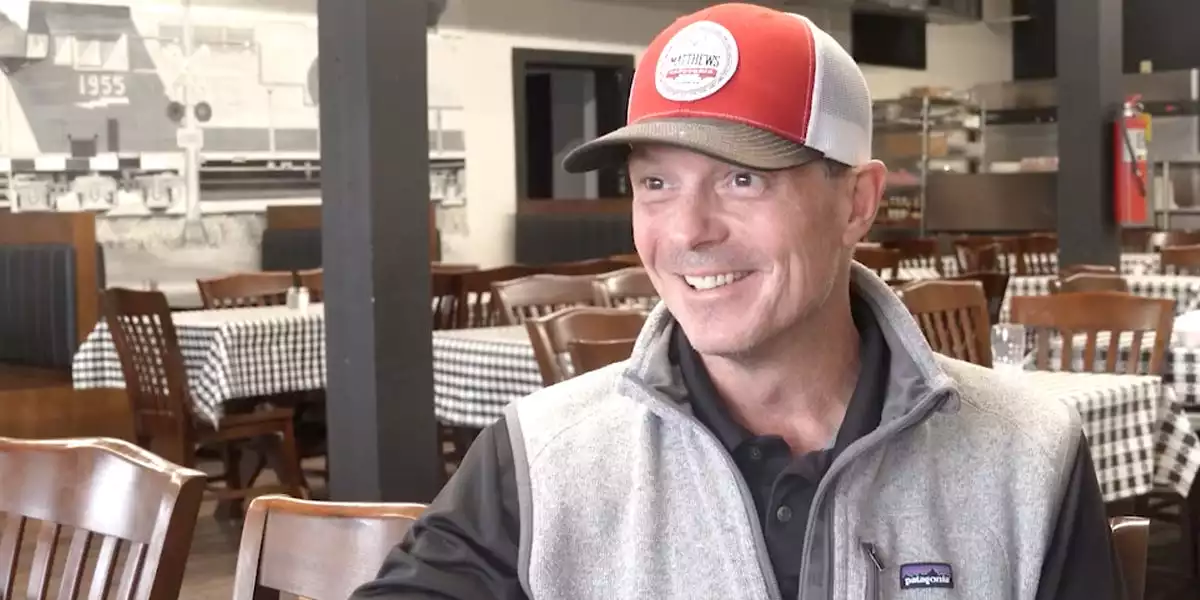

A 70-year cafeteria meets a new era of operational expectations
Matthews Cafeteria in Tucker, Georgia is the kind of business that rarely survives on nostalgia alone. After seven decades, its endurance reflects something more durable: repeatable community trust, craft-based food production, and a family enterprise capable of reinvention without losing its identity. The latest chapter centers on Michael Greene, a third-generation operator who once resisted the family trade, only to return later with a clearer sense of vocation—and a production-first leadership style that keeps the kitchen’s output steady for a roughly 30-person team.
That arc matters because it mirrors a broader shift in small and mid-sized food service: heritage brands are increasingly judged not just on authenticity, but on resilience. Matthews’ story—early mornings, hands-on preparation, and a spouse who stepped into operational leadership during COVID—highlights the lived reality behind “family business continuity.” It also surfaces a strategic question facing many legacy operators: how to preserve the tactile, human experience customers value while meeting modern expectations for speed, predictability, and convenience.
From a business and technology lens, Matthews is best understood as a high-trust, high-craft operation operating in an environment that increasingly rewards process design, data visibility, and contingency planning.
The hidden economics of “manual-first” food service
Matthews’ manual-centric workflows—chef-driven preparation and face-to-face service—are not merely aesthetic choices. They are an operating model. That model can be a competitive advantage in the experience economy, where diners pay for familiarity and provenance, but it also creates structural constraints that become more visible under labor scarcity and inflation.
Key operational dynamics stand out:
- Labor intensity as both moat and bottleneck
Craft knowledge anchors quality and customer loyalty, yet it can limit scale if expertise lives primarily in individuals rather than systems. Without codified training, growth often requires “finding another Michael Greene,” which is rarely feasible.
- Digital absence as an opportunity cost
The lack of clear signals around online ordering, automated inventory, or demand forecasting suggests Matthews may be leaving efficiency gains on the table. In today’s food service market, even modest digital layers can reduce friction—shorter lines, smoother peaks, fewer stockouts—without changing the soul of the brand.
- Pandemic resilience that reveals single-point risk
The COVID-era pivot, with Greene’s wife assuming operational leadership, demonstrates adaptability and trust within the family enterprise. It also underscores a common vulnerability: when leadership continuity depends on a small number of people, the business carries key-person risk unless cross-training and documented playbooks exist.
- Supply chain volatility and margin pressure
Small-batch preparation typically increases exposure to price swings in commodities and local procurement variability. With inflationary headwinds, the margin equation becomes less forgiving, making waste reduction and smarter purchasing more than “nice-to-have” improvements.
For technology leaders and operators, the takeaway is not that Matthews should become a tech company. It’s that selective modernization can protect the very craftsmanship customers come for, by stabilizing labor, reducing waste, and improving throughput.
Succession strategy as a talent system, not a family obligation
Perhaps the most strategically consequential element in Greene’s approach is his non-prescriptive view of succession. His four young sons are not being groomed under obligation; any future involvement is framed as voluntary and passion-driven. In family enterprise terms, that is not sentimental—it is pragmatic.
A voluntary succession model can produce a stronger leadership pipeline because it filters for intrinsic motivation. In service businesses where the work is physically demanding and reputationally fragile, reluctant heirs often create operational drag. By contrast, leaders who choose the role tend to invest more deeply in:
- quality discipline and consistency
- employee retention through credible leadership
- brand stewardship that feels authentic rather than performative
At the same time, a passion-first philosophy needs structure to become a durable competitive asset. The cafeteria’s next phase will likely depend on whether Matthews can translate family continuity into a broader human-capital system—one that can attract and develop talent beyond the family while maintaining cultural integrity.
A practical evolution could include:
- Codifying culinary expertise into a training curriculum (recipes, prep standards, food safety, service cadence) to reduce dependence on informal apprenticeship alone.
- Establishing a leadership “discovery” pathway—rotations across kitchen, front-of-house, purchasing, scheduling, and customer service—open to family members and high-potential employees alike.
- Using competitive compensation and clear progression to counteract the sector’s chronic labor shortages, turning Matthews into a destination employer rather than a stopgap job.
This is where succession intersects with technology: documentation, scheduling systems, and training content platforms can make craft transferable without making it generic.
A modernization path that protects authenticity while expanding resilience
Matthews’ hyperlocal resonance—personal stories, community memory, and the social capital of a long-running dining room—cannot be replicated by digital-only competitors. Yet the same hyperlocal strength can cap growth if the operation remains entirely dependent on in-person throughput and tacit knowledge.
The most credible strategy is selective digital integration, designed to reduce operational strain rather than replace the human experience. A phased approach could include:
- Online ordering and payment to smooth demand spikes, reduce queue times, and capture basic customer insights (peak periods, popular items, repeat behavior).
- Lightweight inventory management to improve yield, reduce spoilage, and support smarter procurement—especially important under commodity inflation.
- Contingency planning and cross-training supported by documented procedures, alternative supplier lists, and scenario modeling for disruptions (labor gaps, supply shocks, public health events).
- Partnerships with regional food-tech platforms that offer logistics, loyalty programs, or marketing reach—without forcing Matthews to surrender independence or dilute its brand DNA.
The broader implication is that Matthews Cafeteria can serve as a case study in how legacy food service businesses modernize responsibly: not by chasing every trend, but by adopting the minimum effective technology needed to protect margins, stabilize labor, and preserve the customer experience. In a market where authenticity is prized but operational excellence decides survival, the winners will be the institutions that treat tradition as a product—and resilience as the strategy.

 By
By
 By
By
 By
By
 By
By
 By
By

 By
By
 By
By