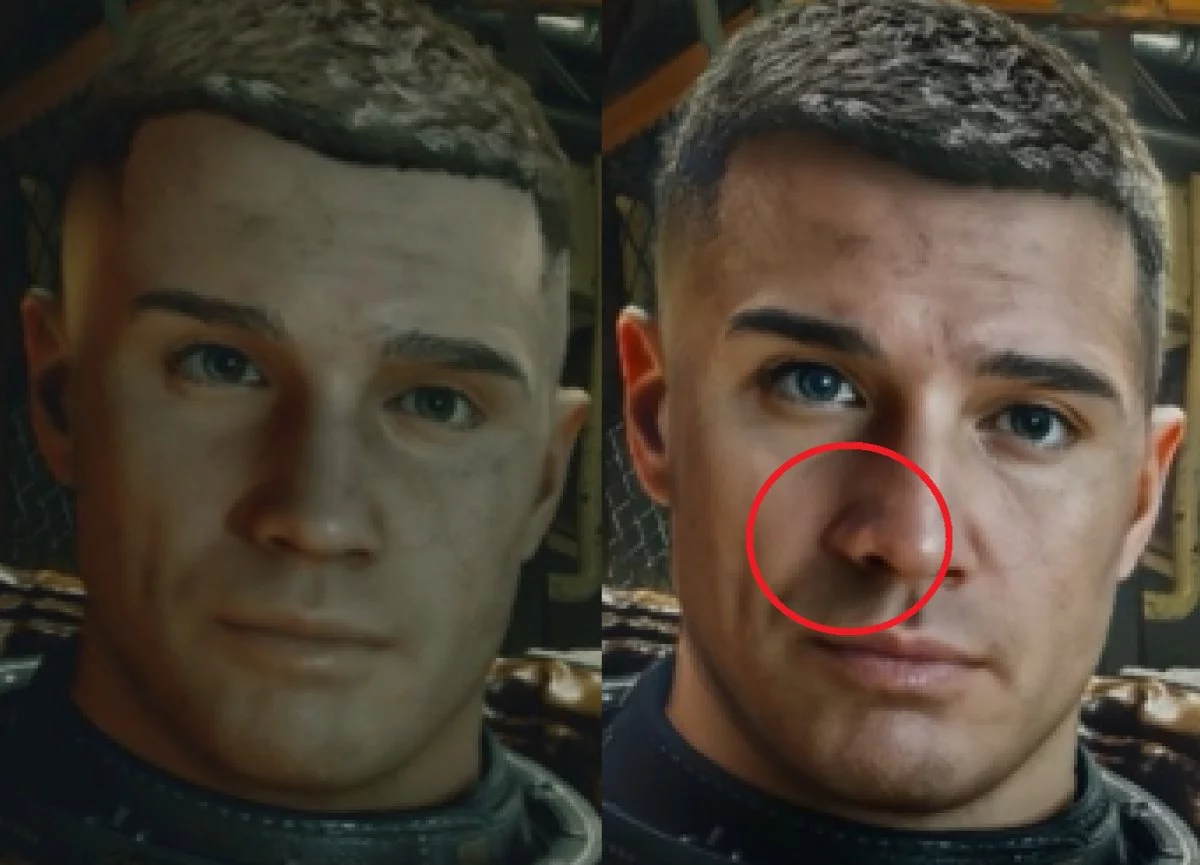

A “giga-nostril” moment that exposed the fault lines in AI rendering
Nvidia’s unveiling of DLSS 5, positioned as the next leap in AI-accelerated graphics, has run into an unusually visceral form of market feedback: gamer ridicule. A promotional “Starfield” screenshot—where a character’s facial shadow ballooned into a surreal, hyper-defined “giga-nostril”—became a shorthand critique for a deeper anxiety about generative AI in real-time rendering. The backlash is not merely about an unflattering frame; it’s about whether AI enhancement is drifting from *fidelity* toward *reinterpretation*.
For years, the promise of DLSS (Deep Learning Super Sampling) has been straightforward: use machine learning to improve performance and image quality, particularly at higher resolutions. DLSS 5 signals a more ambitious direction—neural synthesis of new pixel detail, not just reconstruction. That shift changes the implicit contract between hardware vendor, developer, and player. When AI begins to “invent” visual information, the question becomes: *whose aesthetic is on screen—the artist’s, the engine’s, or the model’s?*
Nvidia CEO Jensen Huang has emphasized that DLSS 5 is not a simple post-process effect, arguing that developers can control generative layers directly. Yet reported correspondence from an Nvidia engineer describing the system as effectively a 2D filter operating on frames and motion vectors complicates that narrative. The tension between executive messaging and engineering reality matters, because in graphics—especially in enthusiast communities—trust is a feature.
—
From supersampling to synthesis: what DLSS 5 implies technically
DLSS 5 represents a pivot from classic upscaling toward generative augmentation, echoing trends in film, photography, and computational imaging where models enhance or reconstruct detail beyond what the raw input provides. Gaming, however, is a harsher proving ground: it is interactive, latency-sensitive, and filled with edge cases—fast motion, particle effects, complex lighting, and stylized art direction.
Key technical implications emerging from the debate include:
- Generative detail can be aesthetically unstable
When a model infers missing information from 2D inputs (frames plus motion vectors), it can produce results that are “too clean,” overly sharpened, or anatomically odd—especially in shadows, skin tones, hair, and high-contrast edges. The “giga-nostril” artifact is emblematic of how small deviations can become instantly legible to players.
- Control levers may exist, but predictability is the real product
Nvidia’s claim that developers can constrain generative layers points to a hybrid approach: artists define boundaries, AI fills gaps. The practical challenge is that stochastic behavior—even if rare—can undermine confidence in a pipeline that must ship across thousands of scenes and millions of player-driven camera angles.
- The 2D-versus-3D integration gap remains central
If the system is primarily operating as a frame-based filter, it lacks holistic awareness of mesh topology, material properties, lighting models, and shader intent. True next-generation AI rendering would ingest richer scene data—geometry, textures, lights, animation states—reducing the chance that the model “hallucinates” detail that contradicts the underlying world.
This is where the industry opportunity sits: the next frontier is not simply better upscaling, but AI-to-3D workflows that respect the deterministic structure of game engines while still extracting performance and quality gains.
—
Market dynamics: premium GPUs, developer adoption, and the cost of a bad demo
DLSS has been a strategic differentiator for Nvidia against AMD FSR and Intel XeSS, helping justify premium pricing and reinforcing Nvidia’s position in the high-end GPU segment. DLSS 5’s generative ambitions could extend that advantage—if adoption is smooth and output is consistent.
But the current backlash highlights how quickly perception can shift when a feature touches the player’s sense of authenticity. In a market shaped by elevated component costs and more cautious discretionary spending, the upgrade calculus is fragile. A single viral artifact can become a proxy for broader skepticism: “Is this improvement, or is it AI gloss?”
From a business standpoint, several pressures converge:
- Developer risk aversion increases when art direction is a brand asset
Studios with distinctive visual identities may hesitate if generative enhancement is seen as flattening style into a generalized “AI look,” or if it introduces edge-case distortions that QA cannot reliably predict.
- Ecosystem lock-in only works when the ecosystem feels dependable
DLSS adoption strengthens Nvidia’s platform gravity. Yet lock-in is a double-edged sword: if players associate the feature with artifacts or “fake detail,” it can erode the very goodwill that makes proprietary advantages sustainable.
- Partnerships and validation programs become strategic, not optional
To counter negative demos, Nvidia may need deeper co-development with marquee studios—shared test suites, art-director sign-off workflows, and subsidized integration support—so that public-facing examples reflect best-case implementation rather than worst-case edge cases.
Competitors are positioned to capitalize. AMD and Intel can emphasize predictability and art fidelity, framing simpler reconstruction approaches as more respectful of original intent—even if they deliver less dramatic gains in certain scenarios.
—
Trust, governance, and the emerging rules of AI-assisted game visuals
The most consequential aspect of the DLSS 5 episode may be neither the artifact nor the feature set, but the governance questions it forces into the open. As real-time generative systems enter mainstream pipelines, studios and vendors will need clearer rules for what AI is allowed to change—and how those changes are disclosed, tested, and reversed.
Several themes are likely to define the next phase of AI graphics adoption:
- Transparency as product strategy: aligning corporate claims (“not a filter”) with technical realities (frame-based operation) to avoid credibility gaps.
- Quality assurance frameworks for generative behavior: defining acceptable ranges of alteration, building automated detection for anomalies, and ensuring robust fallback modes.
- Artist-first tooling: giving art directors practical, scene-level control—so AI assists rather than overrides visual intent.
- Cross-industry learning: borrowing from film post-production and industrial design, where generative tools are increasingly treated as *assistants with guardrails*, not autonomous stylists.
DLSS 5 sits at a pivotal intersection of AI acceleration, creative authenticity, and platform economics. If Nvidia can translate generative power into predictable, art-respecting outcomes—while communicating limitations with precision—the technology could redefine real-time rendering. If not, the “giga-nostril” will linger as a cautionary symbol: in interactive media, the smallest visual lie can become the loudest story.

 By
By
 By
By
 By
By

 By
By

 By
By
 By
By