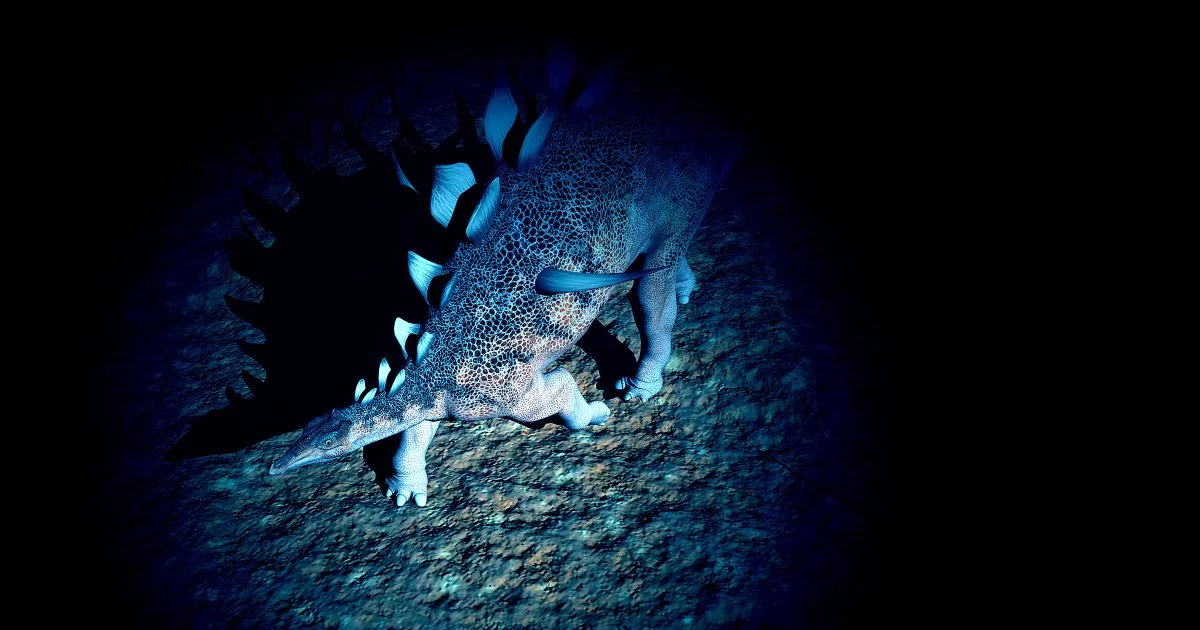

A dinosaur thought experiment that exposes the real physics of seeing across deep time
Astronomer Phil Plait’s revisit of the Chicxulub impact—the asteroid strike that ended the age of non-avian dinosaurs roughly 66 million years ago—is framed as a playful question with serious analytical bite: *If an extraterrestrial civilization sat 66 million light-years away, could it “look back” and watch dinosaurs still roaming Earth today?* Because light takes time to travel, the premise is physically sound. The barrier is not time, but resolution.
Plait’s back-of-the-envelope calculation lands on a stark constraint: to resolve a ~33-foot (10-meter) Tyrannosaurus rex at that distance, an optical system would need an effective aperture on the order of 3.4 light-years in diameter. That number is not a rhetorical flourish; it follows directly from diffraction-limited imaging, where angular resolution improves only as aperture grows. The implication is blunt: even if you had perfect detectors, perfect optics, and perfect stability, the universe charges an unforgiving “aperture tax” for fine detail at extreme range.
The engineering consequences are equally sobering. A monolithic mirror spanning light-years is beyond megastructure—it is interstellar-scale infrastructure. Even at a fantastically thin millimeter thickness, Plait notes the mass would exceed 100 million Earths, turning the thought experiment into a lesson about material limits, not merely optical ambition. Interferometry—combining many smaller telescopes into one “virtual” aperture—does not magically remove the requirement; it redistributes it into baseline length, coherence, and synchronization, while still demanding vast collecting area and extraordinary control.
Why aperture, interferometry, and tracking turn “seeing dinosaurs” into a systems-engineering impossibility
At the heart of the analysis is a simple relationship: angular resolution scales inversely with aperture. When the target is a moving, rotating planet and the desired feature is animal-sized, the problem becomes a multi-variable systems challenge:
- Aperture engineering at cosmic scales: Whether built as a single mirror or synthesized via interferometry, the effective aperture required for dinosaur-level detail is so large that it collides with practical constraints—mass, fabrication, deployment, and structural stability.
- Interferometric arrays are not a shortcut, they are a trade: Arrays can emulate a huge telescope, but only if they maintain phase coherence across vast distances. At optical wavelengths, that implies breakthroughs in:
– Sub-femtosecond timing and clock distribution
– Ultra-precise formation flying and baseline metrology
– Diffraction-limited photonics and wavefront control
- Dynamic tracking is a hidden “fourth dimension”: Earth is not a static billboard. Any attempt to image small features must account for planetary rotation, orbital motion, axial tilt, atmospheric turbulence, and changing illumination. At 66 million light-years, even tiny modeling errors translate into catastrophic blur.
Plait’s comparison to the Event Horizon Telescope (EHT) is instructive. The EHT demonstrated that distributed sensors can act as a single instrument—yet it operates at radio wavelengths, where coherence and atmospheric effects are more forgiving than in the optical. Translating that triumph into visible-light, sub-microarcsecond imaging would require not just incremental progress but a new class of precision space infrastructure.
The business of extreme optics: materials, compute, and the rise of “cloud-like” telescope networks
The most commercially revealing part of this discussion is that the limiting factors are not only optical—they are industrial and computational. Plait’s estimates for interferometric mirror material—on the order of 10^21 metric tons—underscore that the bottleneck is not a single breakthrough but an entire supply chain and manufacturing ecosystem that does not yet exist.
Key economic and industry dynamics emerge:
- Material supply chains beyond Earth: Terrestrial production cannot plausibly support mirror mass on planetary fractions. Any serious path toward ultra-large interferometric systems points to off-Earth resource extraction—lunar, asteroidal, or in-space manufacturing of ultra-light composites, metallic foams, or metamaterials engineered for stiffness-to-mass performance.
- Capital intensity and consortium governance: Projects of this magnitude would likely require multilateral frameworks resembling CERN or the International Space Station, with public-private partnerships allocating risk, intellectual property, and observation time. Falling launch costs—driven by reusable heavy lift—help at the margin, but the macroeconomics still imply hundreds of billions to trillions for mature architectures.
- Compute becomes part of the telescope: Large interferometers are fundamentally data correlation machines. Combining light from many collectors demands:
– Massive bandwidth and storage
– Distributed correlation at scale (effectively a space-based exascale workflow)
– In situ AI preprocessing to reduce raw data volumes before downlink
– Potentially photonic switching and, longer-term, quantum-secure links for synchronization and integrity
This is where the “cloud-in-space” analogy becomes more than metaphor. A future optical array resembles a cloud platform: nodes (telescopes), interconnects (links), and edge compute (local correlators). The competitive frontier shifts toward synchronization standards, networking protocols, and software-defined instrumentation, areas where telecom and hyperscale computing expertise could become as decisive as aerospace heritage.
From fanciful dinosaurs to actionable roadmaps for exoplanet imaging and strategic advantage
Plait’s conclusion is not that ambitious imaging is futile, but that the dinosaur benchmark is intentionally absurd—a calibration point that clarifies what is and isn’t plausible. The nearer-term opportunity is more grounded and, arguably, more transformative: within decades, advancing telescope technologies may allow humanity to resolve continental-scale features and weather patterns on exoplanets tens of light-years away.
A realistic roadmap implied by the analysis looks staged:
- Phase 1: Improve direct imaging and spectroscopy—better suppression of starlight, better detectors, better stability.
- Phase 2: Deploy kilometer-scale interferometers (likely in space) to resolve large-scale atmospheric structures on nearby worlds.
- Phase 3: Expand baselines via lunar infrastructure or Lagrange-point hubs, pairing precision formation flying with industrialized in-space assembly.
Strategically, the prize is not merely scientific prestige. The enabling technologies—precision timing, ultralight materials, autonomous assembly robotics, advanced metrology, and AI-coordinated sensor networks—spill into Earth observation, defense sensing, telecommunications, and high-precision manufacturing. Nations and firms that lead in interferometric algorithms, formation-flying control, and space-based compute will hold leverage in a domain where scientific capability increasingly overlaps with industrial competitiveness.
The enduring value of the “could aliens see dinosaurs?” question is that it reframes wonder as engineering reality: the universe permits extraordinary observation, but it demands extraordinary infrastructure. The next era of astronomy will be shaped less by a single flagship telescope and more by architected networks of instruments, where optics, compute, and geopolitics converge into one of the most consequential technology races of the century.

 By
By
 By
By
 By
By
 By
By
 By
By

 By
By
 By
By