
When AI Leaves the Screen: The Rise of Robot-Written, LLM-Composed Mail
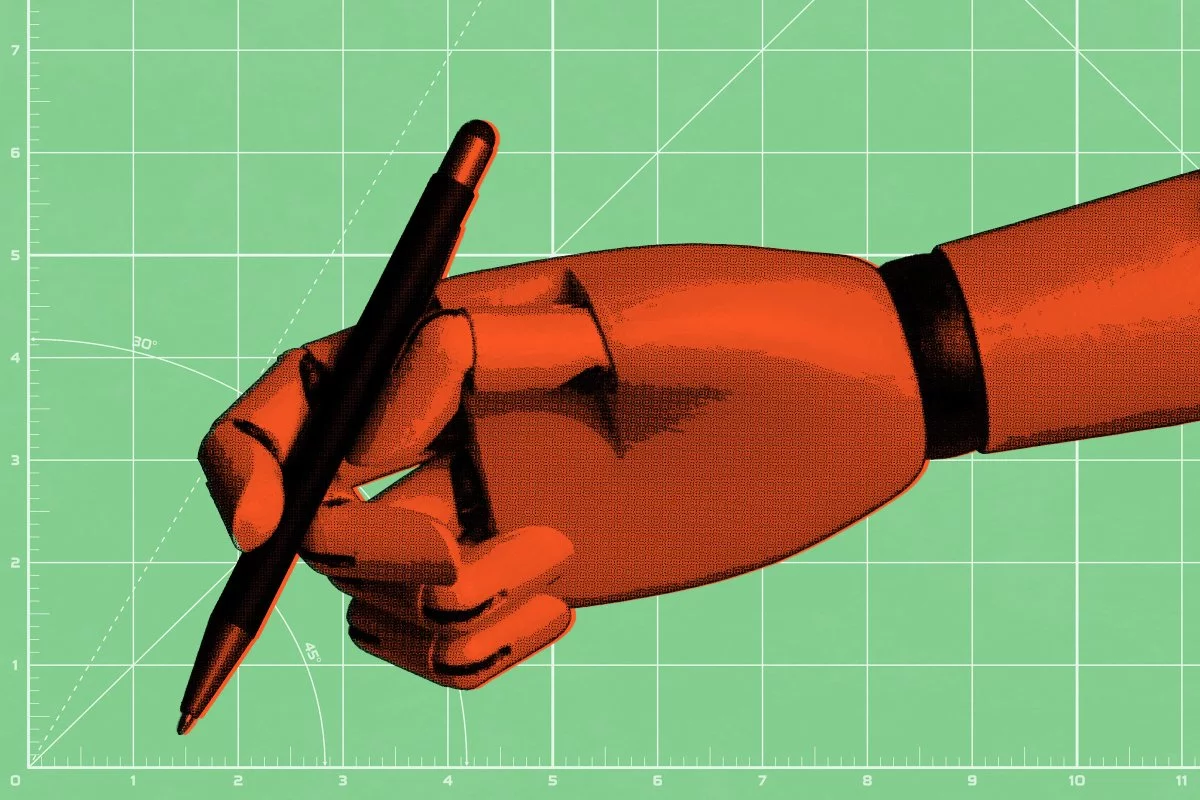
Handwrytten’s latest move signals a notable shift in business communication: AI-generated language paired with robotic handwriting to produce physical letters at scale. The company’s system combines a large language model (LLM) copy engine with proprietary handwriting robots, aiming to deliver what digital channels often struggle to achieve—attention, tactility, and perceived intimacy—without the labor cost of manual note-writing.
This is part of a broader “phygital” convergence, where digital intelligence increasingly manifests as tangible output. In practice, Handwrytten is attempting to industrialize a traditionally artisanal act. The platform can generate message content, adjust tone and length for different recipients, and—if users provide samples—replicate an individual’s penmanship with variability in stroke and pressure that mimics human imperfection. Those micro-variations matter: they are among the cues people subconsciously use to judge whether something feels “real.”
For marketers and customer-success teams, the proposition is straightforward: bring hyper-personalization into direct mail, a channel that has historically been slower, harder to measure, and operationally cumbersome. For recipients, the experience is more ambiguous—an object that looks personal, created through automation. That tension sits at the center of this category’s growth.
Subscription Direct Mail Meets the “Everything-as-a-Service” Economy
Handwrytten’s tiered subscription plans—ranging roughly from 24 to 100 mailed cards per month—reflect a familiar business model: predictable recurring revenue for the vendor, predictable spend and throughput for the buyer. It is the same logic that turned software into SaaS and logistics into on-demand fulfillment, now applied to relationship-building collateral.
The timing is not accidental. Many organizations are confronting digital saturation: inbox overload, declining email engagement, rising paid-media costs, and a general fatigue with screen-first interactions. Physical mail, especially when it appears personalized, can cut through that noise. While “open rate” is an imperfect metric in direct mail, the underlying point resonates with growth teams: a letter is harder to ignore than a notification.
From an economic standpoint, the service also reframes “emotional labor” as an operational variable. Instead of asking sales reps, executives, or customer-success managers to spend hours writing notes, the platform turns that effort into a workflow—one that can be scheduled, A/B tested in spirit if not in strict digital terms, and scaled across segments.
Key market dynamics emerging around this model include:
- Recurring revenue and procurement simplicity for businesses that want consistent outreach without ad hoc ordering
- Higher perceived value per touch compared with email or SMS, particularly for retention, win-back, and high-consideration sales cycles
- A measurable shift toward omnichannel CRM, where physical mail becomes another automated “step” alongside email sequences and ads
Yet the economics will ultimately depend on whether these notes remain a novelty or become a durable channel. If every brand can send “handwritten” mail on demand, the differentiator moves from handwriting itself to timing, relevance, and authenticity of intent.
Competitive Crowding and the Battle for Workflow Integration
Handwrytten positions itself as a leader in the handwritten notes category, but it operates in a crowded field with at least ten direct competitors—including LettrLabs, Postable, Cardly, and others. That level of saturation suggests a market that is both validated and vulnerable: validated because multiple entrants see demand; vulnerable because differentiation can erode quickly.
In categories like this, long-term advantage tends to accrue to companies that become infrastructure rather than novelty. That means deep integration into CRM and marketing-technology stacks—Salesforce, HubSpot, and marketing automation platforms—so that sending a robot-written note is as frictionless as triggering an email campaign. Without seamless APIs, templating, segmentation, and reporting, even a compelling product risks being relegated to a standalone tool used sporadically.
Handwrytten’s most defensible edge may lie in what could be called handwriting IP: the ability for clients to upload handwriting samples and reproduce a recognizable script style. Over time, this creates a proprietary library of styles and performance data—an asset that can raise switching costs and improve output quality.
At the same time, competitive pressure often accelerates consolidation. As direct mail becomes a standard feature in omnichannel marketing, the likely endgame includes:
- Acquisitions by larger MarTech platforms seeking end-to-end customer engagement capabilities
- Partnerships with fulfillment and logistics providers to reduce cost and improve delivery consistency
- White-label distribution that embeds handwriting automation inside broader CRM suites
The strategic question is not merely who can write the most convincing script, but who can become the default “physical touchpoint layer” inside enterprise workflows.
Trust, Biometrics, and the New Ethics of “Personal” Automation
The most consequential implications may be societal rather than mechanical. Handwrytten’s model depends on a delicate psychological contract: recipients interpret handwriting as a proxy for time, care, and individual attention. When that proxy is automated, the meaning of the gesture changes, even if the artifact looks the same.
This introduces a growing authenticity-versus-efficiency trade-off. If recipients begin to assume that “handwritten” equals “robot-written,” the channel could lose its emotional premium—unless brands adopt transparent norms. Disclosure policies, opt-out mechanisms, and responsible use guidelines may become not just ethical safeguards but competitive necessities.
There is also a data dimension that deserves scrutiny. When users upload handwriting samples, the platform accumulates a dataset that is both stylistic and potentially biometric. Over time, such data could enable:
- More accurate handwriting synthesis and personalization
- Handwriting-based authentication concepts (even if not the current product focus)
- Sentiment or intent modeling based on writing characteristics and response outcomes
That raises governance questions about storage, consent, and secondary use—especially as regulators explore AI disclosure rules and as privacy frameworks tighten around sensitive personal data.
Finally, the environmental footprint of a direct-mail resurgence will draw attention. If volumes rise, so will scrutiny of paper sourcing, printing inputs, and delivery emissions. Providers that can credibly offer recycled materials, responsible sourcing, and carbon-aware logistics may find ESG considerations becoming a deciding factor in enterprise procurement.
Handwrytten’s bet is that the future of business communication is not purely digital, but digitally orchestrated and physically delivered—a world where LLMs craft the words, robots render the handwriting, and brands compete on whether the recipient feels remembered rather than targeted. The companies that thrive in this space will be those that treat automation not as a substitute for sincerity, but as a tool that must earn trust with every envelope opened.

 By
By
 By
By

 By
By
 By
By

 By
By