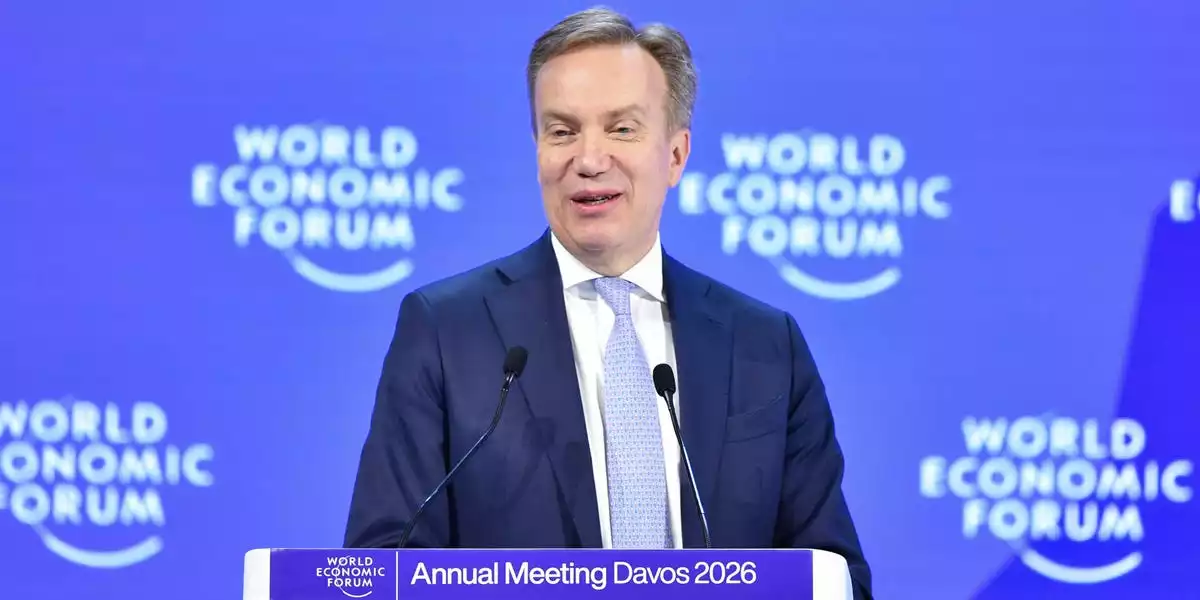

A leadership exit that tests the World Economic Forum’s credibility architecture
Børge Brende’s resignation after more than eight years as President and CEO of the World Economic Forum (WEF) lands as a governance story with outsized implications for global business, technology policy, and institutional trust. The proximate trigger—an independent review prompted by emails released by the U.S. Department of Justice confirming three dinners with Jeffrey Epstein in 2018–2019—matters not only because of the meetings themselves, but because of the reputational mechanics surrounding them.
The most destabilizing element is the credibility gap created by shifting public accounts: Brende’s later acknowledgment of the dinners contradicted earlier denials, inviting scrutiny of how a premier convening institution manages due diligence, disclosure, and crisis communications. For a platform that trades on neutrality and probity, perception is not a soft asset; it is core infrastructure. When that infrastructure is questioned, the Forum’s ability to convene heads of state, CEOs, central bankers, and technologists becomes harder to sustain at the same level of confidence.
The WEF’s co-chairs—André Hoffmann and Larry Fink—have stated the review found no further wrongdoing. Yet even a “no further findings” outcome does not automatically restore trust, because the reputational issue is less about legal culpability and more about institutional safeguards: what was known, when it was known, and what controls existed to prevent high-risk engagements from occurring or persisting.
Due diligence, board oversight, and the new standard for reputational risk management
The Brende episode underscores a reality facing global institutions and multinational corporations alike: reputational risk now behaves like operational risk—fast-moving, evidence-driven, and amplified by document trails. In an era where emails, calendars, and donor networks can surface through litigation or investigative reporting, governance models must assume that private interactions may become public facts.
Key governance dynamics now in focus include:
- Leadership accountability and narrative consistency: Discrepancies between initial denials and later admissions can be more corrosive than the underlying event, because they suggest weak internal reporting lines or reactive disclosure practices.
- Guest and stakeholder vetting protocols: Organizations that convene elite networks require structured screening for high-risk individuals, not only at the point of invitation but through continuous monitoring as new information emerges.
- Board-level ownership of ethics and compliance: The co-chairs’ endorsement of the review’s independence signals an intent to contain the issue, but it may also invite calls for more formalized oversight—such as expanded compliance committees, clearer escalation pathways, and documented decision rights around sensitive engagements.
For the WEF, the challenge is uniquely acute: it is neither a government body nor a typical corporation. Its legitimacy is derived from a hybrid mandate—public-private collaboration—where stakeholders bring their own political and moral capital. That makes the Forum’s governance posture a proxy for the integrity of the broader ecosystem it convenes.
Davos as a strategic asset—and why leadership turbulence can ripple into markets and policy
The WEF’s convening power has long functioned as a form of soft infrastructure for global capitalism: a place where policy ideas are socialized, cross-border partnerships are initiated, and emerging norms—on sustainability, digital governance, and workforce transformation—gain momentum. Leadership instability at the top can therefore create second-order effects that extend beyond the organization’s walls.
From a business and technology lens, several channels matter:
- Membership and sponsorship confidence: Corporate stakeholders assess whether the Forum remains a low-risk venue for brand association and executive participation. Even temporary uncertainty can affect renewals, attendance decisions, and the willingness to anchor initiatives.
- Agenda-setting continuity: The WEF’s influence often comes from sustained, multi-year coalitions on issues like ESG metrics, AI ethics, cyber resilience, and climate finance. A leadership transition can slow consensus-building precisely when companies seek clearer signals for investment and compliance planning.
- Policy-to-market transmission: WEF dialogues frequently intersect with G20, IMF, and World Bank conversations. If the Forum’s voice is muted or distracted, the downstream effect can be a delay in policy coordination—on digital taxation, climate-related disclosure, or AI governance—at a time when inflationary pressures and geopolitical fragmentation already complicate alignment.
The appointment of Alois Zwinggi as interim President and CEO provides operational continuity, but the strategic question is whether the Forum can keep its initiatives insulated from leadership reputational shocks. In today’s environment, institutions are increasingly judged by whether they can demonstrate systemic resilience, not just charismatic stewardship.
What the episode signals for global institutions shaping AI, finance, and geopolitics
Beyond the WEF, the Brende resignation adds to a broader pattern: skepticism toward global “rule-making” bodies and elite conveners is rising, and the threshold for legitimacy is tightening. For technology companies, financial institutions, and policymakers, the lesson is not simply “avoid controversy,” but engineer governance that anticipates scrutiny.
Several forward-looking imperatives stand out—both for the WEF and for peer institutions:
- Process innovation to rebuild trust
– Establish a standing ethics council with rotating civil-society participation to vet high-risk engagements.
– Increase transparency around sponsorships, speaker selection, and governance decisions—potentially using tamper-evident digital audit trails where appropriate.
- Modernize convening models to reduce concentrated reputational exposure
– Expand hybrid and virtual participation to broaden representation and reduce overreliance on a single annual summit.
– Use AI-driven analytics to detect emerging reputational risks and stakeholder concerns earlier, before they escalate.
- Protect delivery pipelines from leadership volatility
– Create cross-industry “rapid response” task forces on urgent domains such as AI safety, grid modernization, and cyber incident coordination.
– Publish multi-year roadmaps tied to measurable outcomes, shifting attention from personalities to deliverables.
- Distribute leadership and decision rights
– Empower regional and thematic leaders with delegated authority, reducing single-point-of-failure dynamics.
– Formalize succession and crisis-management training as a core governance capability.
The WEF’s central value proposition has always been its ability to convene across borders and sectors when formal diplomacy stalls. Whether it can retain that role now depends on how convincingly it demonstrates that its governance systems are as modern—and as accountable—as the global technology and financial architectures it seeks to influence.

 By
By

 By
By
 By
By
 By
By
 By
By

 By
By