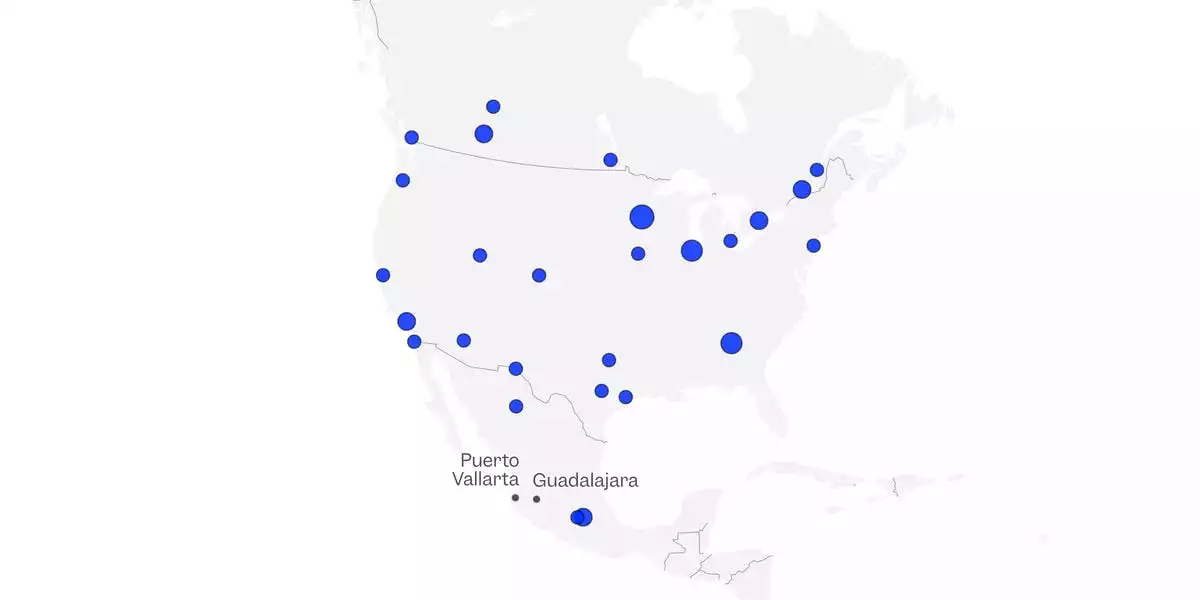

A security shock that rippled through Mexico’s aviation and tourism arteries
The reported killing of Nemesio “El Mencho” Oseguera on February 22, 2026—and the immediate surge of cartel violence that followed—illustrates how quickly a localized security event can metastasize into a national mobility disruption with international economic consequences. Across multiple Mexican states, highway blockades and torched vehicles created a fast-moving perimeter of risk that did not require formal airport closures to paralyze air travel. Instead, the disruption migrated to the most fragile link in the journey: ground access to terminals and surrounding road networks.
The operational outcome was stark. Roughly 370 flight cancellations and more than 39 diversions affected routes into Puerto Vallarta and Guadalajara, two gateways that sit at the intersection of leisure demand, regional commerce, and nearshoring-linked business travel. The most vivid examples—an Aeroméxico Madrid–Puerto Vallarta service circling for nearly 11 hours before diverting to Monterrey, WestJet Calgary–Puerto Vallarta flights returning to Alberta, and private jets rerouted to Austin and southern Texas—underscore a modern aviation reality: when uncertainty spikes, airlines and crews often choose the conservative option, even at high cost.
Government advisories from Canada and the United States urging citizens to shelter in place amplified the perception of danger. For airlines, hotels, and corporate travel managers, perception is not a secondary factor; it is a demand signal that can turn into cancellations, insurance claims, and prolonged reputational drag long after roads reopen.
Tourism revenue, brand confidence, and the economics of “access disruption”
Puerto Vallarta’s role as a tourism engine—accounting for nearly 15% of Jalisco’s tourism receipts—makes it particularly sensitive to interruptions that coincide with peak travel windows. Even a short suspension of arrivals can cascade through the local economy, affecting not only hotels but also the dense supplier ecosystem that supports them.
Key economic fault lines exposed by the episode include:
- Revenue shock across hospitality and services: A multi-day interruption can translate into a 1–2% contraction in state-level hospitality revenues, with knock-on effects for food and beverage suppliers, tour operators, ride services, and informal employment tied to visitor flows.
- Reputation and substitution risk: When the U.S. and Canada issue heightened warnings, travelers with flexible plans often redirect to “safer” substitutes—the Caribbean, Costa Rica, or U.S. domestic beach markets—and that market share can be difficult to win back quickly.
- Price and margin pressure: Airlines absorb immediate costs from diversions and extended holding patterns—fuel burn, crew time, repositioning—then attempt to recover them through yield management. Hotels face the opposite problem: discounting to restore occupancy can compress margins precisely when security-related operating costs rise.
This is the central tension for Mexico’s tourism-dependent regions: the sector is a stabilizer—tourism contributes over 8% of national GDP—yet it is also uniquely exposed to “access disruption,” where airports remain technically open but become functionally unreachable or undesirable.
Nearshoring meets volatility: supply chains, insurance, and operational resilience under USMCA
Beyond leisure travel, the Guadalajara–Puerto Vallarta corridor is economically strategic because it supports just-in-time logistics for regional auto and electronics clusters. Highway blockades do not merely delay tourists; they interrupt the cadence of modern manufacturing, where hours matter and inventory buffers are intentionally thin.
For companies operating under USMCA-linked supply chains, the incident highlights several structural vulnerabilities:
- Logistics fragility in critical corridors: Blocked roads can delay inbound components and outbound finished goods, increasing the probability of missed delivery windows and contract penalties.
- Insurance repricing and “war-risk” logic: Carriers and freight operators may face elevated war-risk premiums and tighter underwriting terms, especially if disruptions recur.
- Cost pass-through dynamics: Diversions, longer routings, and security-driven scheduling changes increase operating costs that can surface as higher airfares, freight rates, and ultimately consumer prices.
At a macro level, Mexico remains a linchpin in North American nearshoring strategy, but sustained volatility can influence boardroom decisions. Multinationals rarely exit overnight; they diversify—adding redundancy across geographies, splitting production lines, or shifting incremental investment elsewhere. The long-term risk is not a sudden collapse in foreign direct investment, but a gradual erosion of momentum as firms price insecurity into capital allocation.
The technology race: geospatial intelligence, AI-driven operations, and crisis communications
If the violence exposed a weakness, it also clarified where competitive advantage may emerge: real-time risk intelligence and digital crisis management. The operational challenge is no longer limited to weather and mechanical reliability; it now includes rapidly evolving ground threats that can render a destination operationally “closed” without any formal aviation restriction.
Several technology and security capabilities are moving from optional to essential:
- Geospatial analytics and live road intelligence: Demand is rising for satellite imagery, geofenced alerts, and verified road-blockage feeds that can be integrated into airline dispatch and corporate travel dashboards. The goal is practical: reduce diversion time, avoid unnecessary holding, and make earlier, safer decisions.
- Dynamic rerouting and fleet reconfiguration: Airlines with machine-learning tools that anticipate cascading disruptions—crew legality, gate availability, downstream rotations—can contain network damage faster than competitors relying on manual playbooks.
- Traveler engagement and duty-of-care platforms: Mobile apps enabling push alerts, secure messaging, and in-app check-ins are becoming core infrastructure for hotel chains and corporate travel programs operating in higher-risk zones.
- Predictive policing and private-sector threat assessments: As authorities accelerate AI-driven forecasting pilots, private security firms and risk-data vendors see expanding demand for hyper-local assessments tailored to specific hotels, routes, and times of day.
The strategic implication is clear: security is increasingly being treated as a data problem—one that can be modeled, monitored, and operationalized—without pretending it can be fully “solved” by technology alone.
For Mexico’s travel economy and nearshoring narrative, the episode is a stress test of resilience. The next chapter will be written by how quickly public authorities restore predictable mobility, how transparently risk is communicated, and how effectively airlines, insurers, and enterprises embed real-time intelligence into decisions that used to be driven primarily by schedules, forecasts, and price.


 By
By
 By
By


 By
By
 By
By