

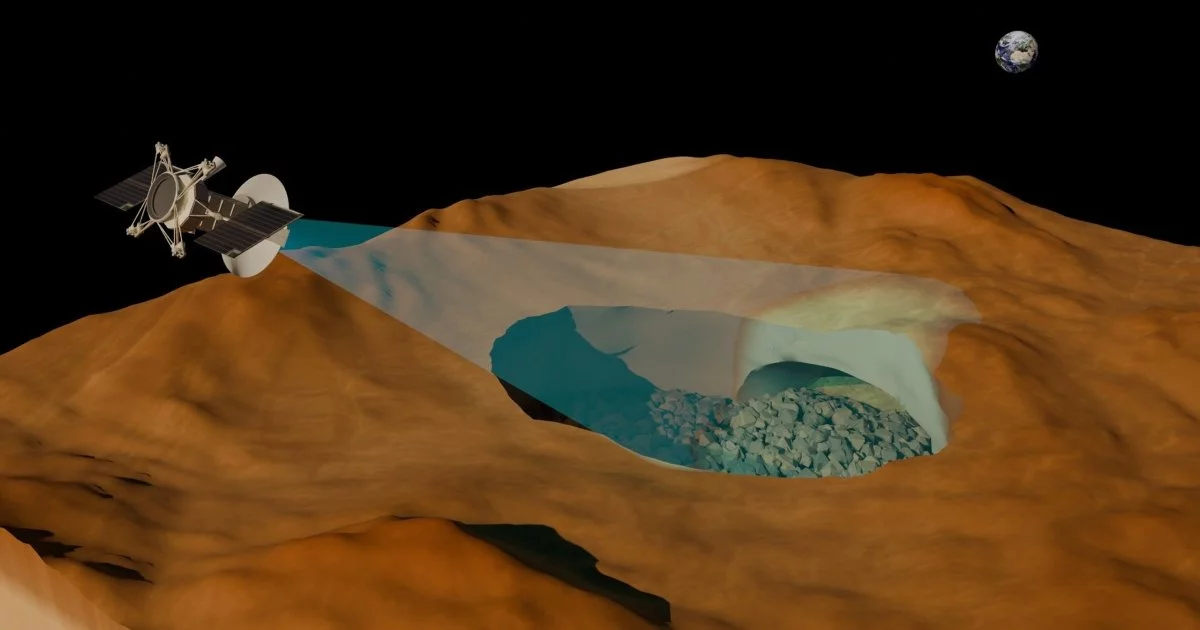

Unveiling Venus’s Subsurface: The Discovery That Rewires Space Technology and Earth’s Industrial Playbook
The revelation of kilometer-scale lava tubes beneath Venus’s surface, confirmed through a fresh radar-driven analysis of archival Magellan spacecraft data, is more than a planetary-science milestone—it’s a tectonic shift for technology, industry, and the emerging off-world economy. These vast, hidden conduits near the Nyx Mons shield volcano, stretching at least 45 kilometers, dwarf their terrestrial counterparts and ignite a cascade of implications for remote sensing, robotics, and the commercial calculus of space.
The Renaissance of Radar: Unlocking Value from the Past and Future
The Magellan mission’s synthetic-aperture radar (SAR), launched more than three decades ago, has become a case study in the latent potential of historical data. The ability to extract new insights from legacy datasets—thanks to modern machine learning and edge analytics—has transformed what was once considered scientific detritus into a goldmine of actionable intelligence.
Key technological inflections include:
- SAR’s Strategic Relevance:
– The leap from Magellan’s original SAR to today’s multi-band, interferometric, and cognitive radar systems promises resolution gains of up to 50×, making the detection of subsurface features not only possible but commercially viable.
– On-orbit processing and AI-enhanced image reconstruction now reduce analytical cycles from months to hours, setting a new standard for both space and terrestrial applications.
- Algorithmic Autonomy:
– The research team’s shift from “sensor-centric” to “insight-centric” mission architectures signals a broader trend: embedding AI at the edge.
– Future Venus orbiters equipped with onboard inference engines could autonomously identify and target geologically significant sites, a paradigm readily transferable to Earth-observation constellations monitoring infrastructure, agriculture, and disaster zones.
- Extreme-Environment Robotics:
– The existence of Venusian lava tubes, offering natural shielding from the planet’s crushing pressure and searing heat, underscores the urgent need for high-temperature electronics, advanced ceramics, and resilient power systems.
– These innovations, while critical for planetary exploration, have immediate terrestrial spill-over, especially in geothermal energy, hypersonic flight, and deep-well drilling.
Economic Catalysts: Space Commerce, Industrial Feedback Loops, and New Asset Classes
The commercial reverberations of this discovery are profound. Global SAR satellite revenues are projected to top $8 billion by 2030, and the validation of large-scale subsurface voids on Venus is a catalytic proof-point for further capital inflows. The bipartisan U.S. CHIPS and Science Act, by earmarking funds for specialty semiconductors, is already lowering barriers for both space and terrestrial buyers.
Emerging economic vectors:
- Lunar and Martian Real Estate:
– As private ventures such as ispace and Intuitive Machines accelerate the race for lunar resource utilization, the confirmation of Venusian lava-tube architectures strengthens the business case for analogous habitats on the Moon and Mars.
– This paves the way for new asset classes, including “subsurface lease rights,” and reframes the risk-reward calculus for investors and insurers alike.
- Cross-Sector Technology Transfer:
– Techniques honed for detecting voids in Venus’s dense crust are immediately applicable to Earth-based challenges: from monitoring subsurface carbon sequestration to critical-minerals exploration, tightening the feedback loop between space innovation and ESG mandates.
- Insurance and Risk Modeling:
– Enhanced geological models of Venus feed directly into comparative planetology, indirectly refining climate-risk assessments on Earth—a differentiator for underwriters in an era of escalating catastrophic-weather events.
Strategic Imperatives: From Data Sovereignty to Quantum-Safe Space
The implications ripple far beyond planetary science. The re-use of legacy U.S. government data surfaces complex questions around open science and strategic control, echoing debates in commercial Earth observation. Meanwhile, the coming wave of high-bandwidth radar missions will force agencies and contractors toward quantum-safe encryption, offering early-mover advantages for vendors in this nascent market. Even the metaverse stands to benefit: high-fidelity Venusian geomorphology will soon inform simulation engines powering defense training and industrial digital twins.
Recommendations for forward-leaning organizations:
- Invest in multi-modal sensor stacks—integrating SAR, hyperspectral, and lidar—with edge-AI pipelines to unlock value across planetary and terrestrial domains.
- Track upcoming mission selections and position in high-temperature avionics and inflatable heat-shields, where first-mover advantage is within reach.
- Pursue public-private partnerships to mine dormant planetary datasets, converting archival data into proprietary IP and actionable insight.
- Build scenario plans around subsurface habitation and lava-tube engineering, as lunar commercialization intensifies.
- Hedge supply-chain exposure in specialty ceramics, wide-bandgap semiconductors, and high-frequency RF modules—materials poised for secular demand growth.
The confirmation of Venusian lava tubes, brought to light by a deft fusion of radar technology and AI-driven analytics, signals a new era where planetary science, commercial strategy, and industrial innovation converge. Those who move decisively—translating insight into capital allocation and cross-sector collaboration—will define the next chapter of the off-world economy, as exploration gives way to infrastructure and the boundaries between science fiction and enterprise dissolve.

 By
By
 By
By
 By
By

 By
By


 By
By


