

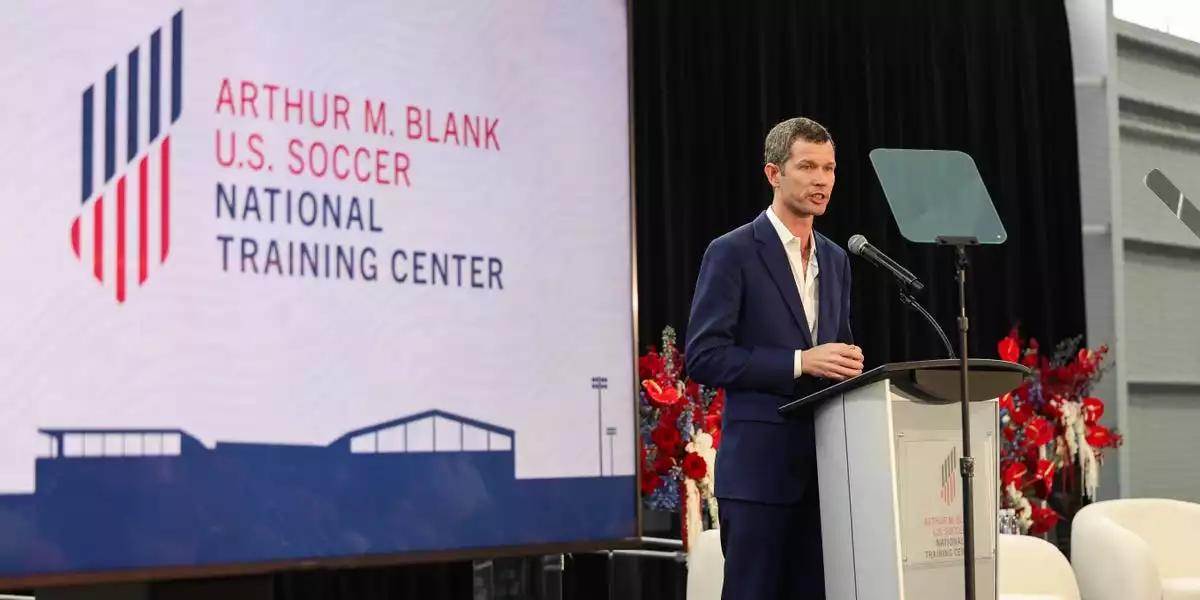

A CEO shaped by ad tech arrives as U.S. Soccer recalibrates its social contract
JT Batson’s ascent to CEO of U.S. Soccer lands at a moment when the federation is redefining both its public legitimacy and its commercial posture. The backdrop matters: Batson stepped into the role amid a landmark pay-equity settlement with the U.S. women’s national team, a dispute that had become as much a reputational referendum as a labor negotiation. Resolving it does not merely close a chapter—it resets the federation’s operating environment with sponsors, athletes, and policymakers increasingly attentive to ESG-aligned governance.
Batson’s professional DNA—rooted in advertising technology entrepreneurship—signals a leadership bet on modern growth mechanics: data, personalization, and scalable digital distribution. In the sports economy, that background is less an outlier than it once was. Federations and leagues are steadily borrowing from high-velocity digital businesses where customer acquisition, retention, and monetization are engineered through feedback loops rather than tradition.
Two strategic implications stand out:
- Trust as an asset class: The pay-equity resolution strengthens U.S. Soccer’s credibility with corporate partners that now evaluate brand risk and social alignment alongside reach and impressions.
- A shift from “sports administration” to “sports enterprise”: Batson’s framing of the 2026 FIFA World Cup as an “IPO moment” reflects a capital-markets mindset: the event creates visibility, but durable value is created in the years after, through disciplined execution and compounding engagement.
Vertical integration: why bringing sponsorship and media rights in-house changes the economics
One of the most consequential moves under Batson has been internalizing sponsorship, media, and licensing rights management, pulling commercial control back from third-party agencies. This is a classic vertical integration play—akin to how major media companies have sought to own content, distribution, and customer relationships end-to-end.
For U.S. Soccer, the benefits are not only financial; they are informational. Owning the commercial stack improves the federation’s ability to learn, iterate, and price its inventory with precision.
Key enterprise advantages of in-house rights management include:
- Tighter data feedback loops: Direct visibility into sponsor performance, fan response, and content consumption enables faster optimization of campaigns and packages.
- More agile sponsorship activation: Instead of annual, static deals, U.S. Soccer can evolve toward modular offerings—digital-first placements, community programs, athlete-led content, and experiential formats.
- Improved licensing yield: With better control over brand governance and distribution, the federation can expand merchandise and licensing across physical retail, direct-to-consumer channels, and emerging digital formats.
- Stronger negotiating leverage: A federation that controls its commercial narrative and audience data can command more favorable terms with broadcasters, platforms, and sponsors.
This restructuring is reinforced by reported financial momentum: three consecutive years of profitability and a three-fold increase in revenue. While the details behind those figures matter—mix shift, one-time effects, and event cycles—the directional signal is clear: U.S. Soccer is attempting to become a more predictable, investable organization rather than one dependent on episodic tournament spikes.
Building an AI-era fan economy beyond the stadium gates
Polling indicating that 70% of Americans engage with soccer is a strategic prompt: the addressable market is already mainstream, but the monetizable relationship is uneven. The federation’s stated priority—using digital and AI tools to reach the vast majority of fans who never enter a stadium—aligns with the central reality of modern sports business: growth is increasingly driven by remote fandom, not seat inventory.
In practical terms, AI and digital infrastructure can help U.S. Soccer do three things at once: broaden access, personalize experiences, and improve decision quality.
High-impact use cases likely to define the next phase include:
- Personalized fan journeys: Recommendation systems for highlights, player stories, and match replays that convert casual interest into habitual engagement.
- Dynamic monetization models: Data-informed pricing for tickets and hospitality, plus smarter bundling of subscriptions, merchandise, and experiences.
- Performance and scouting analytics: Cloud-based platforms that integrate training and match data to support talent identification and player development pathways.
- Immersive and interactive formats: Virtual match-day experiences, augmented overlays, and social viewing features that make national-team moments feel participatory at scale.
The hiring of leaders from outside traditional sports—such as COO Dan Helfrich—underscores a deliberate strategy of importing operating discipline from sectors where experimentation and measurement are standard. In ad tech, personalization at scale is not aspirational; it is operational. Translating that capability into soccer could enable more precise segmentation—youth players, families, multicultural communities, corporate partners—and more efficient commercialization through programmatic-style inventory thinking.
From Atlanta’s training center to the 2026 “IPO moment”: converting spotlight into durable growth
The opening of a national training center in Atlanta is more than a facilities upgrade; it is an institutional anchor. Infrastructure signals permanence, and permanence supports long-horizon planning—especially as U.S. Soccer looks toward a sequence of catalytic events: the 2026 World Cup, the 2028 Los Angeles Olympics, and ambitions tied to co-hosting the 2031 Women’s World Cup.
Batson’s “IPO moment” analogy is instructive because it reframes 2026 as a liquidity event for attention: a surge of global visibility that can either dissipate or be reinvested into durable capabilities. The federation’s challenge is to build an “aftermarket” that keeps new fans engaged, keeps sponsors renewing, and keeps participation rising once the tournament leaves town.
Strategic priorities implied by the current direction are increasingly clear:
- Institutionalize data-driven governance: A centralized data council spanning commercial, sporting, and engagement functions would reduce fragmentation and accelerate learning cycles.
- Scale community ecosystems: Use Atlanta as a blueprint for regional hubs that blend training, events, and tech-enabled fan festivals—creating year-round relevance and revenue.
- Elevate women’s soccer as a growth engine: With pay equity resolved and the U.S. women’s team a powerful cultural property, differentiated sponsorship tiers and content franchises can become a global commercial lever.
- Align with national economic objectives: Coordination with cities, tourism bodies, and public agencies can turn soccer growth into a broader infrastructure and development narrative—important for host-region buy-in and long-term investment.
If U.S. Soccer can pair its newfound commercial control with AI-enabled engagement and credible governance, the federation’s next era may be defined less by isolated tournament peaks and more by compounding enterprise value—built fan by fan, dataset by dataset, and community by community.

 By
By
 By
By

 By
By
 By
By


 By
By







