

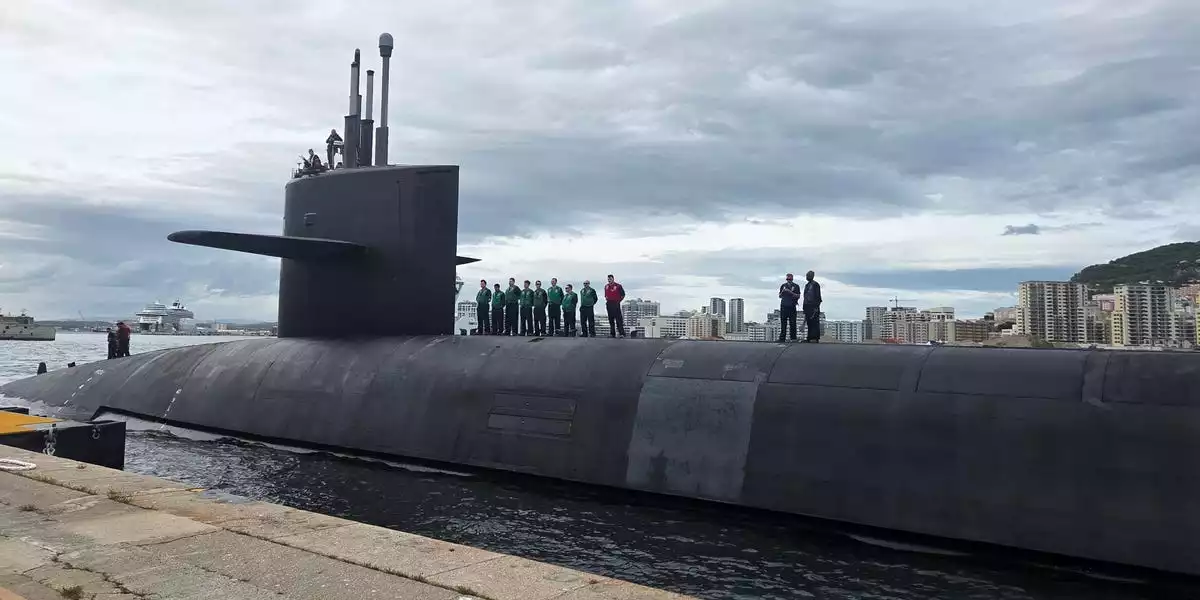

A Gibraltar Port Call That Speaks in Deterrence, Not Declarations
The arrival of a U.S. Navy Ohio-class ballistic-missile submarine in Gibraltar—a British territory positioned at the narrow gateway between the Atlantic and the Mediterranean—lands with the quiet weight that only undersea nuclear forces can deliver. Official messaging may avoid naming adversaries, yet the timing is difficult to separate from the broader strategic weather: heightened U.S.–Iran tensions, warnings around the Strait of Hormuz, and a regional maritime environment increasingly shaped by blockades, drone surveillance, and asymmetric strikes on commercial shipping.
Ohio-class submarines are not routine naval visitors. As one of 14 boats that carry up to 20 Trident II D5 submarine-launched ballistic missiles, the platform represents the most survivable leg of the U.S. nuclear triad—alongside land-based intercontinental ballistic missiles (ICBMs) and strategic bombers. When such an asset becomes visible through a port call, it functions as a calibrated signal: not a tactical move, but a strategic reminder that escalation has ceilings, and those ceilings are enforced by capabilities designed to endure first strikes and still respond.
This is also part of a recognizable pattern. Recent years have seen high-visibility submarine deployments used to communicate resolve—whether surfacing near Norway amid Russian activity or operating in the Red Sea during the Israel–Hamas conflict. Gibraltar adds a new geographic emphasis: the Mediterranean’s entrance, adjacent to shipping lanes that connect European industry, North African energy flows, and Middle Eastern trade routes.
Undersea Deterrence Meets a New Surveillance Era
The Ohio-class design philosophy is built around a single operational truth: deterrence depends on survivability. These submarines leverage advanced acoustic dampening, anechoic coatings, and ultra-quiet propulsion to reduce detectability by passive sonar. That stealth is not merely a technical achievement—it is the foundation of credible second-strike capability, the stabilizing logic that discourages strategic attacks by ensuring retaliation remains possible.
Yet the undersea environment is becoming less forgiving. The proliferation of maritime surveillance drones, over-the-horizon radar, and space-based sensing is steadily compressing the stealth envelope that ballistic-missile submarines have historically relied upon. This is where the next decade’s competition is likely to intensify: not simply in hull counts, but in the ability to preserve concealment in a world saturated with sensors.
Several technology vectors stand out as the undercurrent of this story:
- Resilient command, control, and communications (C³): Submerged connectivity via Very Low Frequency (VLF) links—often at periscope depth—illustrates how deterrence is as much about communications integrity as it is about missiles. In contested littorals, the ability to receive authenticated orders under electronic warfare pressure becomes a strategic asset in its own right.
- Next-generation secure communications: Future-facing concepts such as quantum key distribution and laser-based undersea communications point to a race to reduce transmission delays while hardening encryption against interception and tampering.
- AI-enabled sensor fusion and evasion: Artificial intelligence and machine learning are increasingly positioned to augment both targeting and defensive maneuvering—helping platforms interpret complex acoustic environments and respond faster than human-only workflows allow.
- Counter-stealth innovation: As detection improves, so does the incentive to invest in metamaterials, active noise cancellation, and other approaches that preserve undersea ambiguity.
The Gibraltar visit, viewed through this lens, is not only a geopolitical signal—it is a reminder that strategic stability is now entangled with data, sensors, and communications resilience, not just warhead counts.
Defense Industrial Gravity: Columbia-Class Spending and Supply-Chain Fragility
Behind the operational theater sits a massive industrial reality. The United States is already committed to replacing the Ohio class with the Columbia-class ballistic-missile submarines, a program expected to exceed $110 billion over the coming decade. That investment creates durable demand across a specialized ecosystem: high-tensile steels, titanium-grade materials, bespoke microelectronics, and precision manufacturing that few suppliers can deliver at scale.
This is where deterrence intersects with industrial policy and supply-chain risk. The Trident missile and submarine sustainment pipelines depend on inputs that are increasingly exposed to geopolitical friction—critical minerals such as niobium and tungsten, plus advanced semiconductors subject to export controls and sanctions regimes. The strategic takeaway for defense planners and investors is straightforward: supply chains that were once optimized for efficiency are being re-optimized for resilience and allied redundancy.
The Gibraltar stop itself also has localized economic effects. High-profile naval calls generate port revenues and service contracts—provisioning, maintenance support, and crew logistics—while simultaneously influencing commercial behavior. When naval tensions rise, marine insurers adjust premiums, and those incremental costs can ripple outward into freight rates and commodity pricing. In an era where inflation sensitivity remains high, even subtle increases in shipping risk can become macroeconomically meaningful.
Chokepoints, Alliance Signaling, and the Corporate Risk Map
Docking in Gibraltar carries alliance symbolism as much as operational convenience. It underscores U.S. alignment with a key NATO partner and reinforces the idea that deterrence posture is not confined to the North Atlantic. The message is broad-spectrum: relevant to Iran amid Hormuz anxieties, but also legible to any actor assessing NATO cohesion and Western escalation thresholds.
At the same time, visible demonstrations of survivable nuclear capability can sharpen the security dilemma. Adversaries may respond not symmetrically, but by accelerating anti-submarine warfare (ASW) investments—unmanned undersea vehicles (UUVs), synthetic-aperture sonar, seabed sensor networks, and AI-driven acoustic analytics—pushing the undersea domain toward a more competitive, less predictable equilibrium.
For corporate stakeholders, the strategic map is increasingly defined by chokepoints and the risks that cluster around them:
- Energy and commodity exposure: Any sustained disruption near Hormuz—or heightened insecurity around Mediterranean gateways—can amplify oil price volatility and complicate central-bank inflation management.
- Shipping and logistics planning: Route optimization now requires tighter integration of maritime-domain awareness, threat intelligence, and insurance strategy.
- Technology opportunity and dual-use investment: The same tools that enhance naval survivability—autonomy, sensing, secure communications—also translate into commercial maritime safety, offshore infrastructure monitoring, and port security.
The Gibraltar port call is, on its surface, a brief logistical event. In practice, it is a compressed signal of how modern deterrence works: quiet platforms made visible at chosen moments, backed by industrial scale, contested by accelerating surveillance technology, and felt economically through the price of risk moving across the world’s most valuable sea lanes.

 By
By



 By
By

 By
By
 By
By







