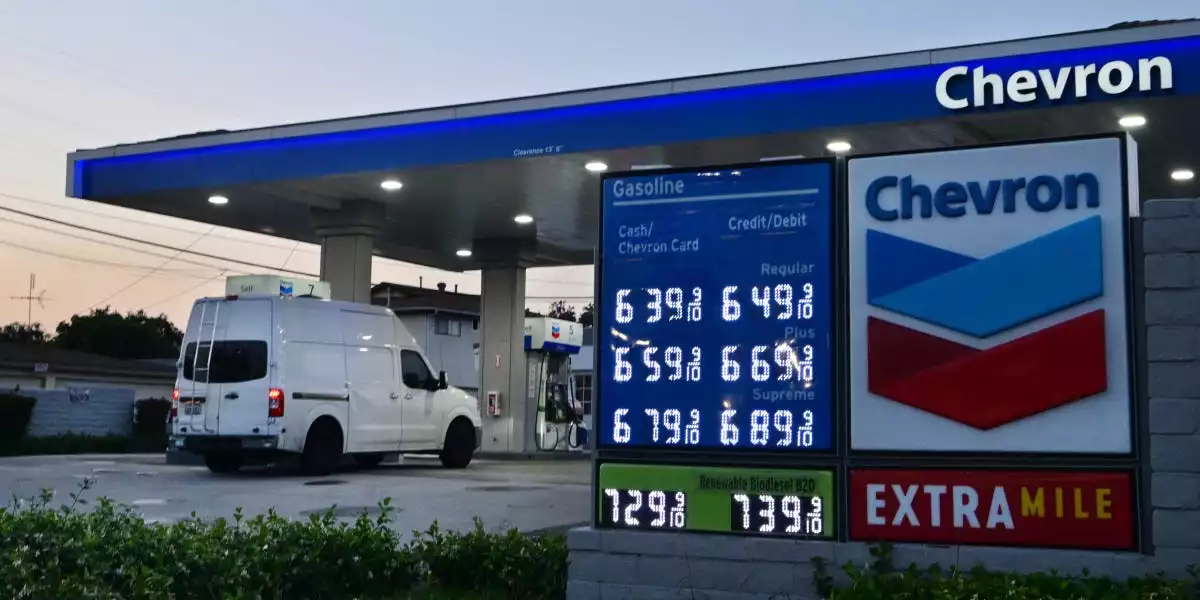

A rapid run-up in U.S. gasoline prices exposes a two-speed fuel economy
The latest surge in U.S. gasoline prices has been swift and uneven. From late February to the end of March, the national average moved from roughly $2.98 per gallon to above $4, and the upward momentum has persisted into April. Yet the headline number masks a widening geographic split: West Coast markets—especially California—have breached $6 per gallon, while parts of the central U.S., including Oklahoma and Kansas, remain comparatively insulated.
For businesses and policymakers, the story is less about a single shock and more about how multiple stressors compound across a tightly optimized fuel system. Regional price dispersion is not merely a consumer inconvenience; it is a signal that refining constraints, logistics bottlenecks, and global crude pricing are interacting in ways that can quickly reprice transportation, distribution, and household budgets.
Key features of the current price environment include:
- Sharp regional variance driven by localized supply constraints and fuel specification differences
- High sensitivity to global risk premiums, even as the U.S. remains the world’s leading oil producer
- Wide forecast uncertainty for summer, with estimates ranging from $3.50 to $5.50 per gallon nationally
This is the kind of market where corporate planning assumptions can become outdated in weeks, not quarters.
Why domestic pump prices still track global oil benchmarks
A common misconception resurfaces whenever U.S. production leadership is cited: that domestic output should naturally translate into domestic price stability. In practice, U.S. gasoline prices remain tethered to international crude benchmarks because oil and refined products are traded in a global clearing market. When overseas buyers can pay more, U.S. barrels and refined products are pulled toward export parity economics, and domestic consumers compete within that same pricing logic.
Three forces are doing the most work in the current cycle:
- Geopolitical risk centered on the Strait of Hormuz
Roughly 20% of global oil flows move through this chokepoint. Even without a physical disruption, heightened U.S.–Iran friction can lift crude futures through a risk premium that filters into wholesale gasoline and, ultimately, retail pricing. Markets price probability, not certainty—so persistent tension can keep prices elevated even if supply continues to move.
- Seasonal transition to summer-grade gasoline
The mandated shift to lower-volatility summer blends increases refining complexity and cost. This seasonal change is predictable, but its impact becomes more pronounced when inventories are tight or when refineries are operating without slack. The result is a structural springtime vulnerability that can magnify other disruptions.
- Midwest refinery outages tightening regional supply
Unplanned refinery downtime—particularly in the Midwest—can create acute constraints around the Great Lakes and adjacent distribution corridors. Because gasoline markets are regionalized by infrastructure (pipelines, terminals, blending capacity) and by formulation requirements, a disruption in one area can produce outsized local price spikes even if national crude supply appears ample.
Taken together, these dynamics explain why “record production” and “high prices at the pump” can coexist—and why the West Coast, with its distinctive fuel specifications and tighter supply optionality, can experience the sharpest moves.
Inflation, logistics, and the second-order effects on business strategy
Sustained high gasoline prices operate like a broad-based tax on mobility and distribution. They feed directly into headline inflation measures and indirectly into the cost structure of nearly every physical supply chain. For the Federal Reserve, elevated fuel costs complicate the inflation picture when core inflation is already proving sticky; for businesses, they complicate margin management and demand forecasting.
The most immediate transmission channels are straightforward:
- Transportation and logistics pass-through: trucking, last-mile delivery, and service fleets reprice routes and surcharges, pushing costs into retail and industrial end markets.
- Consumer sentiment and discretionary spending: higher fill-up costs can compress discretionary budgets, particularly for commuters and lower-income households.
- Demand elasticity and behavioral shifts: while many consumers remain dependent on driving, persistent price pressure can accelerate adoption of:
– carpooling and public transit
– hybrid and electric vehicles (EVs)
– trip consolidation and reduced discretionary travel
For corporate operators—especially in transportation, manufacturing, retail, and field services—this is also a risk-management moment. Volatility matters as much as the price level. Firms that treat fuel as a variable expense rather than a strategic input often discover too late that they are effectively running an unhedged commodity exposure through their P&L.
Technology, infrastructure, and the playbook for navigating a volatile summer
The range of summer forecasts—$3.50 to $5.50 per gallon—is less a prediction than a measure of uncertainty across geopolitics, refining reliability, and demand. That uncertainty is already shaping how executives think about resilience, not just cost.
Several responses are emerging as particularly pragmatic:
- Strategic hedging and procurement discipline
A blended approach—using futures, fixed-price supply agreements, and selective inventory buffers—can reduce earnings whiplash. The objective is not to “beat the market,” but to stabilize planning assumptions and protect operating margins if prices migrate toward the upper-end scenario.
- Refining and midstream de-bottlenecking
The episode underscores how valuable incremental flexibility can be: modular upgrades, improved blending capability, and added storage/pipeline optionality can help redirect flows when a region tightens. Even small capacity improvements in constrained nodes can have outsized price effects.
- Electrification and alternative fuels as economic hedges
High gasoline prices strengthen the business case for EV fleets, renewable diesel, biofuels, and synthetic fuels, particularly where utilization is high and routes are predictable. For OEMs, mobility platforms, and fleet operators, fuel volatility becomes a catalyst for accelerating infrastructure partnerships and total-cost-of-ownership optimization.
- Data-driven fuel management
Real-time pricing and mapping tools—popularized by consumer platforms and increasingly integrated into enterprise systems—are becoming operational levers. When embedded into transportation management systems (TMS), these feeds support dynamic routing, station selection, and more accurate cost forecasting.
What this market is revealing is not simply that gasoline can get expensive, but that the modern fuel ecosystem—globalized, specification-heavy, and operationally tight—can reprice quickly when geopolitics, seasonality, and refinery reliability align in the same direction. For leaders who treat energy as a strategic variable rather than a background cost, the current spike is less a surprise than a stress test—and the summer ahead will reward those who plan for ranges, not point estimates.

 By
By
 By
By

 By
By
 By
By

 By
By
 By
By