

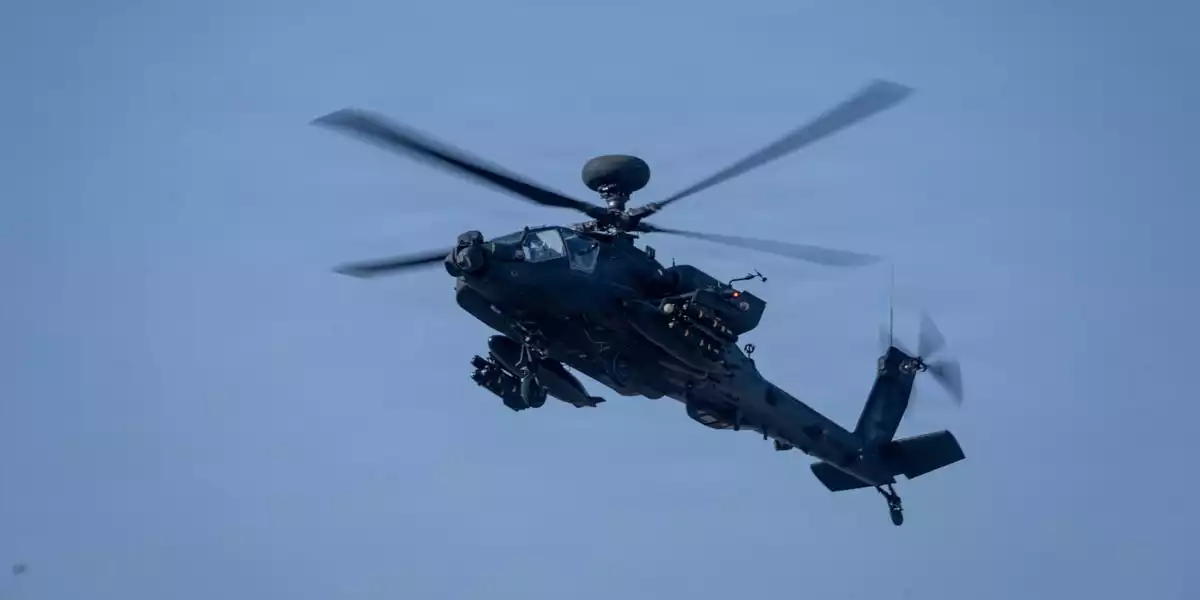

A helicopter down, a crew recovered—and a doctrine quietly rewritten at sea
In the early hours off Oman’s coast, a U.S. Army AH-64E Apache conducting routine patrol operations crashed into the Arabian Sea. The operational headline is mercifully straightforward: within roughly two hours, recovery elements—anchored by the 82nd Airborne Division—retrieved both crew members in stable condition. Yet the strategic meaning of this episode is less about the loss of a single airframe and more about what the rescue revealed: a U.S. Navy uncrewed surface vessel (USV) was used in a personnel-rescue role for the first time under Task Force 59, a unit built to accelerate unmanned maritime operations in the Middle East.
The timing matters. This is described as the first Apache loss in this theater since heightened U.S.–Iran hostilities began, amid a fragile ceasefire and recent U.S. strikes on Iranian radar sites. In other words, the incident sits at the intersection of tactical mishap, regional deterrence messaging, and a Pentagon-wide push to shift risk away from humans and toward machines—especially in waters and airspace where anti-access/area-denial (A2/AD) threats can rapidly turn routine patrols into high-stakes events.
For defense planners and investors alike, the key takeaway is not simply that unmanned systems are proliferating, but that they are now being entrusted with missions once considered inherently “human”—including the emotionally and operationally sensitive task of recovering personnel.
Task Force 59’s rescue milestone signals USV maturity in contested littorals
The first-rescue deployment of a Navy surface drone is a milestone because it compresses years of experimentation into a single, operationally validated proof point: USVs are moving from surveillance and presence to direct participation in time-critical rescue workflows. That shift implies confidence in several technical layers working together under stress:
- Autonomy and remote piloting robust enough to operate in rough sea states and uncertain conditions
- Sensor fusion—often combining radar, thermal imaging, lidar, and electro-optical feeds—to detect and track objects and people in the water
- Navigation and collision avoidance suitable for congested or contested maritime corridors
- Human-machine interfaces that allow operators to act quickly without overloading decision cycles during emergencies
Just as important is what this implies about risk decoupling. A2/AD environments punish predictability and concentrate danger around chokepoints—precisely the kind of geography surrounding the Strait of Hormuz and adjacent waters. Using a USV in a rescue context suggests a deliberate effort to reduce the exposure of manned ships and aircraft during the most vulnerable phases of a recovery operation, when attention is divided and timelines are unforgiving.
At the same time, this milestone highlights a persistent constraint: interoperability under electronic and cyber pressure. Real-time coordination among Army aviation, airborne ISR, and Navy unmanned platforms depends on data links that can be jammed, spoofed, degraded, or denied. The rescue may be read as a success of joint integration—but it also underscores why future unmanned-enabled operations will hinge on hardened, multi-layered communications and resilient command-and-control architectures.
The business of unmanned systems meets the realities of legacy aviation readiness
From a defense-economics perspective, the incident arrives as procurement priorities are already shifting. The Pentagon is spending heavily on unmanned platforms—surface, air, and subsurface—while simultaneously sustaining legacy fleets like the Apache that require deep maintenance pipelines, parts availability, and training throughput. A single crash does not determine force structure, but operational incidents often trigger readiness reviews, and readiness reviews influence budget allocation.
Several industrial dynamics are likely to sharpen as a result:
- USV demand expansion: More procurement and faster iteration cycles for modular USVs with longer endurance and larger payload capacity
- Electronics and AI software opportunities: Growth for sensor integrators, autonomy stacks, edge-compute providers, and secure networking vendors
- Supply-chain stress tests: Increased scrutiny on semiconductors, advanced materials, and specialized communications components—areas where bottlenecks can become strategic vulnerabilities
- Rotary-wing modernization pressure: Renewed debate over how long high-value manned helicopters should operate in contested zones versus shifting certain missions to unmanned or optionally crewed alternatives
This is also where commercial–military convergence becomes more than a talking point. Autonomous navigation, maritime robotics, and remote operations are advancing in civilian sectors such as offshore energy, logistics, and subsea infrastructure. Defense programs can “spill in” commercial innovations—sensors, batteries, autonomy toolchains—while defense demand can “spill out” scale benefits that lower unit costs and accelerate standardization. The rescue mission, by demonstrating real-world utility, strengthens the argument that USVs are not niche prototypes but multi-role assets with expanding mission sets.
Strategic ambiguity, allied interoperability, and what “uncrewed rescue” foreshadows
The crash and recovery unfold under Operation Epic Fury, whose mandate is described as strategically ambiguous—suggesting calibrated deterrence without overt commitment to a broader land campaign. In that context, unmanned systems serve a dual purpose: they are operational tools and geostrategic instruments, enabling presence and responsiveness while attempting to manage escalation risk.
For U.S. partners in the Gulf—many of whom operate advanced rotary-wing fleets and are evaluating maritime drones for security—this episode will likely intensify interest in:
- Interoperability frameworks for shared maritime surveillance and incident response
- Joint training and doctrine for unmanned-assisted search and rescue (SAR) and casualty evacuation
- Common standards for unmanned vessel traffic management and deconfliction in busy littoral zones
Perhaps the most consequential implication is doctrinal: once a USV is proven in a personnel-rescue role, it becomes easier to imagine “logistics drones” pivoting into casualty evacuation support, or maritime “sea taxi” concepts evolving into rapid-response platforms during crises. That, in turn, pressures militaries—and eventually regulators—to define standards for unmanned operations around humans in distress, where reliability, accountability, and safety thresholds must be exceptionally high.
The Apache’s loss is a reminder that manned aviation remains exposed in contested theaters; the successful recovery is a signal that the U.S. military is increasingly prepared to let machines shoulder the most dangerous minutes of a mission—especially when the mission is bringing people home.

 By
By
 By
By
 By
By
 By
By
 By
By


 By
By







