

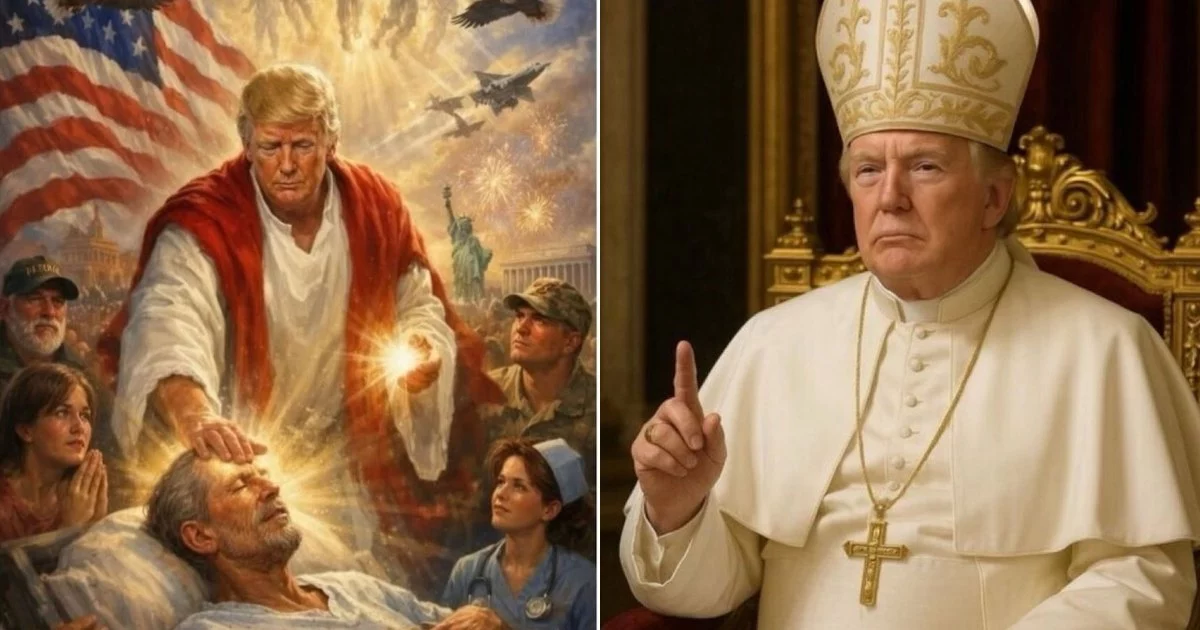

A viral AI image and the collapsing boundary between political theater and synthetic media
The latest flashpoint in U.S. political communication did not arrive as a policy paper or a stump speech, but as an AI-generated image: former President Donald Trump depicted as Jesus Christ, framed by angels, a healing gesture, and an American flag. The post—shared to social media and later deleted—landed in a cultural and religious fault line that is unusually resistant to spin. What made the episode particularly notable was not only the predictable outrage from critics, but the swift, bipartisan recoil, including from conservative and Christian influencers who labeled the image “blasphemous.”
Trump’s subsequent explanation—that he believed the image portrayed him as a doctor—was met with widespread skepticism, in part because it followed earlier AI-adjacent provocations: portrayals of himself as the Pope, and the circulation of a racially charged depiction involving Barack and Michelle Obama. The pattern matters. In the generative AI era, repetition converts “one-off” controversy into a signal of operational risk: a public figure’s digital channels become a high-velocity distribution system for content that can be inflammatory, ambiguous in origin, and difficult to contextualize once it spreads.
For business and technology leaders, the deeper story is not theological offense or partisan spectacle. It is the accelerating reality that synthetic media is now a primary instrument of narrative power, and that the institutions most exposed—political campaigns, governments, platforms, and brand-heavy enterprises—are often the least prepared to manage the speed and scale of AI-driven reputational shocks.
Generative AI as a political communications accelerant—and a disinformation commodity
The Trump image controversy illustrates a widening autonomy gap: the distance between content creation and meaningful oversight has collapsed. With modern text-to-image tools, a provocative visual can be produced in minutes and distributed to millions before any editorial, legal, or ethical review occurs. That is not merely a political problem; it is a structural shift in communications itself.
Three dynamics stand out for analysts tracking AI disinformation, platform governance, and strategic communications:
- Oversight is no longer implicit in production. Historically, high-impact messaging required teams: designers, editors, producers, and gatekeepers. Generative AI compresses that workflow into a single user action, enabling “publish-first” behavior even for the most visible accounts in the world.
- “Meme” framing is becoming a governance loophole. When institutions characterize offensive or misleading AI imagery as mere “internet memes,” they may reduce short-term accountability—but they also normalize a lower standard of truthfulness and intent. Over time, that erodes institutional legitimacy and increases public cynicism toward all digital content.
- Disinformation is being productized. Foreign adversaries and non-state actors—from Tehran to Moscow, as national security observers have warned—are already exploiting generative tools to produce targeted propaganda. The key shift is economic: disinformation no longer requires bespoke capabilities. It can be purchased, outsourced, or iterated rapidly, turning narrative manipulation into disinformation-as-a-service.
In this environment, the question is less “Was this image real?” and more “What does its circulation do to trust?” The answer is rarely benign. Even when audiences recognize content as synthetic, the emotional payload—outrage, tribal reinforcement, religious offense—can be entirely real.
Reputation risk, brand decay, and the limits of crisis playbooks in the AI era
Trump’s political brand has long relied on controlled provocation, but generative AI introduces a new variable: provocation without precision. When synthetic imagery crosses into sacred symbolism or racialized insinuation, the backlash can fracture coalitions that typically hold. The unusually sharp criticism from religious conservatives signals a reputational threshold: some audiences will tolerate disruption, but not perceived sacrilege.
For corporate leaders, the parallel is immediate. AI-generated content—whether posted intentionally, shared by an executive, or weaponized by outsiders—creates a form of reputational exposure that traditional crisis management struggles to contain. The classic playbook assumes:
- a definable source,
- a stable narrative timeline, and
- a limited number of distribution channels.
Generative AI breaks all three. Content can be plausibly denied, endlessly remixed, and redistributed across platforms where context collapses. The result is brand decay by accumulation: not one catastrophic event, but repeated micro-incidents that gradually reduce stakeholder confidence.
This is why “it was just a meme” is not a durable defense. Stakeholders—voters, customers, employees, regulators, investors—are increasingly evaluating not only the content itself, but the governance maturity behind it: Who approved it? What safeguards exist? What accountability follows?
Regulatory momentum and the market implications of synthetic media volatility
The economic and regulatory undertow beneath this episode is easy to miss amid the cultural noise. Yet AI-driven political volatility can ripple outward into markets, particularly in sectors sensitive to policy uncertainty—defense, cybersecurity, energy, and platform-adjacent technology. Investors are already pricing risk around potential regulatory clampdowns on social platforms and AI vendors, especially as election cycles intensify scrutiny.
In Washington and Brussels, frameworks are converging around a central idea: transparency and provenance for AI-generated content. That includes labeling requirements, disclosure rules, and technical standards such as watermarking and content credentials. Incidents like this add political urgency, because they provide a vivid, widely understood example of how synthetic media can destabilize trust quickly—even when no sophisticated hacking is involved.
For organizations operating at scale, the strategic response is becoming clearer and more operational than philosophical:
- Multi-tier approval for AI-generated public content, combining editorial judgment with legal review and technical validation.
- Provenance and attribution tooling, including watermarking and content authenticity standards, to support both compliance and brand protection.
- Real-time monitoring and rapid response, using AI-assisted detection and escalation paths that unite communications, security, and legal teams.
- Executive fluency in generative AI mechanics, so public-facing leaders can respond credibly under pressure rather than improvising explanations that deepen skepticism.
The Trump AI-image episode is ultimately a case study in how synthetic media collapses the distance between impulse and impact. In a world where a single image can trigger religious outrage, bipartisan condemnation, and renewed regulatory debate, the competitive advantage will belong to institutions that treat AI not as a novelty, but as a high-stakes communications infrastructure—one that must be governed with the same rigor as finance, security, and safety-critical systems.

 By
By
 By
By

 By
By
 By
By


 By
By







