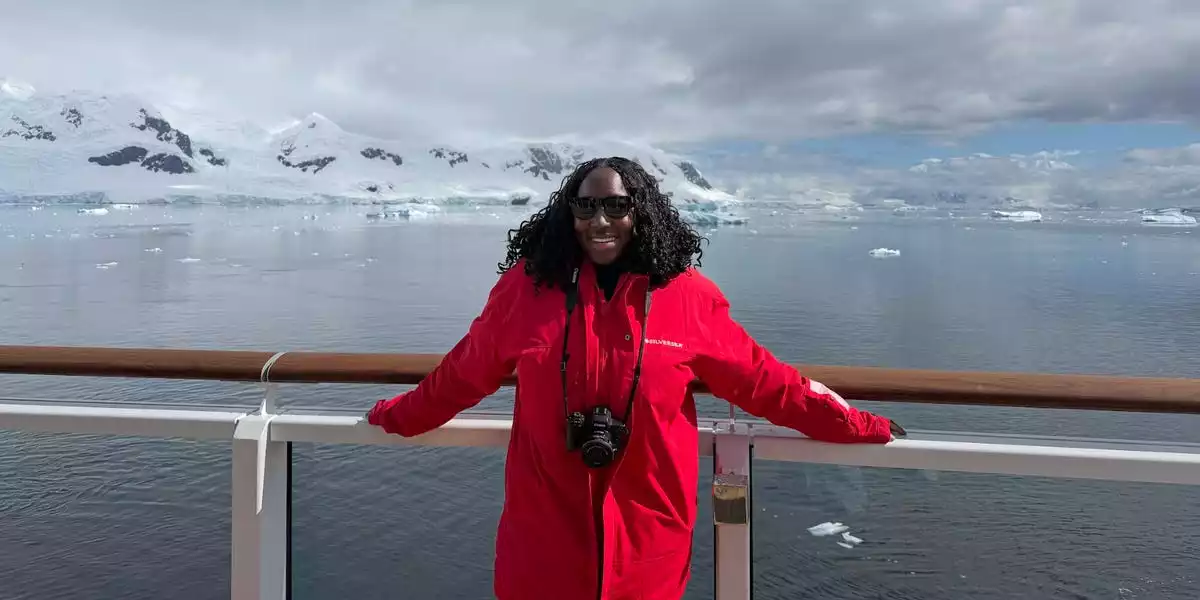

Antarctica as a High-Trust Networking Lab, Not Just a Destination
Vivienne Dovi’s 12-day expedition cruise to Antarctica reads, at first glance, like a familiar story of solo travel: a younger guest surrounded by retirees, uncertain whether she will fit in. Yet the more consequential takeaway is how quickly a remote, tightly shared environment can convert demographic difference into social advantage—and how that dynamic hints at a broader shift in the experience economy, where travel increasingly doubles as a platform for learning, mentoring, and deal-making.
On expedition ships—especially those bound for Antarctica—guests are effectively placed inside a purpose-driven micro-society. The itinerary is demanding, the scenery is singular, and the logistics are complex enough that passengers naturally compare notes, share context, and build rapport. In Dovi’s case, being one of the youngest and traveling alone made her unusually approachable. Retired professionals—many with deep experience in aviation, medicine, and technology—were not merely fellow tourists; they became a rotating panel of informal advisors. The result was not just pleasant conversation but immediately actionable career guidance that fed directly into her consultancy work.
That pattern matters because it reframes expedition cruising from “premium sightseeing” to high-trust relationship formation. Antarctica’s constraints—limited connectivity, shared excursions, repeated group briefings, and communal dining—create conditions that digital networking platforms often struggle to replicate: sustained attention, repeated interaction, and a common emotional reference point. For travel operators and business strategists alike, the implication is clear: the ship is not only transport and accommodation; it is an engineered social environment capable of producing durable professional outcomes.
The Silver Economy Meets the Next-Gen Experience Economy
The demographic backdrop is difficult to ignore. Across developed markets, populations are aging, and many consumers over 60 hold disproportionate discretionary wealth. At the same time, younger cohorts increasingly prioritize authenticity, meaning, and personal development over status-driven luxury. Dovi’s experience sits precisely at that intersection: the “silver economy” supplies capital, time, and expertise; younger travelers bring curiosity, career momentum, and openness to mentorship.
For the travel industry, this creates a set of monetizable dynamics that go beyond ticket yield:
- Ancillary revenue streams tied to expertise, not just amenities: curated talks, small-group masterclasses, or structured “wisdom hours” can become premium programming rather than informal happenstance.
- New client-acquisition channels for consultants and knowledge-intensive SMEs: expedition settings compress relationship-building timelines, turning casual introductions into credible business conversations.
- Destination spillovers for regions that host expedition embarkation: retired experts can be positioned as “experience hosts” for workshops, local lectures, or co-working sessions, stimulating spend in hospitality and professional services.
Crucially, this is not about romanticizing intergenerational harmony. It is about recognizing that retirees are often underutilized economic actors—not passive leisure consumers but potential contributors to value creation. When their expertise is treated as an asset, the travel product becomes more defensible against commoditization and more resilient to price comparison. Antarctica already commands premium pricing due to scarcity and logistics; layering in community and knowledge exchange can deepen differentiation in ways that are harder for competitors to copy.
Where AI, Social Graphs, and XR Could Formalize “Serendipity”
Dovi’s mentorship emerged organically, but the strategic opportunity lies in making those outcomes more reliable—without turning them into forced networking. This is where technology can shift from “onboard convenience” to social facilitation infrastructure.
Several technology-enabled models stand out:
- Digital matchmaking before departure: Cruise operators can use opt-in profiling—professional background, interests, learning goals—to suggest compatible small groups or dining rotations. With appropriate privacy safeguards, AI can identify high-probability mentorship pairings using social-graph logic rather than simplistic demographics.
- Knowledge-transfer marketplaces onboard: The ad hoc “ask a retired expert” dynamic can be productized via mentorship lounges, scheduled micro-consultations, or topic-based salons. Monetization could take the form of subscriptions, premium packages, or tokenized credits—provided the experience remains authentic and not transactional to the point of discomfort.
- Extended reality (XR) as a continuity layer: VR/AR can preserve shared moments—wildlife encounters, landing sites, shipboard lectures—inside persistent digital spaces where conversations continue after the voyage. For operators, XR is not merely entertainment; it can become a post-trip retention tool that extends community life and supports repeat bookings.
The deeper implication is that expedition travel may become a proving ground for AI-mediated community design: using data-driven personalization to shape cabin allocations, shared-table seating, and activity rosters in ways that maximize meaningful interaction. Done well, this is less about “networking” and more about reducing social friction—helping guests find common ground faster in a finite, high-value window.
Strategic Playbooks: From Cruise Lines to Corporate Off-Sites and Alumni Networks
If Antarctica can catalyze trust and exchange among strangers, it is not a stretch to imagine adjacent applications. Cruise lines can treat vessels as curated social ecosystems, while corporations can borrow the model to rethink leadership development and innovation retreats.
High-leverage strategic moves include:
- Curated Mentorship as a Service: add-on modules that formalize mentor-mentee matching with pre-trip onboarding and post-trip digital continuity.
- Cross-sector alliances: expedition operators partnering with edtech firms and leadership consultancies to build “learning expeditions” that blend frontier travel with credentialed micro-learning.
- Human-capital ROI measurement: beyond guest satisfaction, tracking outcomes such as new business wins, mentorship-driven innovations, and network expansion—metrics that matter to sponsors and enterprise clients.
- Corporate alumni integration: organizations can emulate the shipboard dynamic by systematically engaging retired executives in structured mentoring, preserving institutional memory while creating new value.
Dovi’s journey ultimately highlights a market signal: in an era saturated with digital connection, shared physical experiences in extreme environments can produce unusually high-quality relationships. Antarctica may be the backdrop, but the real story is the emergence of travel as a platform for intergenerational knowledge transfer—where the most valuable souvenir is not a photograph, but a network that continues to compound long after the ice fades from view.


 By
By
 By
By
 By
By
 By
By
 By
By

 By
By