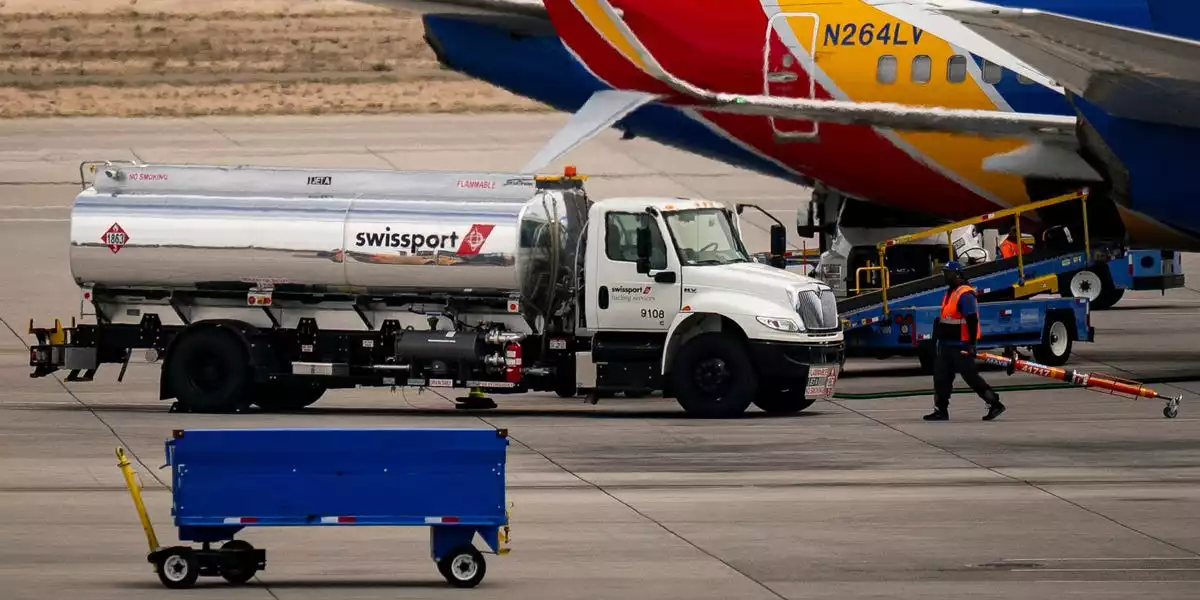

A new energy shock reverberates through commercial aviation economics
The latest escalation of geopolitical risk in the Middle East—most acutely the disruption tied to the Strait of Hormuz—has reintroduced a familiar but destabilizing variable into global markets: a sustained oil price risk premium. With crude moving above $100 per barrel, aviation is once again confronting fuel as a strategic constraint rather than a manageable operating input.
The immediate arithmetic is stark. The cost to fully fuel long-haul wide-body aircraft has surged more than 60% versus pre-conflict levels, pushing an Airbus A380 toward roughly $340,000 per fill and a Boeing 747 above $250,000. Those figures are not merely headline-grabbing; they translate directly into network decisions, pricing behavior, and capital allocation. For U.S. network carriers, Q1 fuel expense rose by an estimated $330–340 million, with Southwest alone adding $164 million—a reminder that even airlines with predominantly domestic footprints remain exposed through refined product pricing and supply chain dynamics.
Consumers are already seeing the pass-through. Average fares are up approximately $90 year-over-year domestically and $199 internationally, reflecting both higher operating costs and a more cautious approach to capacity deployment. Meanwhile, JP Morgan’s expectation that oil could remain in the low triple digits through 2026, alongside U.S. jet fuel averaging around $4.03 per gallon, suggests this is not a brief spike but a planning horizon problem—one that forces airlines to treat fuel volatility as a structural feature of the next cycle.
Pricing power, route discipline, and the return of hard trade-offs
Airlines have several levers, but none are painless. The industry’s near-term playbook is likely to combine incremental fare increases with more granular revenue extraction—while quietly reshaping networks to protect margins.
Key commercial responses now coming into focus include:
- Further ticket price hikes and fuel surcharges, especially on long-haul routes where fuel is a larger share of trip cost and alternatives are limited.
- Route pruning and frequency trimming on marginal markets, with capacity redeployed toward higher-yield corridors and hub banks that improve load factors.
- Ancillary fee expansion—bags, seat selection, change flexibility, lounge access—where dynamic pricing can be tuned faster than base fares.
- Tighter revenue management that prioritizes yield over volume, particularly if demand softens under higher prices.
In Europe, the calculus is further complicated by passenger-rights frameworks such as EU261, which can convert operational disruption into direct cash liability. When fuel-driven schedule changes, reroutes, or cancellations rise, compensation obligations can become a meaningful cost center—effectively adding a regulatory “shadow price” to operational resilience. This is one reason European carriers may be quicker to reduce schedule fragility, even if it means sacrificing some top-line growth.
The competitive implications are uneven. Large legacy airlines with diversified revenue streams and stronger balance sheets can absorb volatility longer and may even gain share as weaker competitors retrench. Smaller carriers and low-fare operators—where margins are thin and customer price sensitivity is high—face a sharper dilemma: raise fares and risk demand erosion, or hold prices and accept margin compression. In past cycles, that asymmetry has been a precursor to distressed consolidation, slot reshuffling, and opportunistic M&A.
Technology and operations: efficiency becomes a frontline strategy
High jet fuel prices don’t just change budgets; they accelerate technology adoption by making efficiency investments pay back faster. This is where the current shock intersects with a longer-running transformation in aviation operations and fleet strategy.
Three technology-driven themes stand out:
- Fleet modernization and engine efficiency
Airlines are incentivized to retire older, fuel-hungry aircraft sooner and prioritize next-generation engines such as LEAP and GEnx, where double-digit fuel burn improvements can materially reshape unit economics. Expect more creative deployment as well: narrowbody “neo” families on longer sectors, and expanded use of aircraft like the A321XLR to serve thinner long-haul routes with lower trip cost and less fuel exposure.
- Digital flight operations and AI-enabled fuel conservation
Fuel savings increasingly come from software as much as hardware. Airlines are expanding AI-driven route optimization, continuous descent approaches, and real-time decision support that accounts for winds, congestion, and airspace constraints. The operational stack is also evolving: digital twins and predictive maintenance reduce unplanned aircraft-on-ground events, protecting utilization and preventing costly disruption cascades. High-throughput satellite connectivity adds a subtle but meaningful advantage—enabling in-flight data updates that support rerouting decisions with measurable fuel impact.
- Sustainable Aviation Fuel (SAF) and alternative propulsion as strategic hedges
When conventional jet fuel rises, the effective premium for SAF narrows, improving the business case for long-term offtake agreements. While SAF is not a near-term volume solution for the entire sector, high prices can accelerate contracting, investment, and supply-chain buildout. Over a longer horizon, elevated fossil fuel volatility also strengthens the rationale for hydrogen and hybrid-electric R&D—particularly for regional and short-haul segments where certification pathways may mature sooner.
What to watch next: inventories, hedging discipline, and capital under pressure
The durability of this episode will hinge on supply fundamentals as much as geopolitics. Global inventory drawdowns point to tightening conditions that can persist even if headlines fade, especially in a world where upstream investment is cautious and spare capacity is politically and operationally constrained. For airlines, that means fare volatility may extend into late summer and beyond, with planning uncertainty bleeding into schedule design and corporate travel contracting.
Hedging will separate winners from laggards. Carriers with disciplined derivatives programs can smooth earnings and avoid abrupt fare shocks; under-hedged airlines may face quarter-to-quarter whiplash that complicates guidance, labor negotiations, and fleet planning. At the same time, higher interest rates and wider credit spreads raise the cost of financing aircraft, pressuring return on invested capital just as the case for fleet renewal strengthens—an uncomfortable tension that will define boardroom debates.
The industry is entering a phase where resilience is not a slogan but an operating model: airlines that combine sophisticated fuel procurement, data-driven operational efficiency, and selective network discipline will be best positioned to protect margins while competitors scramble to react. In a market repriced by geopolitics, execution—not optimism—becomes the most valuable asset.

 By
By
 By
By
 By
By


 By
By