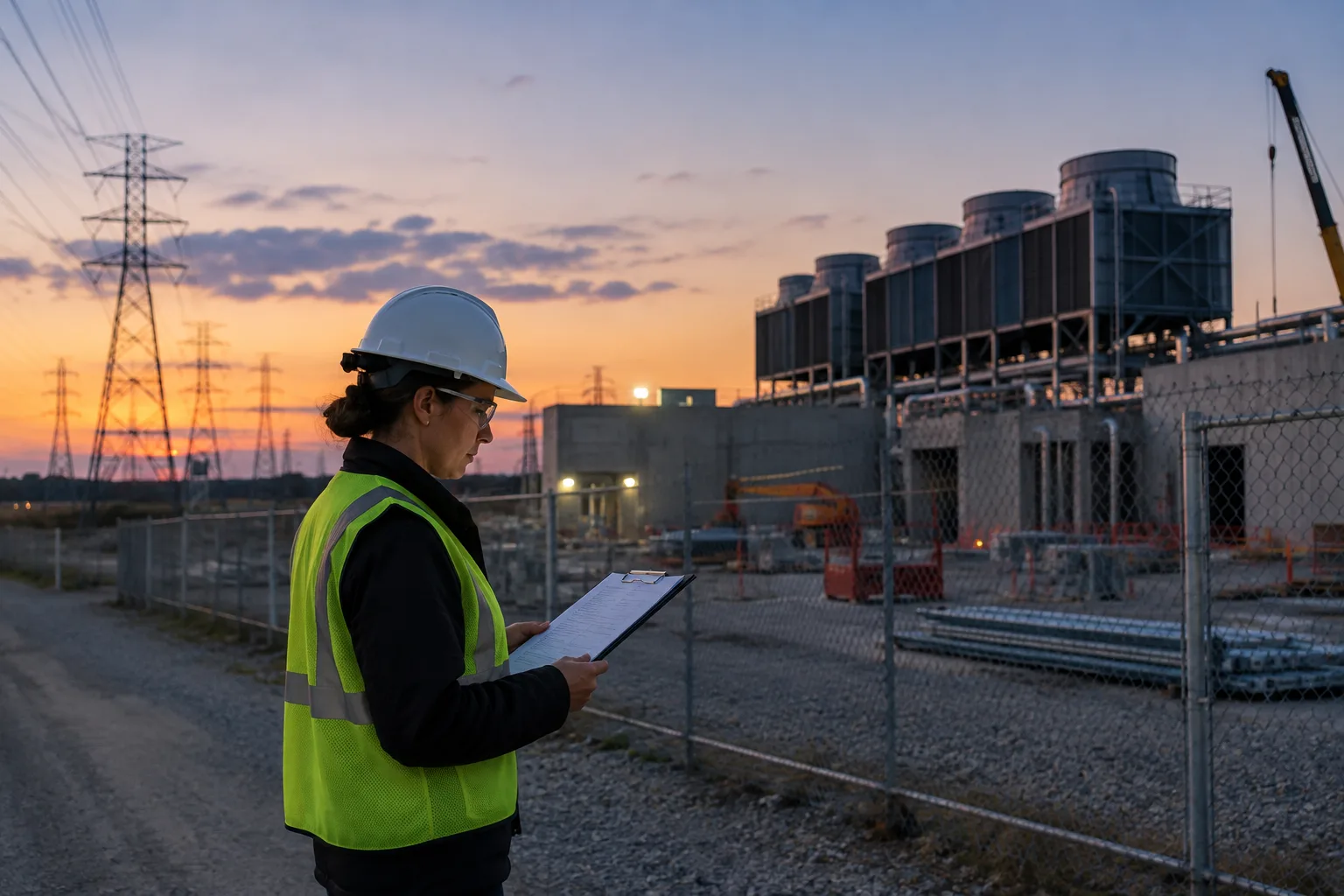

Rural America’s data-center reckoning: when digital infrastructure meets physical limits
The United States’ data-center boom—fueled by AI training and inference, cloud migration, and latency-sensitive edge services—is colliding with a hard reality: the most attractive parcels for rapid expansion are often in rural counties whose grids, water systems, and governance capacity were never built for 24×7 industrial-scale computing loads. What once looked like a straightforward growth story is now becoming a defining local issue, with residents turning county hearings into referendums on whether the benefits of hyperscale development justify the costs.
The shift in public sentiment is striking. A Heatmap poll shows 70% of Americans now oppose data centers in their vicinity, up from 42% a year ago—a dramatic swing that signals more than routine “not-in-my-backyard” friction. It suggests a broader recalibration: communities are increasingly asking who bears the externalities of the AI economy, and whether the promised dividends—jobs, tax base expansion, and infrastructure upgrades—are commensurate with the resource draw.
At the center of many objections are tangible, local concerns:
- Electricity price pressure as utilities plan new generation and transmission for concentrated demand
- Water scarcity in regions already facing drought risk or stressed aquifers
- Noise and quality-of-life impacts, including constant fan and cooling-system output
- Skepticism about job creation, especially once construction crews depart and facilities shift to lean operational staffing
This is not merely a permitting story; it is a test of whether the digital economy can scale without eroding the social contract in the places that host its physical backbone.
Power, water, and the new “industrial load” politics of AI-era computing
Data centers are often described as the factories of the modern economy, but the analogy understates the intensity and constancy of their resource profile. Unlike many industrial operations, hyperscale facilities demand continuous uptime, high power density, and robust redundancy. That translates into a planning challenge for rural grids: a single campus can represent a step-change in demand that forces utilities to accelerate investments—costs that can ripple into broader rate structures.
Electricity is only half the equation. Cooling remains a defining constraint, and in many markets the fastest path to deployment still leans on water-intensive cooling designs. In water-stressed regions, the optics and the arithmetic can quickly turn political: residents see new industrial consumption arriving just as households and farmers are being asked to conserve.
This is where the debate becomes structurally important for the tech sector. Data centers are not optional; they are foundational to:
- AI model training and inference capacity
- Cloud services and enterprise workloads
- Content delivery, streaming, and real-time applications
- Edge computing for industrial, healthcare, and autonomous systems
Yet the siting model that optimized for cheap land and favorable tax treatment is increasingly running into a new set of constraints: community acceptance, resource governance, and ratepayer fairness. Public utility commissions and local governments are beginning to treat these as first-order issues rather than afterthoughts—raising the prospect of water-use caps, noise ordinances, and heavy-user surcharges that could materially change project economics.
The jobs narrative under scrutiny—and why “social license” is becoming a balance-sheet issue
A recurring flashpoint is the mismatch between the scale of proposed developments and the number of permanent jobs they create. Construction phases can employ large numbers temporarily, but modern facilities are designed for efficiency: automation, remote monitoring, and specialized contractors reduce long-term headcount. For communities asked to absorb major infrastructure and environmental burdens, the “jobs engine” pitch is losing persuasive power.
The Salt Lake City-area case cited in the material—where a proposed development backed by Kevin O’Leary would reportedly span land twice the size of Manhattan while yielding around 2,000 permanent positions—illustrates the political vulnerability of the traditional playbook. When state leaders call for a 75% scale-back and developers resist, the dispute becomes symbolic: not just about one project, but about whether the industry is willing to right-size ambitions to local capacity.
This is where ESG and financing dynamics intersect with local politics. Investors, insurers, and lenders increasingly evaluate:
- Water consumption and sourcing transparency
- Carbon intensity and renewable procurement credibility
- Community opposition risk and permitting durability
- Reputational exposure tied to environmental justice and rural equity
In practice, “social license to operate” is evolving into a measurable risk category—one that can delay timelines, raise capital costs, or strand assets if regulatory conditions change midstream.
A bipartisan backlash with midterm implications—and a roadmap for more durable deployment
Perhaps the most consequential element is the political realignment. Opposition is described as bipartisan and notably strong among 18–34 voters, a demographic central to the tech sector’s long-term legitimacy. Data centers are becoming a proxy issue for wider anxieties: resource scarcity, distrust of corporate promises, and a sense that rural communities host the infrastructure while metropolitan areas capture the economic upside.
That dynamic makes data-center siting a plausible midterm election flashpoint, not only in state legislatures but in the granular arenas that actually decide projects—county commissions, zoning boards, and local bond measures.
For operators and policymakers, the path forward is less about messaging and more about redesigning the development compact. Several approaches stand out as both practical and politically legible:
- Diversified deployment models: smaller, distributed facilities and hybrid architectures that reduce single-site strain and improve resilience
- Resource-efficiency innovation: closed-loop cooling, water recycling, and alternative cooling approaches that materially cut freshwater dependence
- Community Benefit Agreements (CBAs): recurring revenue allocations for local infrastructure, education, and workforce development—structured, enforceable, and transparent
- Jurisdictional political-risk planning: integrating polling, demographic trends, and pending regulatory proposals into site selection and contract terms
- Constructive policy engagement: standardized environmental metrics and equitable rate frameworks that clarify who pays for grid upgrades and how benefits are shared
The data-center industry is building the physical substrate of the AI economy, but it is also stepping into a new era of accountability—one where megawatts and gallons are debated as intensely as latency and throughput. The companies that treat rural communities as long-term partners rather than permitting hurdles will move faster, face fewer surprises, and earn the durable legitimacy that large-scale computing now requires.

 By
By
 By
By
 By
By

 By
By

 By
By
 By
By