

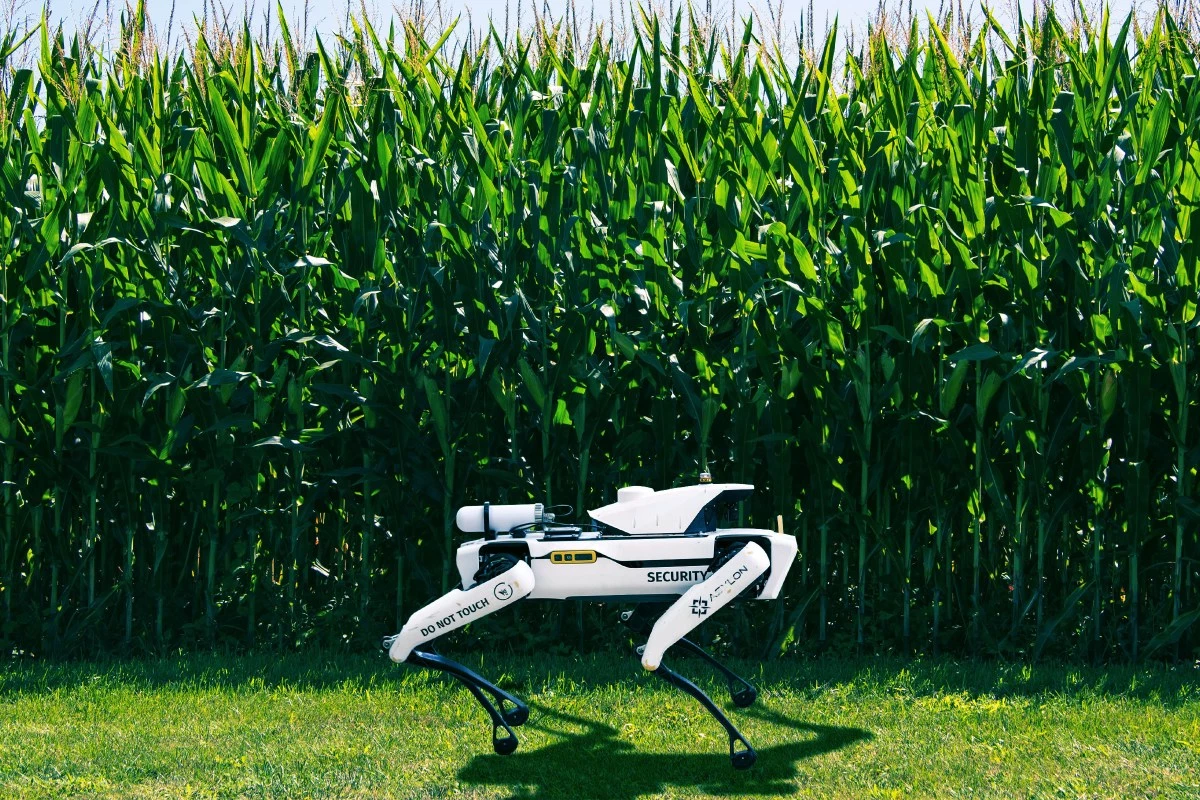

From factory automation to field perimeter defense: why “robot dogs” are moving into agriculture
Industrial robotics are undergoing a visible role expansion: from repetitive, controlled factory tasks to mobile, autonomous security in open, high-risk environments. Bayer’s deployment of Asylon’s quadruped “robot dogs” across an 8,000-acre corn operation in Hawaii signals that this shift is no longer experimental. It is operational—built around real budgets, measurable risk, and a growing expectation of continuous monitoring.
What makes this deployment notable is not the novelty of a robotic patrol, but the capability stack now being packaged for civilian infrastructure and agriculture:
- Thermal imaging for heat signatures that can indicate intrusions, equipment anomalies, or early wildfire conditions
- Electro-optical sensors for identification, tracking, and evidentiary recording
- Autonomous patrol routines that reduce dependence on constant human presence across vast acreage
- Live data streaming into both Bayer’s Hawaii Security Operations Centre and Asylon’s Robotic Security Operations Centre, creating a dual-layer monitoring model
This architecture reflects a broader convergence of operational technology (OT)—machines operating in the physical world—and information technology (IT)—networks, analytics, and centralized command. In practical terms, it means security is becoming less about isolated guards and cameras, and more about integrated sensing, automated detection, and coordinated response.
Agriculture, historically under-instrumented compared with data centers or airports, is now being treated as critical infrastructure—because in a world of tighter inputs and higher volatility, yield is an asset class worth defending.
The ROI logic: a $900,000 bet against catastrophic loss in a $123 billion corn economy
Bayer’s reported investment—exceeding $900,000 in security robotics for corn alone—may sound like a luxury until it is placed against the economics of modern agribusiness and the asymmetric nature of agricultural risk. A single incident can cascade:
- Theft or vandalism can disrupt operations, compromise genetic or proprietary materials, and create downstream delays
- Wildfire can erase an entire season’s value in hours, with insurance, remediation, and supply-chain penalties following
- Wildlife incursions can damage acreage and infrastructure, and introduce biosecurity concerns
- Operational downtime during peak windows can be more costly than the physical damage itself
The Hawaiian estate’s strategic importance sharpens the calculus: it reportedly accounts for 90% of Bayer’s international feed-corn exports. Protecting that node is not merely local risk management; it is supply continuity protection. At a macro level, the U.S. industrial corn complex generated $123 billion in 2024, underscoring why security spending increasingly resembles capital preservation rather than discretionary overhead.
Just as importantly, robotics can be framed as a response to labor and coverage constraints. Remote or environmentally challenging locations make it difficult to scale human patrols without escalating cost and fatigue risk. Robotics, by contrast, can offer:
- Persistent coverage without shift limitations
- Standardized patrol quality and consistent sensor output
- Centralized monitoring that can be scaled across sites
- A pathway to security-as-a-service models that convert capex into predictable opex
For large operators, the question is less “Why spend on robots?” and more “What is the cost of not detecting an incident early enough?”
Food-security pressure meets geopolitical shock: why asset protection is becoming strategic resilience
This security modernization is unfolding alongside a broader and more fragile global context. The summary points to a looming food crisis shaped by disruptions to roughly one-third of global fertilizer supplies amid the Iran conflict, with fertilizer and fuel costs rising and squeezing farmers worldwide. The human stakes are stark: an estimated 2.3 billion people face heightened food insecurity risk.
In that environment, protecting planted acreage becomes a form of resilience. When input costs surge, the margin for error collapses. Farmers and agribusinesses cannot easily “make up” lost yield when fertilizer availability is constrained or priced out of reach. Security, therefore, becomes intertwined with food economics:
- If fertilizer is scarce, every acre successfully brought to harvest matters more
- If fuel is expensive, rework and repeated field operations become costlier
- If supply chains are stressed, disruptions at key export nodes amplify price volatility
This is where robotics’ strategic relevance expands. A robotic patrol is not just guarding against petty theft; it is helping stabilize a production system under geopolitical strain. The same security platforms appearing at high-profile civilian sites—data centers, border facilities, and other sensitive locations—are now being adapted to agriculture because the underlying requirement is similar: protect high-value, high-consequence assets with continuous situational awareness.
Yet the optics are complex. The image of robotic guards patrolling fields during a global food emergency can invite scrutiny about priorities and equity—especially if advanced protection becomes concentrated among the largest, best-capitalized operators.
The next phase: security-as-a-service, sensor fusion, and the ESG questions that follow
The trajectory suggested by Bayer and Asylon’s model points toward a near-term future where agricultural security is delivered as a bundled platform—hardware, monitoring, analytics, and response—rather than a patchwork of guards, fences, and cameras. Several implications stand out for business and technology leaders:
- Security-as-a-service in agriculture: subscription or outcome-based contracts that combine robotics, 24/7 remote operations centers, and incident workflows
- Multi-purpose autonomy: the same ground robots that detect intrusions could carry payloads for soil moisture, pest detection, or plant stress analytics, blurring security and agronomy into a unified field intelligence layer
- Data governance and liability: persistent monitoring raises questions about geo-location data, evidentiary retention, misidentification, and responsibility in malfunction scenarios
- ESG and access: if robotics become a competitive moat, smaller producers may be left behind unless cooperatives, insurers, or public–private programs help democratize access
What emerges is a clear signal: agriculture is being reclassified in practice as critical infrastructure, and the tools of critical infrastructure protection—autonomy, sensor fusion, centralized command—are arriving at the farm gate. The companies that treat robotics not as spectacle but as disciplined risk engineering will shape how resilient, secure, and investable the global food system becomes under the next wave of geopolitical and climate-driven shocks.

 By
By
 By
By
 By
By

 By
By
 By
By

 By
By







